Moisture control is one of the most critical factors in industrial production efficiency. When drying systems underperform, production lines slow down, product quality suffers, and fuel costs rise unnecessarily. At Shalimar Engineering, we’ve helped plants across cement, mining, fertilizer, and chemical industries solve these problems with properly engineered rotary dryer systems built for continuous heavy-duty operation.
Every extra kilogram of moisture passing through to downstream processing adds cost, reduces throughput, and increases rejection rates making the right thermal drying system a direct investment in plant profitability.
What Is a Rotary Dryer?
Definition and Working Principle
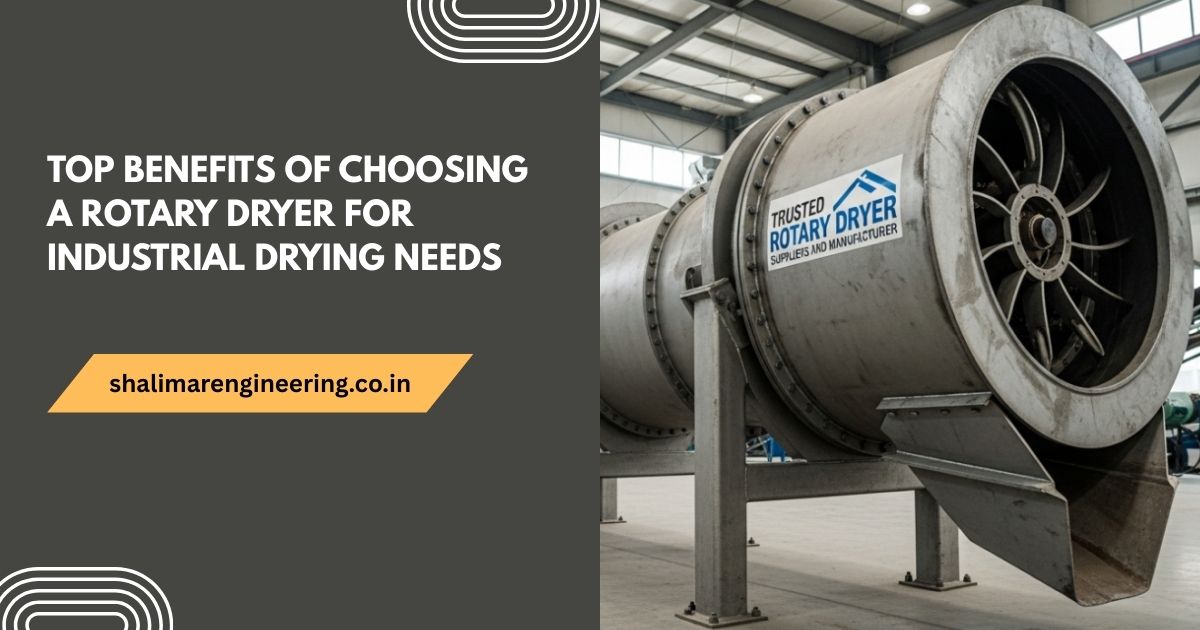
A rotary dryer is a large rotating cylindrical drum through which wet material and hot drying gases pass simultaneously, progressively reducing moisture to target levels. Unlike batch systems, industrial rotary dryers operate continuously, accepting wet feed at one end and discharging dried material at the other without interruption. Internal lifting flights cascade material through a hot air stream, creating uniform contact between material particles and drying gas that drives efficient, consistent moisture evaporation.
Key Components
Every industrial rotary dryer relies on five core components the rotating shell (main processing chamber), the burner system (generates hot drying gases), lifting flights (cascade material through the gas stream), the drive mechanism (maintains consistent drum rotation), and the discharge system (controls material exit while minimizing heat loss).
Types of Rotary Dryers
Direct heat rotary dryers bring hot gases into direct contact with material, the most energy-efficient configuration for most applications. Indirect rotary dryers heat the drum externally for heat-sensitive or contamination-sensitive products. Single drum dryers suit standard capacity needs, while triple pass rotary dryers route material through three concentric drums for maximum heat transfer in a compact footprint.
Have specific drying requirements? Send us an enquiry and our team will recommend the right configuration for your needs.
Top Benefits of Choosing a Rotary Dryer
High Drying Efficiency
The cascading action inside a rotary drum dryer creates continuous, uniform contact between material and the hot gas stream far more effectively than static drying methods. This uniform heat distribution eliminates hot spots and reduces drying time compared to batch or tray dryers, translating directly into higher production output from the same installed equipment.
Large Production Capacity
High-capacity rotary dryers with drum diameters up to 4 metres and lengths up to 30 metres deliver throughput that smaller drying systems cannot match ideal for cement plants, mining operations, and fertilizer plants requiring continuous bulk material drying across production shifts.
Energy-Efficient Operation
Modern energy-efficient rotary dryers incorporate optimized airflow and properly designed flight configurations that extract maximum drying energy from each unit of fuel burned. Heat recovery possibilities including exhaust gas recirculation further reduce fuel consumption per ton, improving plant operating economics over the equipment’s service life.
Versatility Across Materials
The rotary drum dryer handles an exceptionally diverse range of materials: coal, sand, iron ore, limestone, biomass, sludge, and fertilizer intermediates within the same basic equipment configuration. Drum speed, airflow temperature, flight design, and retention time can all be adjusted for each material’s specific drying characteristics.
Consistent Moisture Control
Precise temperature management within a rotary dryer system produces consistent final moisture content across continuous production runs reducing downstream material rejection in cement raw meal preparation, pelletizing feed conditioning, and fertilizer production where moisture specification compliance directly impacts product quality and yield.
Low Maintenance & Long Service Life
Heavy-duty industrial rotary dryers are engineered for decades of continuous service. Robust shell construction, replaceable liner systems, and durable trunnion designs minimize structural wear. Planned maintenance can typically be scheduled during routine plant outages without requiring extended unplanned downtime.
See the complete range of industrial drying equipment from Shalimar Engineering built for demanding applications.
Key Industries That Rely on Rotary Dryers
Cement Manufacturing Plants
Consistent feed moisture entering the rotary kiln directly impacts kiln fuel consumption and clinker quality. Cement plant dryers positioned upstream of grinding circuits ensure stable feed conditions that improve overall plant efficiency and reduce kiln operating costs.
Mineral Processing & Iron Ore Pelletizing
Mining dryer equipment handles abrasive ore concentrates at high throughput while delivering consistent output moisture for downstream processing. For iron & ore pelletizing plants, precisely dried ore concentrate feeds are critical for consistent pellet formation and strength making upstream drying accuracy central to pelletizing yield and quality.
Chemical, Fertilizer & Biomass Plants
Chemical intermediates, granular fertilizers, and biomass fuels all require precise post-processing moisture control for product stability and downstream handling. Continuous industrial dryers in these applications handle sticky, temperature-sensitive, or fibrous materials while delivering consistent final moisture output across production shifts.
Operating in one of these industries? Contact our team to discuss how a rotary dryer can reduce your drying costs.
Rotary Dryer vs Other Drying Equipment
| Factor | Rotary Dryer | Fluidized Bed Dryer | Flash Dryer | Tray Dryer |
|---|---|---|---|---|
| Capacity | Very High | Medium | High | Low |
| Energy Efficiency | High | Medium | Medium | Low |
| Bulk Material Suitability | Excellent | Limited | Limited | Poor |
| Maintenance | Low | Medium | Medium | Low |
| Installation Cost | Moderate | Higher | Moderate | Low |
Rotary dryers deliver the best combination of high capacity, bulk material handling, and energy efficiency for heavy industrial applications. Tray dryers suit small batch applications but cannot approach rotary dryer throughput at industrial scale. Fluidized bed dryers struggle with coarse, heavy, or sticky bulk materials common in mining and cement sectors.
How to Choose the Right Rotary Dryer for Your Plant
Production Capacity & Material Characteristics
Selecting the correct rotary dryer starts with clearly defining production capacity both current throughput and future expansion needs. Material characteristics drive key design decisions: bulk density, particle size, initial and target moisture content, temperature sensitivity, and abrasiveness all influence drum sizing, flight design, and liner specification.
Integration with Existing Equipment
For plants already operating rotary kilns, ball mills, or roller mill plants, rotary dryer output moisture must align with downstream equipment requirements. Budget evaluation must cover total cost of ownership capital, fuel consumption, maintenance, and liner replacement not just initial purchase price.
Want to see real installations? Visit our gallery for photos of rotary dryers and plant projects we’ve delivered.
Common Challenges & Preventive Maintenance Tips
Uneven Drying & Overheating
Uneven final moisture typically indicates worn flights or non-uniform feed distribution. Regular flight inspection during planned maintenance prevents gradual performance decline. Overheating results from burner set-point errors or reduced feed rates preventive measures include feed monitoring with automatic burner turndown and regular thermocouple calibration.
Dust & Wear Management
High dust generation indicates excess airflow velocity or high feed fines content. Proper sizing of the cyclone separator and dust collection system captures entrained fines before exhaust discharge. For abrasive materials, wear-resistant liner materials extend replacement intervals significantly.
Conclusion: Why Rotary Dryer Remains the Preferred Industrial Drying Solution
The industrial rotary dryer has maintained its position as the preferred bulk material drying system for heavy industrial applications because it consistently delivers high throughput, reliable moisture control, operational durability, and competitive operating cost. No alternative drying technology matches this combination across the full range of bulk industrial materials and production scales.
Shalimar Engineering designs, manufactures, and supplies rotary dryers and complete drying equipment systems for plants across cement, mining, chemical, fertilizer, and biomass sectors engineered to your exact production requirements from specification through commissioning.
Need a customized rotary dryer solution for your plant? Submit your enquiry or contact us directly. Our team is ready to deliver a drying system built for your production needs.
Frequently Asked Questions (FAQs)
1. What materials can be dried in a rotary dryer?
A: Rotary dryers handle coal, sand, iron ore, limestone, biomass, sludge, fertilizer, and chemical intermediates making them one of the most versatile industrial drying equipment solutions available.
2. What is the difference between direct and indirect rotary dryers?
A: Direct heat rotary dryers pass hot gases through the material for maximum efficiency, while indirect rotary dryers heat the drum externally used for heat-sensitive or contamination-sensitive products.
3. How long does a rotary dryer last? A properly maintained industrial rotary dryer delivers 15-25 years of reliable service with planned maintenance covering flight inspection, liner replacement, and lubrication.
4. Can a rotary dryer be customized for specific materials?
A: Yes drum diameter, length, flight design, liner material, and burner specification can all be engineered for your specific material and production requirements. Contact Shalimar Engineering to discuss your application.
5. What is the typical fuel consumption of a rotary dryer?
A: Fuel consumption depends on initial feed moisture, target output moisture, throughput rate, and burner efficiency. A properly specified energy-efficient rotary dryer minimizes fuel cost per ton through optimized airflow and heat recovery integration.