Introduction
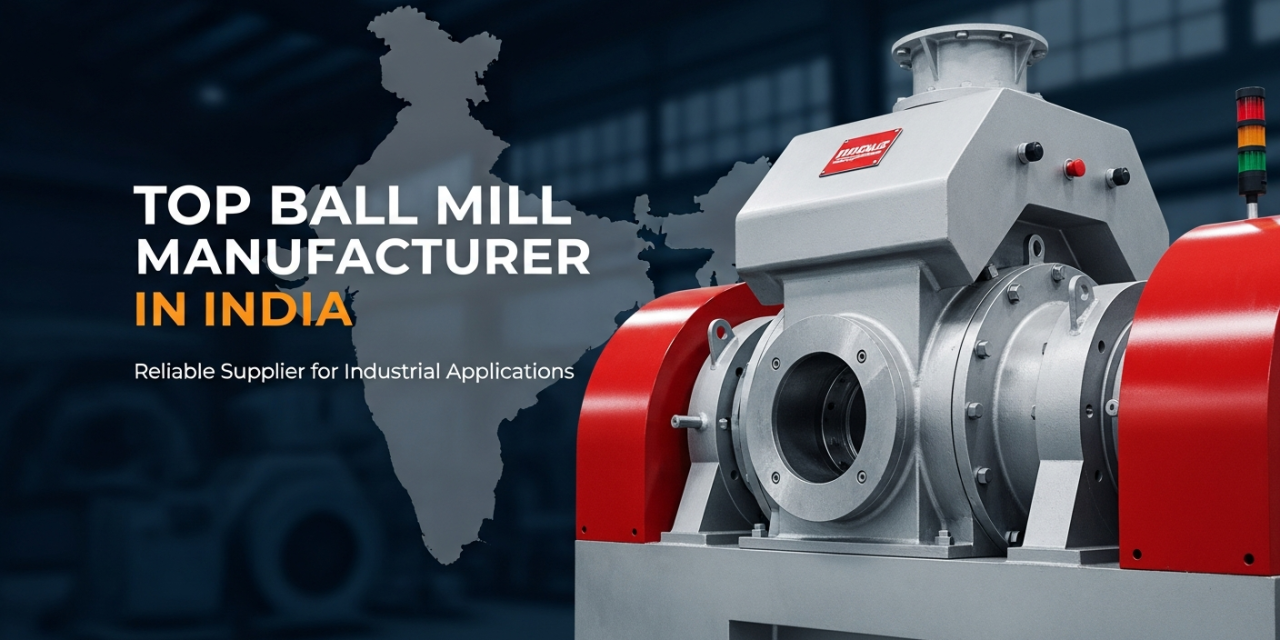
India’s industrial sector continues to grow at a rapid pace, creating increasing demand for reliable grinding equipment across manufacturing industries. Among the various machinery required for material processing, the ball mill remains a cornerstone of operations in cement plants, mining facilities, pharmaceutical units, and chemical processing industries. Selecting a dependable ball mill manufacturer directly impacts production efficiency, operational costs, and product quality.
This comprehensive guide examines what makes a ball mill supplier trustworthy, the critical applications of grinding equipment in Indian industries, and how to identify manufacturers that deliver value through quality construction, technical expertise, and ongoing support. For businesses seeking grinding solutions, understanding these factors ensures smart investment decisions that yield long-term benefits.
Get Expert Consultation from India’s Leading Manufacturer →
Understanding Ball Mill Technology and Operations
A ball mill functions as a rotating cylindrical vessel partially filled with grinding media typically steel, ceramic, or rubber balls. As the cylinder rotates around its horizontal axis, the grinding media cascades and tumbles, reducing material size through three primary mechanisms:
Impact grinding occurs when balls drop from the shell’s upper portion, striking material with significant force. This mechanism effectively breaks larger particles into smaller fragments, initiating the size reduction process.
Attrition grinding happens as balls slide and roll against each other and the mill lining. Material trapped between grinding surfaces experiences frictional forces that progressively reduce particle size. This mechanism is particularly effective for achieving medium to fine particle distributions.
Abrasion results from continuous surface contact as material particles rub against grinding media and mill linings. This mechanism contributes to producing very fine powders required in specialized applications.
The grinding efficiency depends on multiple parameters including rotation speed, grinding media size and material, mill filling percentage, feed characteristics, and discharge arrangement. Experienced ball mill manufacturers understand these variables and design equipment optimized for specific applications.
Critical Industrial Applications in India
Indian industries utilize ball mills across diverse sectors, each with unique requirements:
Cement Industry Applications
India ranks as the world’s second-largest cement producer, making the cement sector the largest consumer of industrial grinding equipment. Ball mills grind cement clinker combined with gypsum and other additives to produce various cement grades. The grinding fineness directly affects cement properties including strength development, setting time, and workability.
Modern cement plants operate continuous grinding circuits processing hundreds of tons per hour. The grinding stage often accounts for 40-50% of total cement production costs due to high energy consumption. Efficient ball mills designed by quality manufacturers reduce power consumption while maintaining required fineness, significantly impacting profitability.
Shalimar Engineering supplies cement ball mills ranging from 50 TPH to 500 TPH capacity, meeting the needs of both regional and large-scale cement manufacturers across India.
Mining and Mineral Processing
India’s mining sector processes iron ore, gold, copper, bauxite, and various industrial minerals. Ore processing facilities use ball mills to liberate valuable minerals from host rock through size reduction. The grinding circuit represents a critical stage in mineral beneficiation, enabling effective downstream separation.
Different ore characteristics require specific grinding approaches. Hard, abrasive ores like iron ore and gold-bearing quartz demand robust mill construction with wear-resistant liners. Processing gold ore often requires extremely fine grinding to achieve optimal gold recovery through cyanidation or other extraction methods.
As a leading ball mill manufacturer, Shalimar Engineering designs mills capable of handling India’s diverse ore types, incorporating features that extend equipment life while maintaining grinding efficiency.
Pharmaceutical Manufacturing
The pharmaceutical industry requires precise particle size control for active pharmaceutical ingredients (APIs) and excipients. Particle size affects drug dissolution rates, bioavailability, and formulation stability. Ball mills provide the controlled grinding environment necessary for pharmaceutical applications.
Pharmaceutical ball mills must meet stringent hygiene standards, typically requiring stainless steel construction with smooth internal surfaces for easy cleaning. Many pharmaceutical applications demand batch processing with thorough cleaning between product changes to prevent cross-contamination.
Chemical Processing Industries
Chemical manufacturers grind various compounds for catalysts, pigments, specialty chemicals, and intermediate products. The required particle size distribution varies widely based on end-use requirements. Some chemical grinding operations require inert atmosphere processing to prevent oxidation or unwanted reactions.
Ceramic Production
India’s ceramic industry, including tiles, sanitaryware, and tableware, relies on ball mills for raw material preparation. Grinding clay, feldspar, quartz, and other minerals produces uniform slurries or powders essential for ceramic forming processes. The particle size distribution affects ceramic properties including strength, porosity, shrinkage, and surface finish.
Request Custom Ball Mill Solution for Your Industry →
What Defines a Top Ball Mill Manufacturer in India
Distinguishing excellent manufacturers from average suppliers requires evaluating multiple factors:
Manufacturing Experience and Technical Expertise
Established manufacturers bring accumulated knowledge about material behavior, equipment design, and operational challenges. Shalimar Engineering has served Indian industries for years, developing deep understanding of application-specific requirements across sectors.
Experienced ball mill manufacturers anticipate potential issues during design phases, incorporating features that prevent common operational problems. They provide valuable consultation regarding equipment sizing, material selection, and process optimization based on proven track records.
Quality Manufacturing Standards
Quality construction determines equipment reliability and longevity. Reputable manufacturers follow ISO 9001 quality management systems, ensuring consistent manufacturing processes. Quality control includes:
- Raw material testing and certification verification
- Dimensional accuracy inspection during fabrication
- Welding quality assessment through non-destructive testing
- Component assembly verification
- Pre-delivery performance testing
Ball mill suppliers committed to quality source components from certified vendors, maintain comprehensive documentation, and provide material test certificates with equipment delivery.
Design and Engineering Capabilities
Every grinding application presents unique challenges. The ability to customize mill dimensions, select appropriate materials of construction, specify suitable drive systems, and integrate auxiliary equipment ensures optimal performance.
Shalimar Engineering’s engineering team works closely with clients to understand their specific requirements, providing customized ball mill designs that address material characteristics, capacity needs, space constraints, and operational preferences.
Material Selection and Construction Quality
Mill construction materials significantly impact performance and durability:
Mild steel construction offers economical solutions for non-corrosive, moderately abrasive materials. Properly designed mild steel mills provide reliable service in many applications.
Stainless steel construction suits pharmaceutical, food, and corrosive chemical applications. While costlier than mild steel, stainless steel prevents contamination and resists corrosion.
Specialized alloy construction addresses highly corrosive environments or extreme operating conditions.
Liner materials include rubber (economical but lower abrasion resistance), manganese steel (high impact resistance), and chromium alloy (superior abrasion resistance for highly abrasive materials).
Energy Efficiency Focus
With energy costs representing significant operational expenses, energy-efficient ball mill designs provide substantial savings. Modern mills incorporate:
- Optimized mill geometry reducing power requirements
- Variable frequency drives enabling speed optimization
- High-efficiency motors meeting IE3 or IE4 standards
- Integrated classifiers for closed-circuit grinding, preventing over-grinding
Leading ball mill manufacturers prioritize energy efficiency, helping clients reduce operational costs while meeting environmental objectives.
Comprehensive Technical Support
Equipment purchase represents just the beginning of the manufacturer-client relationship. Ongoing support includes:
Pre-installation support: Foundation design assistance, site assessment, equipment layout planning
Installation and commissioning: Supervision of equipment erection, alignment verification, initial operation guidance
Operator training: Comprehensive training on operation, routine maintenance, and troubleshooting
After-sales service: Technical support for operational issues, maintenance guidance, spare parts supply
Preventive maintenance programs: Scheduled inspections, predictive maintenance recommendations
Quality ball mill suppliers like Shalimar Engineering maintain dedicated service teams ensuring clients receive timely support throughout equipment lifecycles.
Speak with Our Technical Team Today →
Types of Ball Mills for Different Applications
Understanding available ball mill configurations helps in selecting appropriate equipment:
Overflow Discharge Ball Mills
Overflow mills discharge material through the outlet trunnion when internal material level exceeds the trunnion height. This simple discharge mechanism suits fine grinding applications where longer residence time is acceptable. Overflow ball mills typically operate at 65-75% of critical speed, creating cascading action ideal for producing very fine products.
Grate Discharge Ball Mills
Grate mills incorporate perforated plates at the discharge end, controlling particle size output. Only adequately ground material passes through grate openings, preventing over-grinding and improving energy efficiency. The forced discharge reduces residence time, increasing throughput capacity. Grate ball mills operate at 75-80% critical speed, suitable for coarser grinding requirements.
Tube Mills
Tube mills feature length-to-diameter ratios exceeding 3:1, providing extended grinding zones. Multiple compartments with different ball sizes enable progressive size reduction within a single unit. Tube mills excel at producing very fine products efficiently, commonly used in cement finish grinding.
Wet and Dry Grinding Mills
Wet grinding mills process materials mixed with water or other liquids, producing slurries. Wet grinding generally achieves finer particle sizes with lower energy consumption and dust generation.
Dry grinding mills process materials without liquid addition, suitable for moisture-sensitive materials or applications requiring dry powder products.
Key Specifications to Consider
When selecting ball mills from manufacturers, evaluate these specifications:
Capacity and Throughput
Mill capacity, measured in tons per hour (TPH), must match production requirements. Oversized mills increase capital and operating costs, while undersized mills create production bottlenecks. Experienced ball mill manufacturers help determine appropriate sizing based on feed characteristics and product requirements.
Drive System Components
The drive system includes motors, gear reducers, and couplings. Motor power requirements depend on mill size, material characteristics, and desired throughput. Variable frequency drives provide operational flexibility and energy savings through speed optimization.
Premium ball mill suppliers specify reliable drive components from reputable manufacturers, ensuring long-term reliability and minimizing downtime risks.
Mill Dimensions
Internal diameter and length determine mill capacity and grinding characteristics. Diameter affects grinding media cascading behavior, while length influences residence time. The optimal diameter-to-length ratio depends on application requirements.
Material of Construction
As discussed earlier, construction materials must suit the application environment and processed materials. Corrosive materials require corrosion-resistant construction, while highly abrasive materials demand wear-resistant liners.
Shalimar Engineering: Your Trusted Ball Mill Manufacturer
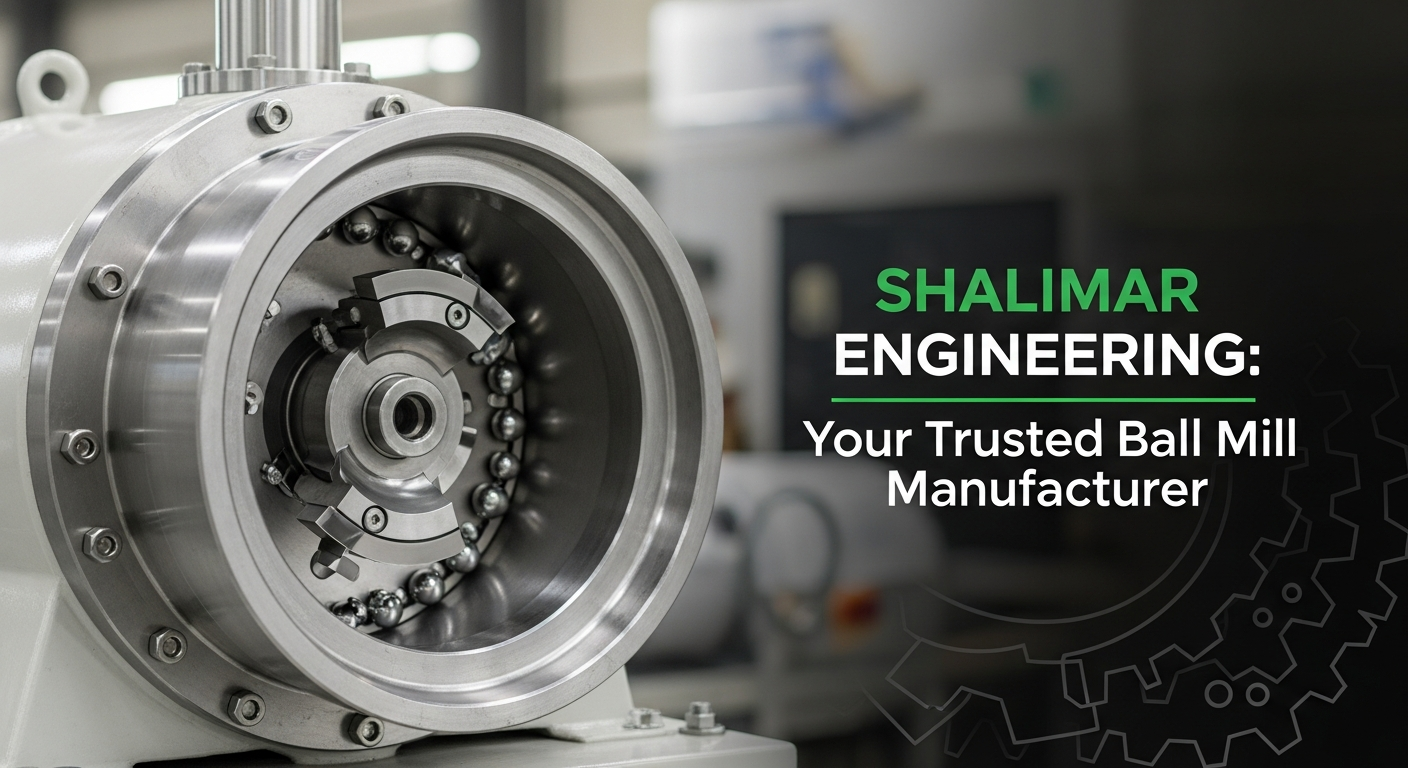
Shalimar Engineering has established itself as a reliable ball mill manufacturer in India through:
Proven Manufacturing Excellence: Decades of experience designing and manufacturing industrial equipment for diverse sectors demonstrates capability and reliability.
Quality-Focused Approach: Adherence to stringent quality standards ensures durable equipment that performs consistently throughout extended operational periods.
Custom Engineering Solutions: Tailored designs address specific grinding challenges, ensuring optimal results for each unique application and industry requirement.
Competitive Pricing Structure: Direct manufacturer pricing eliminates intermediary markups, providing exceptional value without compromising quality or performance.
Comprehensive Client Support: From initial consultation through installation, commissioning, and ongoing maintenance, Shalimar Engineering supports clients throughout the complete equipment lifecycle.
Pan-India Service Network: Service capabilities across India ensure prompt support regardless of installation location, minimizing downtime and maintaining productivity.
Get Your Free Technical Consultation & Quote →
Installation and Commissioning Services
Professional installation ensures optimal ball mill performance:
Foundation Design Support
Proper foundation design handles static loads, dynamic forces, and vibrations. Shalimar Engineering provides foundation drawings and specifications, ensuring adequate support for trouble-free operation.
Equipment Erection and Alignment
Precise alignment of mill components, bearings, and drive systems is critical. Misalignment causes excessive wear, vibration, and premature failures. Professional installation teams use laser alignment tools achieving specified tolerances.
Commissioning and Performance Testing
Commissioning involves initial operation under supervision, verifying all systems function correctly. Performance testing confirms the ball mill meets guaranteed specifications for capacity, power consumption, and product fineness.
Operator Training Programs
Comprehensive training covers normal operation procedures, routine maintenance tasks, common troubleshooting scenarios, and safety protocols. Well-trained operators maximize equipment performance and longevity.
Maintenance and Spare Parts Support
Regular maintenance extends ball mill operational life:
Daily Monitoring: Temperature checks, unusual noise detection, vibration assessment, power consumption tracking
Weekly Maintenance: Lubrication system inspection, bolt tightness verification, visual inspection of accessible components
Monthly Inspections: Liner wear assessment, grinding media level verification, coupling condition review
Annual Overhauls: Comprehensive bearing inspection, liner replacement, gear oil change, structural integrity assessment
Shalimar Engineering maintains extensive spare parts inventory including liners, grinding media, bearings, seals, and drive components. Quick spare parts availability minimizes downtime, maintaining production schedules.
Cost Considerations and Return on Investment
Ball mill pricing varies based on:
- Mill size and capacity
- Materials of construction
- Drive system specifications
- Degree of customization
- Auxiliary equipment requirements
- Installation scope
While initial capital cost is important, total cost of ownership including energy consumption, maintenance requirements, and operational reliability provides better value assessment. Quality equipment from reputable ball mill manufacturers offers superior long-term economics despite potentially higher initial costs.
Quality Certifications and Compliance
Shalimar Engineering maintains certifications ensuring product quality and manufacturing standards. ISO 9001 certification demonstrates commitment to quality management systems. Equipment designs comply with relevant Indian and international standards for mechanical equipment safety and performance.
Client Success Stories
Shalimar Engineering has supplied ball mills to cement manufacturers, mining operations, pharmaceutical companies, and chemical processors across India. Client testimonials highlight:
- Reliable equipment performance meeting production targets
- Energy-efficient operation reducing operational costs
- Responsive technical support minimizing downtime
- Customized solutions addressing specific challenges
- Professional installation and commissioning services
Conclusion
Selecting the right ball mill manufacturer in India requires careful evaluation of manufacturing capabilities, technical expertise, quality standards, and support services. Shalimar Engineering combines decades of manufacturing experience with customer-focused service, delivering grinding solutions that meet demanding industrial requirements.
Whether you need ball mills for cement production, mineral processing, pharmaceutical manufacturing, or chemical processing, working with an established ball mill supplier ensures you receive equipment designed for reliability, efficiency, and longevity. Quality manufacturing, custom engineering capabilities, competitive pricing, and comprehensive support make Shalimar Engineering the preferred choice for Indian industries.
For detailed technical specifications, application-specific recommendations, and competitive quotations on industrial grinding equipment, contact Shalimar Engineering to discuss your grinding requirements and receive expert guidance on optimal solutions for your operations.
Get started with India’s trusted ball mill manufacturer today!