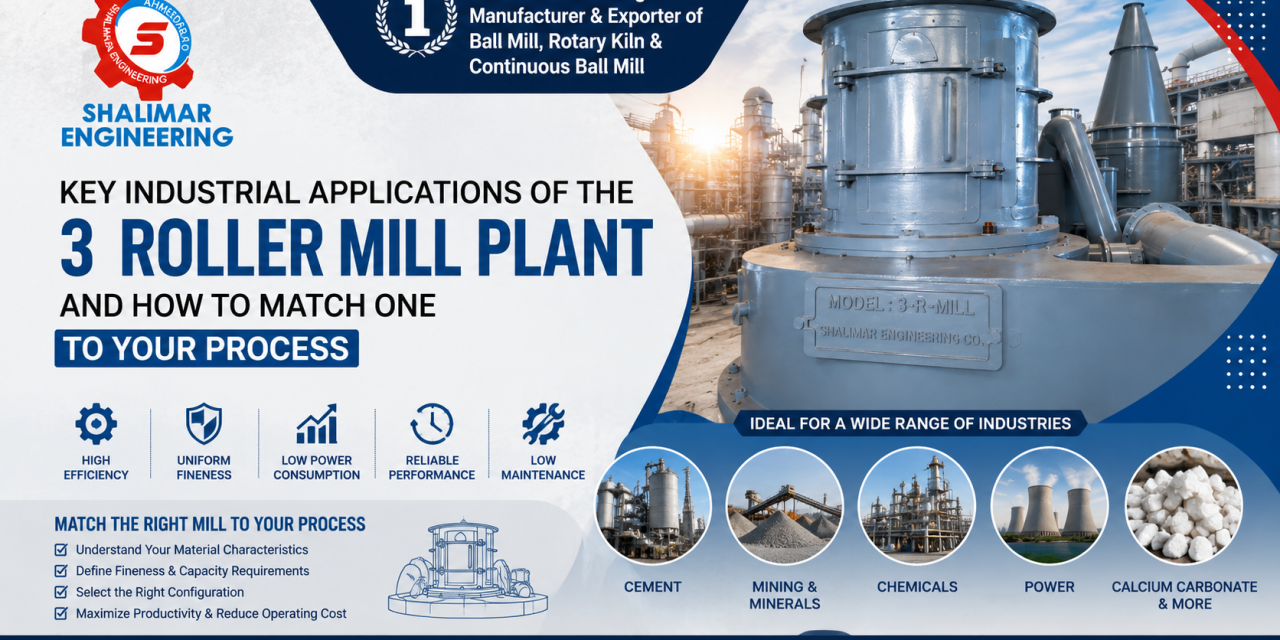
Key Industrial Applications of the 3 Roller Mill Plant and How to Match One to Your Process
Selecting the right particle size reduction machinery is one of the most critical decisions for any processing facility. Across mineral, chemical, fertilizer, and industrial manufacturing sectors, raw materials vary significantly in hardness, moisture content, and target fineness. The 3 Roller Mill Plant has earned its reputation as a highly adaptable workhorse for medium-to-fine grinding, but optimal performance relies on precise engineering alignment. Matching the mill’s nip pressure, surface treatment, and airflow systems to your specific material prevents costly bottlenecks, extends wear life, and ensures consistent micron-level precision across every production run.
Why Application Matching Determines Your Grinding Success
Buying a grinding mill is not the same as buying a general-purpose machine. Every industry — and within it, every specific material type — places different demands on the equipment. The particle size you need, the hardness of your feed material, your required throughput, the moisture tolerance of your process: all of these variables determine whether a given machine configuration will serve you well or underperform from the start.
The 3 Roller Mill Plant is one of the most versatile configurations available for medium-fine grinding applications, but that versatility only becomes an advantage when the machine is properly matched to your specific industrial context.
This breakdown covers the key industries that rely on roller mill grinding, what they require from their equipment, and how to approach the matching process effectively — whether you are operating in UAE, South Africa, Bahrain, Kuwait, or Saudi Arabia.
Mineral Processing — The Core Application
Mineral processing represents the most significant industrial segment for 3 Roller Mill Plants globally. The range of minerals that benefit from roller mill grinding is extensive:
- Calcium carbonate — used in paints, plastics, paper, and rubber; requires precise fineness control
- Feldspar — used in ceramics and glass; demands consistent particle distribution
- Talc — used in cosmetics, plastics, and pharmaceuticals; requires ultra-gentle grinding to avoid contamination
- Barite — used in oil drilling fluids; requires specific gravity consistency along with particle size
- Gypsum — used in construction and agriculture; processed at high throughput with moderate fineness
- Limestone — used in cement, agriculture, and environmental applications; versatile grinding requirements
Each of these minerals interacts differently with the grinding mechanism. Softer minerals like talc and gypsum require lower roller pressure to avoid over-grinding. Harder materials like barite and feldspar need higher nip pressure and potentially harder roller surface treatment.
A competent supplier will guide you through these distinctions rather than offering a one-size-fits-all specification.
Chemical Industry Processing
The chemical processing sector is another major user of roller mill technology. In this context, the equipment handles a wide range of synthetic and naturally occurring base chemicals, including:
- Sulfur-based compounds used in fertilizers and agricultural chemicals
- Sodium compounds used in glass and detergent manufacturing
- Pigment bases used in paints, inks, and coatings
- Specialty industrial chemicals requiring precise particle size for controlled reaction rates
Chemical processing places additional demands on grinding equipment beyond particle size. Material compatibility is critical — certain chemicals react with carbon steel surfaces, requiring stainless steel or coated rollers. Dust containment becomes important for chemicals with health or environmental exposure limits. And in some cases, the grinding environment itself must be inert (nitrogen-blanketed) to prevent oxidation or combustion.
When specifying a roller mill for chemical processing, these factors must be addressed in the engineering brief to your supplier before any order is placed.
Fertilizer Manufacturing
In fertilizer production, roller mills serve both primary grinding and blending-prep functions. Base materials like rock phosphate, potassium compounds, and ammonium sulfate often require size reduction before mixing or granulation.
For fertilizer manufacturers across the GCC and South Africa — where agricultural support industries are either growing or already well-established — the 3 Roller Mill Plant offers a reliable, moderate-throughput option that balances output quality with energy efficiency.
Buyers in this segment should pay particular attention to:
- Corrosion resistance in machines handling nitrogen or sulfur compounds
- Easy access maintenance design, since fertilizer residues can build up on internal surfaces and require regular cleaning
- Throughput capacity that aligns with batch or continuous production schedules
For a broader view of how roller-based and ball-based grinding compare for different industrial materials, reviewing industrial grinding solutions for processing plants provides useful technical context.
Construction Material Production
Cement plants, aggregate processors, and construction material manufacturers use roller mills for grinding gypsum, slag, fly ash, and limestone — all of which serve specific functional roles in concrete and cement formulations.
In construction material applications, the key performance metric is throughput rather than ultra-fine particle size. These materials are typically processed to relatively coarse specifications (100 to 500 microns) but at very high volumes.
For buyers in Iraq, where active construction sector growth is driving consistent demand for construction material inputs, a 3 Roller Mill Plant configured for high-throughput moderate-fineness operation can be an effective production asset.
Have Questions About Industrial Machinery?
Get in touch with our engineering experts at Shalimar Engineering to discuss your project requirements, technical specs, or site support.
Food and Pharmaceutical Grade Grinding
A smaller but technically demanding application segment is food-grade and pharmaceutical grinding, where roller mills process materials like spices, grains, excipient powders, and active pharmaceutical ingredients.
In these applications, the machine requirements are fundamentally different from industrial grinding:
- Food-grade or pharmaceutical-grade stainless steel contact surfaces
- GMP-compliant design with cleanable geometry and no dead zones
- Validation documentation support for regulatory requirements
- Temperature control to prevent heat damage to heat-sensitive materials
If your application falls in this category, be explicit with potential suppliers from the very first conversation. Not all roller mill manufacturers have the certifications, materials, or design experience required for regulated-sector grinding.
Matching the Right Configuration to Your Operation
When you know your industry and material type, the next step is translating that into a machine specification. Use this framework:
Step 1: Define Your Output Target What particle size (D50 or D90) does your downstream process require? What output tolerance can you accept?
Step 2: Characterize Your Feed Material What is the hardness (Mohs scale), moisture content, bulk density, and maximum lump size of what you are feeding in?
Step 3: Determine Your Throughput Requirement What volume per hour does your process need? Is that demand constant or variable?
Step 4: Evaluate Your Utility Constraints What power supply is available? Do you have compressed air? What is your installation footprint?
Step 5: Check for Special Requirements Are there corrosion concerns? Contamination risks? Regulatory compliance requirements?
Once you have clear answers to these five questions, you are in a position to have a genuinely productive conversation with any supplier. And you can evaluate their response quality as a direct indicator of their technical capability.
For context on how the 3-roller configuration compares with higher-capacity setups, exploring the 5 Roller Mill Plant alongside your baseline requirements clarifies whether your throughput needs are best served by a three-roller or a five-roller configuration.
Evaluating Suppliers Against Your Application Needs
Once your process requirements are defined, use them as a filter when evaluating suppliers. The right supplier will:
- Ask you the same questions you found in the framework above
- Provide application-specific references or case studies
- Offer a machine specification that is directly traceable to your stated requirements
- Give you a realistic performance guarantee, not an inflated claim
On our industrial equipment page, you can review the full range of grinding and processing solutions available, which gives you a sense of product depth and engineering focus as evaluation inputs.
The wrong supplier will quote you immediately without asking about your material, offer a generic specification, and avoid committing to specific performance parameters. That pattern is a clear signal to keep looking.
Frequently Asked Questions (FAQ)
Q1. Can a 3 Roller Mill Plant handle heat-sensitive materials without degrading product quality?
Yes, but it requires continuous process cooling. For heat-sensitive chemical or food-grade grinding, chilled air circulation or water-jacketed roller configurations are integrated to keep internal grinding temperatures low and prevent thermal degradation.
Q2. What is the maximum hardness (Mohs scale) a 3 Roller Mill can efficiently process?
A 3 Roller Mill Plant is ideal for soft-to-medium-hard materials with a Mohs hardness of up to 6. For materials exceeding 6 Mohs (like quartz), alternative heavy-duty mills or specialized high-abrasion roller liners are recommended.
Q3. How does feed moisture content affect 3 Roller Mill efficiency?
Standard roller mills work best with feed material containing less than 6% moisture. If raw material moisture is higher, installing an integrated hot-air drying system within the mill circuit ensures efficient grinding without roller clogging.
Q4. What is the typical operational lifespan of grinding rollers before maintenance is needed?
Depending on material abrasiveness, roller surfaces usually operate between 8,000 to 12,000 hours before requiring re-surfacing or replacement. High-chromium alloys and tungsten carbide hard-facing extend this lifespan significantly.
Your Next Step Is Specific, Not General
Many buyers start the procurement process with broad searches and end up in conversations that are too generic to be useful. The more specific you are about your application — material type, output target, throughput, and special requirements — the faster you move toward a supplier relationship that actually serves your operation.
Take the time to complete your application profile before reaching out. It will make every conversation more productive, and it will make the supplier’s response quality immediately apparent.
Match Your Application with the Right Roller Mill Configuration
Tell us what you are grinding, what output you need, and where your facility is located. Our technical team will respond with a configuration recommendation and a competitive price.
Get in touch with our team and let’s match the right grinding solution to your process requirements.