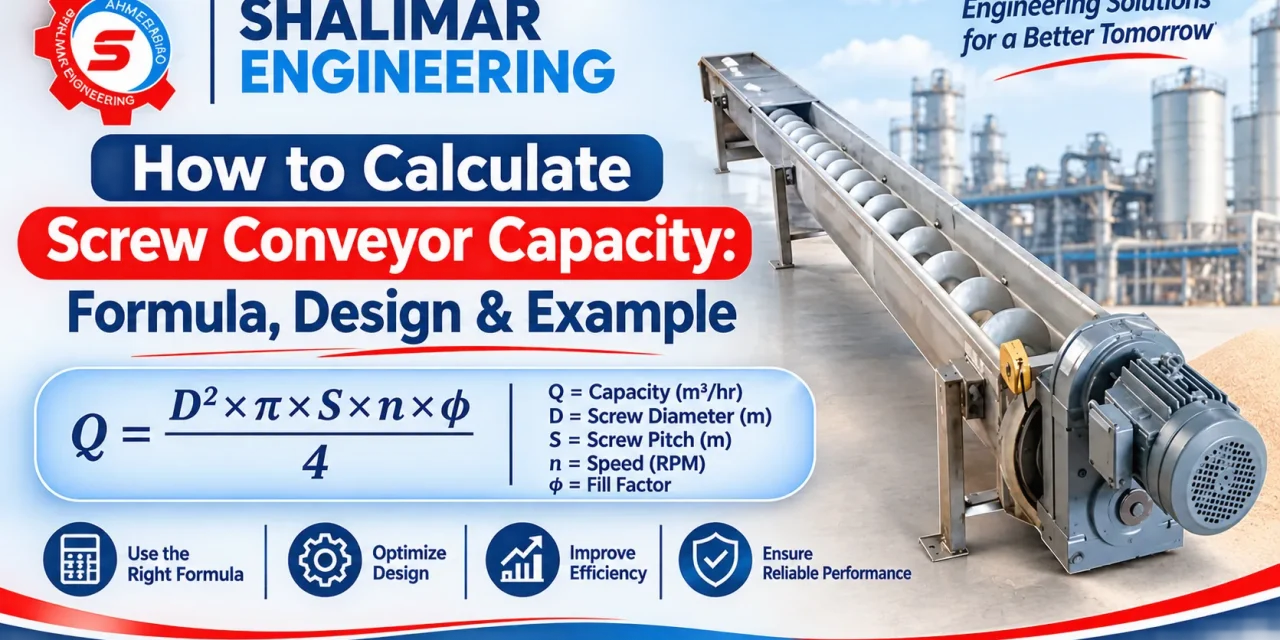
Screw conveyor capacity is calculated with the formula Q = 47.1 × (D² − d²) × S × N × C, where Q is the volumetric capacity in m³/h, D is the screw diameter, d is the pipe (shaft) diameter, S is the pitch, N is the speed in rpm, and C is the loading factor. Multiply the result by the material’s bulk density to get mass capacity in tonnes per hour. This guide explains the formula, every variable, and a full worked example. At Shalimar Engineering, we design and manufacture screw conveyors in India, so these are the exact calculations our engineers use.
Key Takeaways
- Volumetric capacity: Q (m³/h) = 47.1 × (D² − d²) × S × N × C.
- Mass capacity = volumetric capacity × material bulk density.
- Loading factor (C) depends on the material; fill level is rarely 100%.
- Incline reduces capacity — a steep screw carries far less than a horizontal one.
- Correct sizing needs material, throughput, and layout, not just the formula.
What is screw conveyor capacity?
Screw conveyor capacity is the amount of material a screw conveyor can move in a given time. It’s usually measured in cubic metres per hour (m³/h) by volume, or tonnes per hour (TPH) by weight.
The principle is simple. A rotating screw (auger) inside a trough or pipe pushes material forward with each turn. The bigger the screw, the faster it turns, and the fuller it runs, the more it carries.
Knowing the capacity matters for two reasons. First, to make sure the conveyor meets your plant’s throughput. Second, to avoid oversizing, which wastes money and power.
Getting this right from the start saves costly mistakes later. A conveyor that’s too small becomes a bottleneck; one that’s too big is an unnecessary expense. That’s why the capacity formula is the first thing our engineers calculate for any screw conveyor project.
The screw conveyor capacity formula
There are two steps: volume first, then weight.
Step 1 — Volumetric capacity (m³/h):
Q = 47.1 × (D² − d²) × S × N × C
The constant 47.1 comes from (π/4) × 60, which converts the area swept per revolution into an hourly rate. It assumes D, d, and S are in metres and N in rpm.
Step 2 — Mass capacity (tonnes/h):
Mass capacity = Q × ρ
Here ρ (rho) is the material’s bulk density in tonnes per m³. So if you know how heavy a cubic metre of your material is, you simply multiply.
That’s the whole method. The volume formula gives you the space moved; the density converts it to weight. Every other adjustment, loading and incline, is handled by the factor C and the design charts, which we cover below.
What each variable means
Here’s every term in the formula, with typical values.
| Symbol | Meaning | Unit | Notes |
|---|---|---|---|
| Q | Volumetric capacity | m³/h | The answer you’re solving for |
| D | Screw (flight) outside diameter | m | The main sizing choice |
| d | Pipe / shaft diameter | m | The screw wraps around this |
| S | Screw pitch | m | Distance between flights; often = D |
| N | Rotational speed | rpm | Limited by material and wear |
| C | Loading / fill factor | — | Fraction of trough filled (see below) |
| ρ | Material bulk density | t/m³ | Converts volume to weight |
The loading factor C is the one people forget. A screw almost never runs 100% full. Light, free-flowing materials may run at 45%, while heavy or abrasive ones run at 15–30%. Always apply the right C, or your capacity will be badly overstated.
The three dimensions, visualised
Before the worked example, it helps to picture the three measurements the formula depends on.
The screw diameter D sets the outer sweep, the pipe diameter d is the solid core material can’t occupy, and the pitch S is how far the material advances per turn.
Worked example, step by step
Let’s calculate the capacity for a real-world screw conveyor moving cement.
Given values:
- Screw diameter, D = 0.30 m
- Pipe diameter, d = 0.09 m
- Pitch, S = 0.30 m (equal to D)
- Speed, N = 40 rpm
- Loading factor, C = 0.30 (typical for cement)
- Bulk density, ρ = 1.4 t/m³
Step 1 — Volumetric capacity:
Q = 47.1 × (0.30² − 0.09²) × 0.30 × 40 × 0.30
Q = 47.1 × (0.09 − 0.0081) × 0.30 × 40 × 0.30
Q = 47.1 × 0.0819 × 0.30 × 40 × 0.30
Q ≈ 13.9 m³/h
Step 2 — Mass capacity:
Mass = 13.9 × 1.4 ≈ 19.5 tonnes/h
So this screw conveyor moves roughly 19.5 TPH of cement. If your plant needs 30 TPH, you’d increase the diameter, speed, or pitch and recalculate. That’s the power of the formula: you can test any change on paper before cutting steel.
Factors that affect real capacity
The formula gives the ideal figure. Real conditions shift it. Account for these.
- Loading factor (C). The biggest variable. Free-flowing grains run fuller (up to 45%); sluggish, sticky, or abrasive materials run much lower (15–30%).
- Incline. A horizontal screw carries the most. Capacity drops steadily as the angle rises, and can fall by half or more on a steep incline.
- Material properties. Bulk density, particle size, moisture, and flowability all change throughput and the loading you can safely use.
- Screw speed. Faster is more capacity, up to a limit. Too fast causes excess wear, power draw, and material churning.
- Pitch type. Standard pitch (S = D) is the baseline. Short or variable pitch is used for inclines and feeding, and changes capacity.
Treat the formula as your starting point, then adjust for these real-world factors. Our engineers build these corrections into every material handling system we design.
Design and sizing tips
Use these practical rules when you move from formula to final design.
- Start from your required throughput. Work backwards from the TPH you need, then solve for diameter and speed.
- Pick a standard diameter. Screws come in standard sizes. Round up to the next standard rather than a custom size.
- Keep speed sensible. Lower speeds reduce wear on abrasive materials, even if it means a larger diameter.
- Match the pitch to the job. Standard pitch for horizontal transport; reduced pitch for inclines or controlled feeding.
- Leave a safety margin. Size for a little above your peak demand so the conveyor never becomes a bottleneck.
- Consider the material. Abrasive or hot materials need the right flight thickness and steel grade.
When a screw conveyor isn’t the ideal fit, a different system may suit better. For vertical lifts, a bucket elevator works well; for long distances or dust-free transfer, consider a pneumatic conveying system or a belt conveyor.
Common mistakes in capacity calculation
These errors catch people out and lead to the wrong conveyor size.
- Assuming 100% fill. The most common mistake. Always apply a realistic loading factor C.
- Ignoring incline. Using the horizontal figure for an inclined screw badly overstates capacity.
- Mixing up units. Keep D, d, and S all in metres, or the constant 47.1 won’t apply.
- Forgetting bulk density. Volume isn’t weight. Always convert to TPH with the material’s density.
- Using a generic C. Loading factor is material-specific. A value for grain won’t fit cement or ash.
- No safety margin. Sizing exactly to demand leaves no room for surges or wear over time.
Avoid these, and your calculated capacity will match reality closely.
Need help sizing your screw conveyor?
Share your material, throughput, and layout, and our engineers will calculate the exact capacity and recommend the right screw conveyor for your plant.
FAQ
Q1. What is the formula for screw conveyor capacity? Volumetric capacity Q (m³/h) = 47.1 × (D² − d²) × S × N × C. Multiply Q by the material’s bulk density to get capacity in tonnes per hour.
Q2. What does the loading factor mean? It’s the fraction of the trough actually filled with material. A screw rarely runs full; typical values range from 15% for heavy materials to 45% for free-flowing ones.
Q3. How does incline affect screw conveyor capacity? Incline reduces capacity. A horizontal screw carries the most; as the angle rises, throughput falls, often by half or more on a steep incline.
Q4. How do I convert m³/h to tonnes per hour? Multiply the volumetric capacity in m³/h by the material’s bulk density in tonnes per m³. For example, 14 m³/h of a 1.4 t/m³ material is about 19.6 TPH.
Q5. Does a bigger pitch always mean more capacity? Up to a point. Standard pitch (equal to the diameter) is the baseline. Larger pitch can increase flow on horizontal runs but reduces control on inclines.
Q6. Can I use this formula for any material? Yes, but you must use the correct loading factor and bulk density for that material. These values are what make the result accurate.
Final thoughts
Calculating screw conveyor capacity comes down to one formula and the right inputs. Find the volume with Q = 47.1 × (D² − d²) × S × N × C, then multiply by bulk density for tonnes per hour. The care is in the loading factor, the incline, and the material, not the maths.
Get those inputs right and you’ll size a conveyor that meets your throughput without overspending.
As an industrial equipment manufacturer in India, Shalimar Engineering designs and builds screw conveyors and complete material handling systems for mineral, cement, chemical, and fertilizer plants. Contact our team for a capacity calculation and quote tailored to your material.