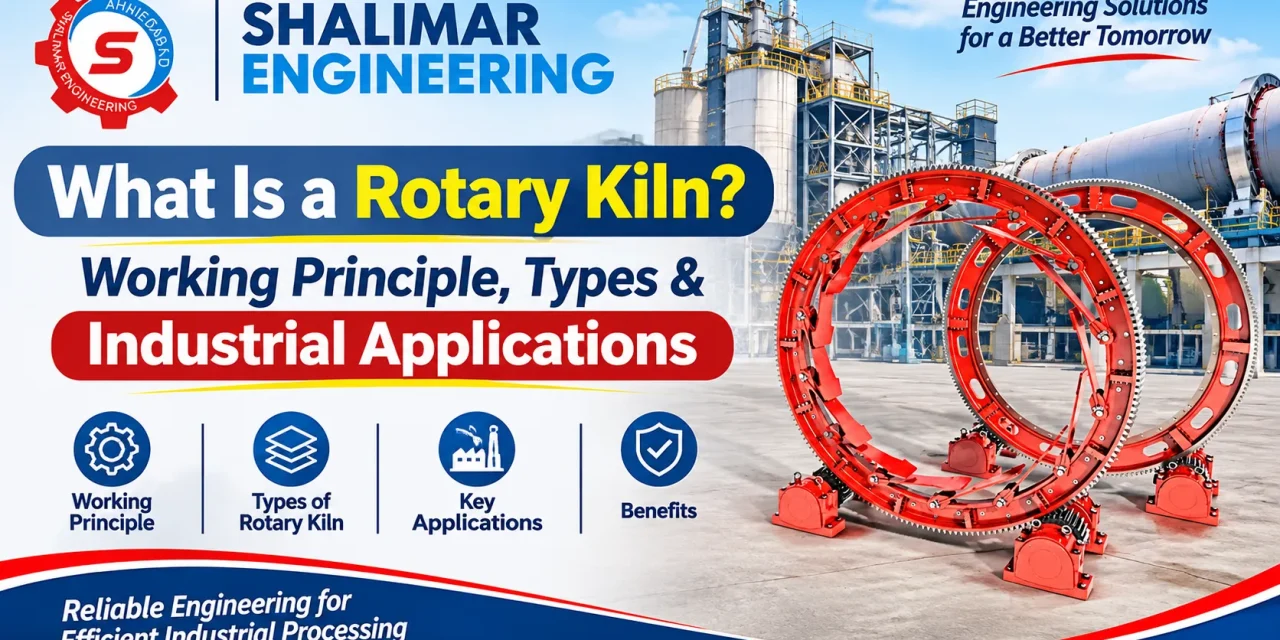
A rotary kiln is a long, rotating cylindrical furnace that heats bulk material to very high temperatures to cause a physical or chemical change, a process called calcination. It’s tilted slightly and turns slowly, so material fed in at the upper end moves gradually to the lower discharge end while being heated. Rotary kilns are the backbone of cement, lime, and many mineral processing industries. At Shalimar Engineering, we manufacture rotary kilns in India, and this guide explains how they work, their types, and where they’re used.
Key Takeaways
- A rotary kiln is a long, slowly rotating, tilted furnace that heats bulk material to high temperatures.
- Material moves by gravity from the feed end to the discharge end as the kiln turns.
- The core process is calcination — driving a chemical or physical change with heat.
- Two main types: direct-fired (gas touches material) and indirect-fired (heated through the shell).
- Used across cement, lime, bauxite, and mineral processing worldwide.
What is a rotary kiln?
A rotary kiln is a large industrial furnace shaped like a long cylinder. It lies almost horizontal, tilted at a small angle, and rotates slowly on its axis.
Its job is to heat bulk material to a high enough temperature to change it, chemically or physically. This heat treatment is known as calcination.
The design is clever in its simplicity. Because the kiln is tilted and turning, material fed in at the high end slowly tumbles down to the low end, heating evenly all the way.
Think of it as a giant, gently sloping rotating oven. Raw material goes in one end; finished, transformed product comes out the other.
Rotary kilns handle enormous throughput continuously, which is why they’re central to heavy industry. You can see the range on our rotary kiln product page.
How a rotary kiln works
The working principle is a continuous flow. Here’s what happens from feed to discharge.
- Feeding. Raw material enters at the higher (feed) end of the tilted kiln.
- Rotation and travel. As the kiln slowly rotates, the tilt and tumbling move material steadily toward the lower end.
- Heating. A burner fires into the kiln. Hot gases bring the material up to its reaction temperature.
- Reaction (calcination). At peak temperature, the material changes, moisture and gases are driven off, or compounds break down and reform.
- Discharge. The transformed product exits at the lower end, ready for cooling and the next process stage.
The key variables are temperature, rotation speed, slope, and how long material stays inside (retention time). Adjusting these controls the reaction. Get them right and the kiln produces consistent, high-quality output around the clock.
Main parts of a rotary kiln
A rotary kiln looks simple from outside, but several key parts work together.
- Shell. The long steel cylinder that forms the body of the kiln.
- Refractory lining. Heat-resistant bricks or castable inside the shell that protect the steel and hold the heat.
- Tyres (riding rings) and rollers. Support the kiln and let it rotate smoothly on its stations.
- Drive system. A motor, gearbox, and girth gear that turn the kiln at a controlled speed.
- Burner. Fires fuel (gas, oil, coal, or alternative fuels) to generate the heat.
- Feed and discharge ends. Where raw material enters and finished product exits.
- Seals. Keep hot gases in and cold air out at both ends.
The refractory lining is the heart of durability. A good lining protects the shell and keeps the process efficient, which is why its design and quality matter so much.
The process, visualised
Here’s the whole flow in one picture: feed in high, heat while rotating, discharge transformed at the low end.
The tilt and rotation together are what move the material; the burner supplies the heat that drives the calcination reaction along the way.
Types of rotary kilns
Rotary kilns are classified a few different ways. Here are the main types.
| Type | How it differs | Best for |
|---|---|---|
| Direct-fired | Hot gases contact the material directly | Most high-temperature processes (cement, lime) |
| Indirect-fired | Material heated through the shell, no gas contact | Sensitive materials needing a controlled atmosphere |
| Co-current | Gas and material flow the same direction | Heat-sensitive materials |
| Counter-current | Gas and material flow opposite ways | Maximum heat transfer and efficiency |
| Batch type | Processes one load at a time | Small volumes, varied materials |
| Continuous | Runs non-stop with steady feed | High-volume industrial production |
Most large plants use continuous, direct-fired, counter-current kilns for efficiency. For smaller or specialised runs, a batch type rotary kiln may suit better. The right type depends on your material, volume, and temperature needs.
Industrial applications of rotary kilns
Rotary kilns appear across heavy industry wherever material needs high-temperature processing. Key uses include:
- Cement production. Converting raw meal into clinker is the classic rotary kiln job. See our cement kiln.
- Lime calcination. Turning limestone into quicklime for construction, steel, and chemicals, handled by a lime kiln.
- Bauxite calcination. Processing bauxite for the aluminium and refractory industries with a bauxite kiln.
- Mineral processing. Roasting, calcining, and treating a range of ores and minerals.
- Waste and recycling. Treating or recovering value from industrial waste streams.
- Chemical processing. Driving high-temperature reactions in bulk chemical production.
The same core machine, tuned for each material, serves all of these. That versatility is why the rotary kiln remains an industrial standard.
Advantages of rotary kilns
There’s a reason rotary kilns dominate high-temperature processing. Their strengths include:
- High, continuous throughput. They process large volumes non-stop, ideal for industrial scale.
- Even heat treatment. Constant tumbling exposes all material to the heat uniformly.
- Flexibility. One kiln design can handle many materials with the right settings.
- High-temperature capability. They reach the extreme temperatures many reactions need.
- Reliable and robust. Built heavy, they run for years with proper maintenance.
- Process control. Temperature, speed, and retention time can be tuned for consistent quality.
These advantages make the rotary kiln hard to beat for continuous, high-temperature bulk processing. Few other systems match its combination of scale, flexibility, and reliability.
How to choose a rotary kiln and manufacturer
A rotary kiln is a major investment. These factors guide a sound choice.
- Material and reaction. The temperature and chemistry decide the kiln type, size, and refractory.
- Throughput. Your required tonnes per hour sets the kiln’s diameter and length.
- Direct vs indirect firing. Choose based on whether the material can contact combustion gases.
- Refractory and shell quality. These determine how long the kiln lasts and how efficiently it runs.
- Fuel type. Gas, oil, coal, or alternative fuels affect the burner and running cost.
- Manufacturer experience. A proven maker gets the engineering, heat balance, and build right.
That last point matters most. A rotary kiln is only as good as its design and build. Choosing an experienced rotary kiln manufacturer ensures the kiln is correctly sized, efficient, and built to last.
Planning a rotary kiln for your plant?
Share your material, target output, and process, and our engineers will size the right rotary kiln, direct or indirect, and the correct refractory for your application.
FAQ
Q1. What is a rotary kiln used for? A rotary kiln heats bulk material to high temperatures to change it chemically or physically (calcination). It’s used in cement, lime, bauxite, mineral processing, waste treatment, and chemical production.
Q2. What is the working principle of a rotary kiln? Material is fed into a long, tilted, rotating cylinder. The tilt and rotation move it toward the discharge end while a burner heats it to the reaction temperature.
Q3. What is the difference between direct-fired and indirect-fired kilns? In a direct-fired kiln, hot gases contact the material directly. In an indirect-fired kiln, heat passes through the shell without gas contact, for sensitive materials or controlled atmospheres.
Q4. What is calcination in a rotary kiln? Calcination is the heat-driven change the kiln performs, such as driving off moisture and gases or breaking down compounds, for example turning limestone into quicklime.
Q5. What are the main parts of a rotary kiln? The shell, refractory lining, support tyres and rollers, drive system, burner, feed and discharge ends, and seals.
Q6. How is a rotary kiln’s capacity determined? By its diameter, length, slope, rotation speed, and retention time, matched to the material and the required throughput.
Final thoughts
A rotary kiln is a deceptively simple machine, a long, tilted, rotating furnace, that does one of the heaviest jobs in industry: transforming bulk material with heat. Understanding its working principle, types, and parts helps you choose and run one well.
Whether it’s cement clinker, quicklime, or a mineral, the right kiln, correctly sized and lined, delivers consistent output for decades.
As an industrial equipment manufacturer in India, Shalimar Engineering designs and builds rotary kilns for cement, lime, bauxite, and mineral processing plants. Contact our team to discuss a kiln sized and built for your material and output.