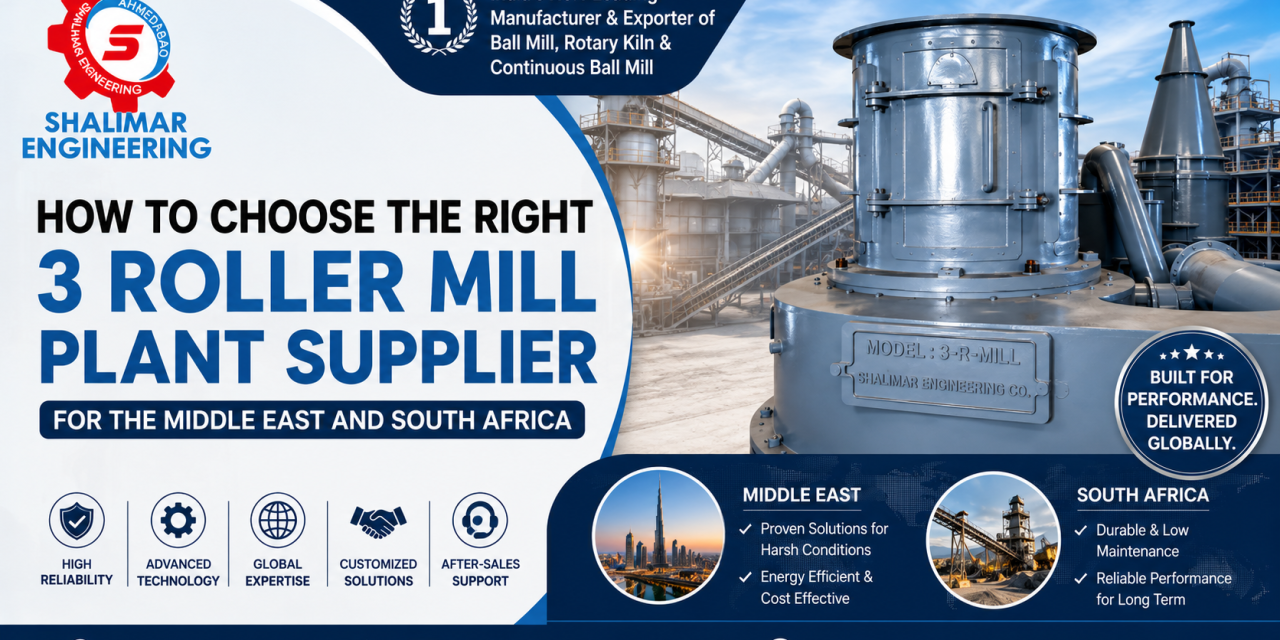
How to Choose the Right 3 Roller Mill Plant Supplier for the Middle East and South Africa
When your production line depends on consistent, fine-particle output, the supplier you choose for your grinding setup defines everything that follows. Whether you are running a mineral processing unit in Saudi Arabia, a chemical processing plant in UAE, or an industrial facility in South Africa, getting the right 3 Roller Mill Plant supplier is not just a procurement decision — it is a long-term operational commitment.
The wrong supplier means downtime, maintenance headaches, poor particle consistency, and ultimately, revenue loss. The right one gives you a machine that performs, a team that supports you post-installation, and a partnership that scales with your growth.
So how exactly do you choose wisely? Here is what to evaluate.
Technical Competence Should Be Non-Negotiable
The first thing you need to assess is whether the supplier actually understands how roller mills work at a deep engineering level — not just whether they can quote you a price.
A quality supplier should be able to:
- Explain the working principle clearly, including how the three rollers create differential pressure to achieve uniform size reduction
- Specify the exact output granularity their equipment achieves for your material type
- Provide engineering drawings, load specifications, and power consumption data upfront
- Offer customization for different feed materials, including minerals, chemicals, and fertilizers
If a supplier cannot walk you through their machine’s RPM range, roller gap adjustment mechanism, and throughput capacity for your specific raw material, that is a red flag you should not ignore.
When you look at Minerals Chemicals Grinding Equipments, what separates capable manufacturers from the rest is their command of engineering precision across varied material types.
International Export Experience to Your Region
Many Indian manufacturers produce excellent industrial grinding equipment but lack the logistics infrastructure and compliance knowledge required for international delivery. This becomes especially critical when shipping to countries like Iran, Iraq, Kuwait, and Bahrain, where customs documentation, port-specific regulations, and local certification requirements add complexity.
Your supplier should ideally have:
- A strong track record of machinery exports to your specific country or region
- Familiarity with international trade compliance, including HS codes, commercial invoices, and certificate of origin documentation
- Relationships with freight forwarders experienced in Middle Eastern and African shipping lanes
- After-sales support capabilities either through local agents or remote technical assistance
A supplier with confirmed export history to GCC nations, North Africa, and South Asia demonstrates they understand the logistical realities of international industrial equipment delivery.
Need a Reliable 3 Roller Mill Plant Supplier?
Choose Shalimar Engineering for advanced 3 Roller Mill Plant solutions designed for mineral, chemical, and industrial grinding applications across the Middle East and Africa. Our team provides technical guidance, customized equipment options, and complete project support.
Quality Certifications and Manufacturing Standards
You would not buy structural steel without a material test certificate. The same discipline applies to your grinding equipment procurement.
Ask every prospective supplier to share:
- ISO certifications for manufacturing quality
- Details about the steel grades and casting processes used for rollers
- Quality control protocols for pre-dispatch inspection
- Warranty terms and what they cover
The best 3 Roller Mill Plant suppliers provide third-party inspection options, allowing you to send a representative or hire an independent inspection agency before shipment. This is standard practice in high-value industrial equipment procurement and any serious supplier will accommodate it.
Machine Customization Capability
A standard catalogue machine rarely fits every operation perfectly. Your feed material may have unique moisture levels, hardness ratings, or specific output particle size requirements that demand customized engineering.
Strong suppliers offer:
- Variable roller pressure adjustment systems
- Material-specific roller surface treatments (corrugated, smooth, or compound profiles)
- Integrated de-dusting or air classification options
- Options to pair with upstream or downstream equipment like feeders, elevators, or classifiers
If you eventually scale up, you will also want to know whether a 4 Roller Mill Plant or a higher-capacity model is part of the same supplier’s product range, making future expansion seamless rather than disruptive.
After-Sales Support and Spare Parts Availability
This is the factor most buyers underweight during the selection process, and the one that causes the most pain after installation.
Ask your supplier these specific questions before signing anything:
- What is the typical lead time for replacement rollers if mine wear out?
- Do you stock spare parts or manufacture them on demand?
- Is remote diagnostic assistance available if my team encounters operational issues?
- Can your team visit our facility in UAE, Qatar, or Saudi Arabia for on-site servicing?
A supplier that provides a clear, honest answer to each of these questions is worth more than one offering the lowest price with vague post-sale commitments.
Pricing Transparency and Payment Terms
Industrial equipment purchases involve significant capital outlay. The pricing structure your supplier offers should be clear, detailed, and free from hidden costs.
Insist on a proforma invoice that itemizes:
- Machine cost
- Packaging and export crating
- Freight charges (if included)
- Installation supervision cost (if applicable)
- Commissioning support
Internationally, buyers in Oman, Qatar, and South Africa often prefer supplier-arranged shipping on CIF or FOB terms. Confirm which trade terms your supplier can accommodate and what payment milestones they require — advance, against documents, or on delivery.
What Makes a Supplier Truly Reliable?
Beyond technical specs and compliance, reliability comes from reputation. Talk to other buyers in your industry who have sourced similar equipment. Ask for reference contacts. Check whether the supplier has been in operation long enough to have a verifiable track record.
Reliable suppliers also invest in after-purchase relationship-building — they follow up on installation progress, offer operator training documentation, and provide clear escalation paths if equipment issues arise.
When evaluating any grinding equipment provider, look at the 3 Roller Mill Plant specifications in detail and cross-reference them with your actual operational requirements. The more specific your requirements are, the easier it becomes to separate serious suppliers from catalogue listers.
Make the Right Decision the First Time
Choosing an industrial equipment supplier across international borders takes careful due diligence. But the effort invested in proper supplier evaluation pays back many times over in reduced operational risk, better machine performance, and a longer usable life for your equipment.
Whether your plant is in Kuwait, Bahrain, UAE, or South Africa, the standards for what makes a supplier trustworthy remain the same: technical depth, export experience, quality assurance, and genuine post-sale commitment.
Take the time to evaluate each supplier against these criteria before you commit. Your grinding line will thank you for it.
Ready to Source a Reliable 3 Roller Mill Plant for Your Region?
If you are evaluating suppliers for your industrial grinding setup in the Middle East or Africa, get in touch with our team today. We are equipped to handle international enquiries with full technical documentation and competitive pricing.
Contact our team to discuss your project requirements and receive a detailed quotation.