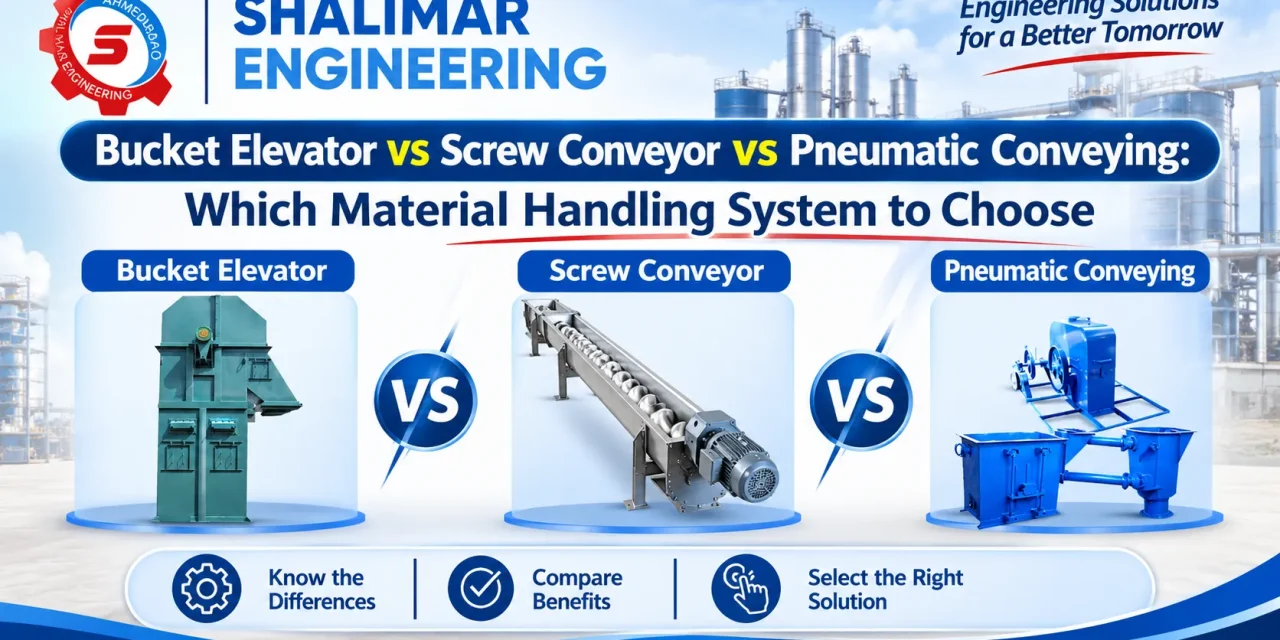
Choose a screw conveyor for short horizontal or slightly inclined transfer, a bucket elevator for lifting material vertically, and a pneumatic conveying system for moving fine or powdered material over longer, dust-free routes. Each system suits a different direction, distance, and material type. Picking the wrong one causes bottlenecks, spillage, and wasted power. This guide compares all three so you can choose with confidence. At Shalimar Engineering, we manufacture all three systems in India and help plants select the right fit.
Key Takeaways
- Screw conveyor: best for short, horizontal or low-incline transfer of most bulk materials.
- Bucket elevator: best for lifting material vertically to height.
- Pneumatic conveying: best for fine powders over longer, dust-free, flexible routes.
- Direction, distance, and material decide the right choice, not price alone.
- The wrong system causes bottlenecks, spillage, dust, and wasted power.
Why the right conveying system matters
Moving material inside a plant sounds simple, but the system you choose shapes efficiency, cost, and reliability for years.
The wrong choice shows up fast. A screw conveyor forced to lift steeply loses capacity. A bucket elevator used for a horizontal run makes no sense. Pneumatic conveying on a coarse, heavy material wastes huge amounts of power.
The right choice does the opposite. It matches the direction you need to move material, the distance, and what the material actually is.
Three questions settle most decisions: Which way is the material going (across, up, or both)? How far? And what is it (fine powder, granules, or lumps)? Answer those, and the right system becomes clear. Browse the full range of material handling equipment to see the options.
What is a screw conveyor?
A screw conveyor moves material using a rotating screw (auger) inside a trough or pipe. Each turn pushes the material along.
It’s the workhorse of short-distance transfer. Simple, enclosed, and reliable, it handles most dry bulk materials well.
Best for:
- Short to medium horizontal runs
- Gentle inclines (up to around 20–30 degrees)
- Powders, granules, and small lumps
- Controlled feeding and metering
Watch out for:
- Capacity drops sharply on steep inclines
- Not ideal for very abrasive materials over long runs
- Limited distance compared to belts or pneumatic systems
For horizontal transfer and feeding, a screw conveyor is usually the simplest, most cost-effective choice.
What is a bucket elevator?
A bucket elevator lifts material vertically using a series of buckets fixed to a belt or chain. The buckets scoop material at the bottom and discharge it at the top.
When you need to raise material to height, this is the specialist. Nothing moves bulk material straight up more efficiently.
Best for:
- Vertical lifting to silos, hoppers, or upper floors
- High-capacity elevation of grains, cement, minerals
- Continuous, steady throughput
- Saving floor space (it goes up, not across)
Watch out for:
- Only lifts; it doesn’t move material horizontally
- Needs correct bucket and speed selection for the material
- Requires a feed system at the base
To raise material to a silo, hopper, or bin, a bucket elevator is the go-to system.
What is a pneumatic conveying system?
A pneumatic conveying system moves material through a sealed pipeline using air pressure or vacuum. The material travels in the air stream from point to point.
This is the choice for fine, dry materials and complex routes. Because it uses pipes, it can bend around a plant and keep everything fully enclosed.
Best for:
- Fine powders and dry granular materials
- Longer distances and routes with bends
- Dust-free, fully enclosed transfer
- Hygienic or contained processes
Watch out for:
- Higher power use than mechanical conveyors
- Not suited to coarse, heavy, or abrasive lumps
- More complex to design and balance
For fine powders or flexible, dust-free routes, a pneumatic conveying system or a dense phase conveying system is the right fit.
Side-by-side comparison
Here’s how the three systems stack up across what matters most.
| Feature | Screw Conveyor | Bucket Elevator | Pneumatic Conveying |
|---|---|---|---|
| Main direction | Horizontal / low incline | Vertical (up) | Any, including bends |
| Distance | Short to medium | Vertical lift | Medium to long |
| Best material | Powders, granules, lumps | Grains, cement, minerals | Fine dry powders |
| Dust control | Enclosed | Enclosed | Fully sealed |
| Power use | Low | Low to medium | Higher |
| Routing flexibility | Straight runs | Straight up | Very flexible |
| Typical cost | Low | Medium | Medium to high |
No single system wins everywhere. Each is best at one job. Match the system to your direction, distance, and material, and you’ll get the best result for the lowest running cost.
Quick decision guide
Start with the single most important question: which way does the material need to move?
This covers most cases. When a job combines directions, such as lifting then transferring, plants often use two systems together, for example a bucket elevator feeding a screw conveyor.
How to choose: the key factors
Beyond direction, weigh these factors before you decide.
- Material type. Fine powder leans pneumatic; granules and lumps suit screw or elevator. Abrasive or hot material narrows the options.
- Throughput. High-capacity vertical lifts favour bucket elevators; metered feeding favours screw conveyors.
- Distance and layout. Long or winding routes favour pneumatic. Short straight runs favour mechanical conveyors.
- Dust and hygiene. Sealed pneumatic systems win where dust control or containment is critical.
- Power and running cost. Mechanical conveyors use less power; pneumatic trades power for flexibility and cleanliness.
- Maintenance. Simpler mechanical systems are easier to service; pneumatic needs more careful setup.
Weigh these together, not in isolation. The best system is the one that fits the most of your real priorities, not just one of them.
Common mistakes when choosing
These errors lead plants to the wrong system. Avoid them.
- Forcing one system to do everything. No single conveyor is best at every job. Combining systems is often the right answer.
- Using a screw conveyor for steep lifts. Capacity collapses on steep inclines. Use a bucket elevator instead.
- Choosing pneumatic for heavy, coarse material. It wastes power and wears out fast. Mechanical conveyors fit better.
- Ignoring dust rules. For fine or hazardous dust, an open or poorly sealed system creates a safety and compliance problem.
- Sizing on price alone. The cheapest system upfront can cost more in power, spillage, and downtime.
- Skipping the material data. Density, flowability, and abrasiveness change everything. Get them before deciding.
Get the basics right and the choice becomes straightforward.
Not sure which system fits your plant?
Tell us your material, how far and which way it needs to move, and your throughput. Our engineers will recommend the right conveying system, or the right combination, for your process.
FAQ
Q1. Which is better, a screw conveyor or a bucket elevator? Neither is universally better. A screw conveyor is best for horizontal or low-incline transfer; a bucket elevator is best for lifting material vertically. They do different jobs.
Q2. When should I use pneumatic conveying instead of a screw conveyor? Use pneumatic conveying for fine, dry powders, longer distances, routes with bends, or when fully dust-free, enclosed transfer is needed.
Q3. Can a screw conveyor move material vertically? Only up gentle inclines, and capacity drops sharply as the angle rises. For true vertical lifting, a bucket elevator is the right choice.
Q4. Is pneumatic conveying more expensive to run? Usually yes. It uses more power than mechanical conveyors. You pay for that in exchange for flexibility, long reach, and dust-free transfer.
Q5. Can I combine these systems? Yes, and plants often do. A common setup is a bucket elevator lifting material, then a screw conveyor distributing it horizontally.
Q6. How do I decide which system I need? Start with direction (across, up, or flexible), then distance and material type. Those three answers point to the right system in most cases.
Final thoughts
Choosing between a screw conveyor, bucket elevator, and pneumatic conveying system comes down to three questions: which way, how far, and what material. Answer those honestly and the right system almost picks itself. Many plants use two in combination for the best result.
The mistake to avoid is forcing one system to do a job it isn’t built for. That’s where bottlenecks, dust, and wasted power come from.
As an industrial equipment manufacturer in India, Shalimar Engineering designs and builds all three systems for mineral, cement, chemical, and fertilizer plants. Contact our team and we’ll recommend the right conveying solution for your material and layout.