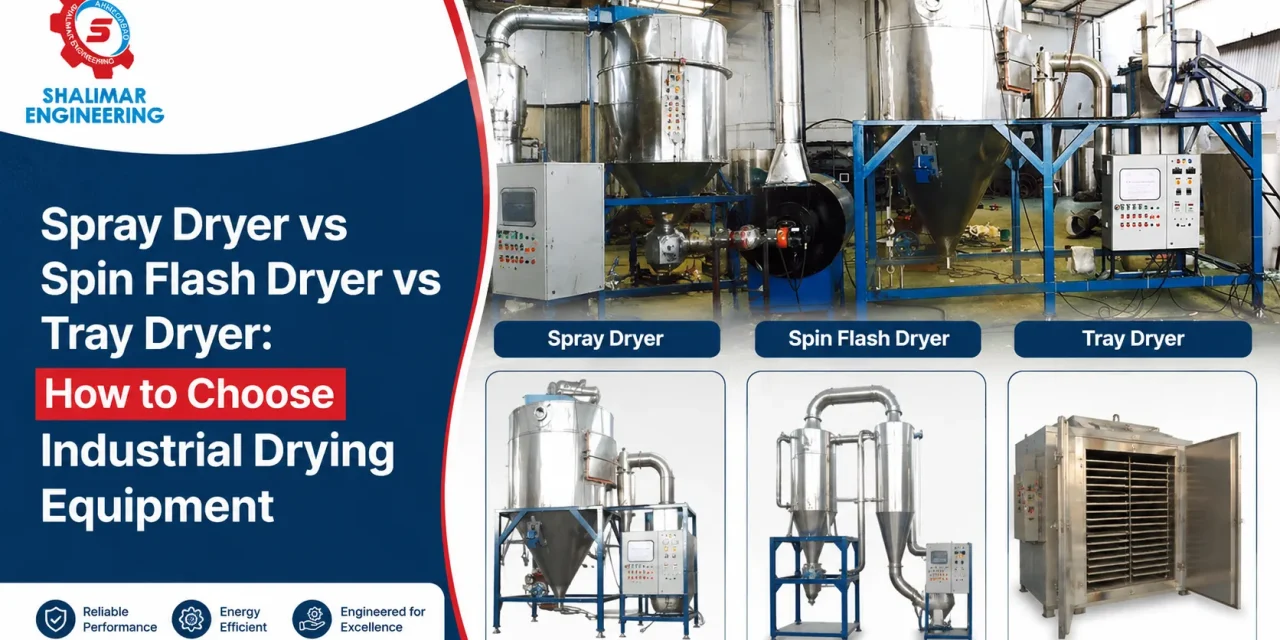
Choose a spray dryer to turn a liquid or slurry directly into a dry powder, a spin flash dryer to dry wet cakes and pastes into powder in one step, and a tray dryer to batch-dry solids, granules, or small quantities gently. The right dryer depends on your feed’s form (liquid, paste, or solid), your volume, and how heat-sensitive the material is. The wrong one wastes energy and damages product quality. At Shalimar Engineering, we manufacture all three dryers in India and help plants pick the right one.
Key Takeaways
- Spray dryer: turns a liquid or slurry straight into dry powder, continuously.
- Spin flash dryer: dries wet cakes and pastes into powder in a single step.
- Tray dryer: gently batch-dries solids, granules, or small quantities.
- The feed form decides the dryer — liquid, paste, or solid.
- Volume and heat-sensitivity fine-tune the final choice.
Why the right dryer matters
Drying is one of the most energy-hungry steps in any process plant. The dryer you choose affects product quality, running cost, and throughput for years.
Pick the wrong one and the problems are immediate. Feed a liquid to a tray dryer and you’ll wait forever. Use a spray dryer for a chunky solid and it simply won’t work. Over-heat a sensitive product and you ruin it.
The right dryer matches three things: the form of your feed, how much you need to dry, and how delicate the material is.
The single most important question is the feed form. Is it a pumpable liquid, a wet paste or cake, or a solid? That answer alone rules most dryers in or out. Explore the full range of drying equipment to see the options.
What is a spray dryer?
A spray dryer turns a liquid or slurry directly into a dry powder in one continuous step. The feed is atomised into a fine mist inside a hot-air chamber, where the tiny droplets dry almost instantly.
Because drying is so fast, the product spends very little time hot, which protects heat-sensitive materials.
Best for:
- Liquids, solutions, and pumpable slurries
- Continuous, high-volume powder production
- Heat-sensitive products (food, pharma, chemicals)
- Consistent particle size and free-flowing powder
Watch out for:
- Only works with pumpable feeds, not solids or pastes
- Larger footprint and higher capital cost
- Needs careful setup for each product
To convert a liquid straight into powder at scale, a spray dryer is the specialist.
What is a spin flash dryer?
A spin flash dryer dries wet cakes, pastes, and sludges directly into a fine powder in a single step. Inside the chamber, a rotating agitator breaks up the wet feed while hot air flashes off the moisture.
It fills the gap between a spray dryer (liquids only) and solid dryers. If your feed is too thick to pump but too wet to handle as a solid, this is often the answer.
Best for:
- Wet cakes, pastes, and sludges
- Continuous powder production from high-moisture feeds
- Replacing a two-step dry-then-grind process
- Chemicals, dyes, pigments, and similar materials
Watch out for:
- Feed must be consistent for stable operation
- Not for free-flowing liquids (use a spray dryer)
- Needs correct airflow and agitator setup
For pastes and wet cakes, a spin flash dryer dries and powders in one efficient step.
What is a tray dryer?
A tray dryer dries material in batches. The wet solid is spread on trays, loaded into an insulated chamber, and hot air circulates over them until dry.
It’s the simplest, most flexible dryer. Low cost and easy to run, it suits smaller volumes and a wide variety of products, which is why it’s a staple in pharma and food labs and plants.
Best for:
- Solids, granules, and wet cakes in batches
- Small to medium volumes
- Products needing gentle, controlled drying
- Operations handling many different materials
Watch out for:
- Batch process, so lower throughput than continuous dryers
- More manual loading and unloading
- Not suited to liquids or very high volumes
For gentle batch drying of solids, a tray dryer is reliable and cost-effective, and it meets cGMP needs for pharma.
Side-by-side comparison
Here’s how the three dryers compare across what matters most.
| Feature | Spray Dryer | Spin Flash Dryer | Tray Dryer |
|---|---|---|---|
| Feed form | Liquid / slurry | Paste / wet cake | Solid / granules |
| Operation | Continuous | Continuous | Batch |
| Output | Fine powder | Fine powder | Dried solid |
| Volume | High | Medium to high | Low to medium |
| Heat exposure | Very short | Short | Longer |
| Capital cost | High | Medium | Low |
| Best industries | Food, pharma, chemicals | Chemicals, dyes, pigments | Pharma, food, labs |
Each dryer owns a different feed form. A spray dryer for liquids, a spin flash for pastes, a tray dryer for solids. Match the dryer to your feed first, then refine by volume and heat-sensitivity.
Quick decision guide
Start with the one question that settles most cases: what form is your feed in?
Once the feed form points you to a dryer, refine the choice by your volume and how heat-sensitive the product is.
How to choose: the key factors
After the feed form, weigh these to settle the final choice.
- Feed form. The first filter: liquid points to spray, paste to spin flash, solid to tray.
- Throughput. Continuous dryers (spray, spin flash) suit high volume; tray dryers suit smaller batches.
- Heat sensitivity. Spray drying exposes product to heat briefly; tray drying takes longer, so set temperatures carefully.
- Product form wanted. Need a fine free-flowing powder? Spray or spin flash. Just need it dry? A tray dryer may do.
- Capital and running cost. Tray dryers are cheapest to buy; continuous dryers cost more but handle volume efficiently.
- Compliance. For pharma, confirm cGMP-compliant design, which a tray dryer can be built to meet.
Weigh these together. The best dryer fits your feed, volume, and product-quality needs at the right cost.
Common mistakes when choosing a dryer
These errors lead to the wrong dryer and poor results. Avoid them.
- Ignoring the feed form. Trying to tray-dry a liquid, or spray-dry a solid, simply won’t work. Match the feed first.
- Over-heating sensitive products. Too much heat or too long in the dryer degrades food, pharma, and fine chemicals.
- Sizing on price alone. The cheapest dryer upfront can cost far more in energy and lost product quality.
- Forgetting throughput. A batch tray dryer can’t keep up with high continuous demand; you’ll create a bottleneck.
- Skipping compliance. For pharma, a non-cGMP dryer fails audits. Confirm the design meets your standards.
- No trial on your material. Drying behaviour varies. Testing your actual feed avoids costly surprises.
Get the feed form and these factors right, and the dryer choice is straightforward.
Not sure which dryer suits your material?
Tell us your feed form, moisture, volume, and product requirements. Our engineers will recommend the right dryer, spray, spin flash, or tray, and size it for your process.
FAQ
Q1. What’s the difference between a spray dryer and a spin flash dryer? A spray dryer dries pumpable liquids and slurries into powder. A spin flash dryer dries thicker pastes and wet cakes that can’t be pumped. Both produce powder continuously.
Q2. Which dryer is best for heat-sensitive products? A spray dryer is often best, because droplets dry almost instantly and spend very little time hot. A tray dryer can also work at low, controlled temperatures.
Q3. Can a tray dryer dry liquids? No. A tray dryer is for solids, granules, and wet cakes spread on trays. For liquids, use a spray dryer.
Q4. Which dryer is cheapest? A tray dryer has the lowest capital cost and is simplest to run, which is why it suits smaller volumes and varied products.
Q5. What dryer turns a paste directly into powder? A spin flash dryer. It breaks up wet cakes and pastes while flashing off moisture, giving a dry powder in one step.
Q6. How do I choose the right industrial dryer? Start with the feed form (liquid, paste, or solid), then weigh volume, heat-sensitivity, product form, cost, and any compliance needs.
Final thoughts
Choosing between a spray dryer, spin flash dryer, and tray dryer starts with one question: what form is your feed? Liquid points to spray, paste to spin flash, solid to tray. From there, volume, heat-sensitivity, and cost refine the decision.
The costly mistake is forcing a dryer onto the wrong feed. Get the match right and you save energy, protect product quality, and avoid bottlenecks.
As an industrial equipment manufacturer in India, Shalimar Engineering designs and builds spray, spin flash, and tray dryers for food, pharma, chemical, and mineral plants. Contact our team and we’ll recommend the right drying equipment for your material.