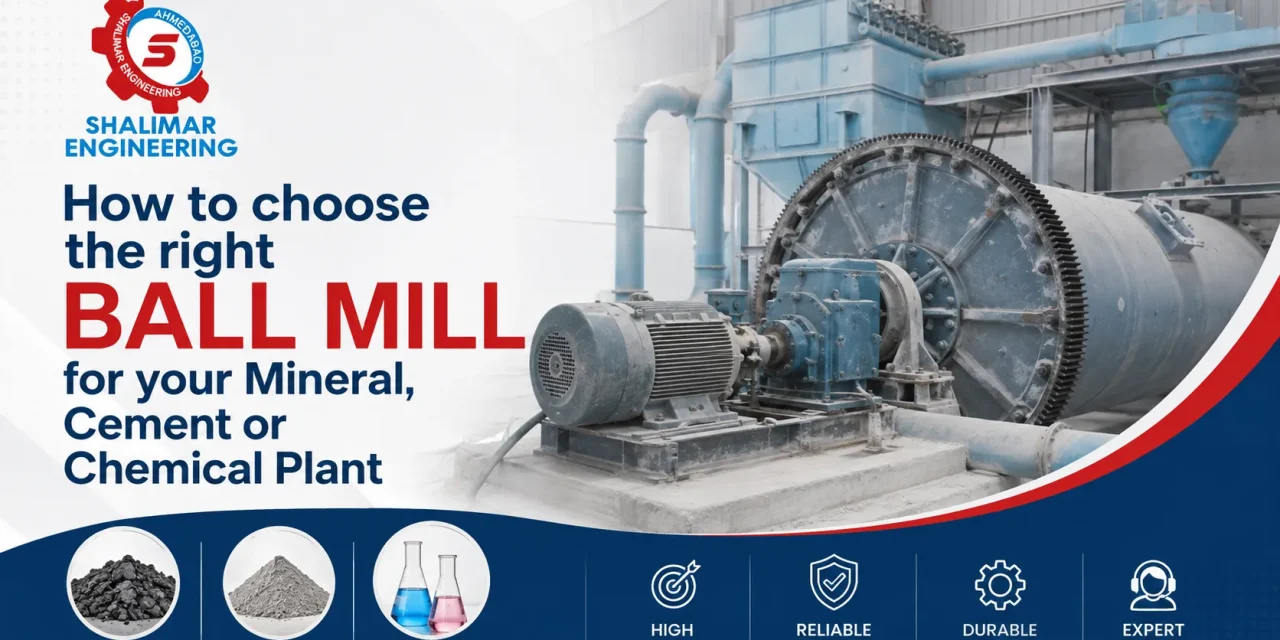
Choosing the right ball mill comes down to four decisions made before you ever speak to a supplier: target particle size, feed material hardness, required throughput, and whether the process runs batch or continuous. Once those four parameters are defined, the mill type, liner material, grinding media, and motor size follow logically. Shalimar Engineering serves mineral, cement, and chemical plants across India and the Middle East. This article walks through each decision point in the order you face it when specifying a grinding mill for a real plant.
The selection process is not complicated, but it is sequential. Get the parameters wrong at the front end and every downstream decision compounds the error: oversized media in an undersized mill, the wrong liner for the feed hardness, a batch machine where a continuous one was needed. This guide is structured to prevent that.
Key takeaways
- Four parameters first:Particle size target, feed hardness, throughput, and batch vs. continuous process mode determine every downstream specification.
- Critical speed is the reference:Industrial ball mills run at 65–80% of critical speed; fraction of critical speed, not RPM, is the transferable parameter across mill sizes. Understanding this ball mill working principle is essential before comparing models.
- Mill type drives fineness:Tumbling mills suit tonnes-per-hour production at 10–300 µm; planetary mills reach 0.5–5 µm but handle only millilitres per batch.
- Liner and media are a paired decision:Match liner material and grinding media to feed abrasiveness and product purity requirements together.
- Maintenance before commissioning:Build your tiered maintenance programme before the mill starts, not after the first breakdown.
- Discharge configuration matters:Overflow mills suit finer products; grate-discharge mills suit higher throughput and coarser grinding.
How does a ball mill actually work?
The grinding action inside the mill
A rotating cylindrical shell lifts steel or ceramic grinding media until they cascade or cataract back onto the feed material, breaking particles through impact and attrition. The ratio of impact to attrition shifts with mill speed, filling level, and media size. Coarser feeds benefit from higher impact energy, achieved with larger media at greater drop height, while fine grinding relies more on attrition, where smaller media in close contact wear particles down through surface friction rather than blunt force.
Understanding this ball milling balance is practical, not academic. If you target a 100 µm product from a hard mineral feed, you need enough impact energy to break coarse particles first, then enough attrition contact time to finish the job. Specifying media that is too small for the feed, or running the mill too slowly to lift the charge properly, produces neither efficiently.
Critical speed and why it controls everything
The ball mill working principle centres on critical speed. The critical speed (Nc) is calculated as Nc = 42.3 / √D, where D is the effective internal diameter in metres. Above critical speed, the grinding media centrifuges against the shell and grinding stops entirely. Industrial mills operate at 65–80% of critical speed, where the charge lifts and cascades correctly.
For a 3 m diameter mill, critical speed is approximately 24.4 RPM. The practical operating range is therefore 15.9 RPM at 65% through to 19.5 RPM at 80%. The important point is that RPM alone is meaningless when comparing mills of different sizes: a laboratory jar running at 100 RPM and an industrial mill running at 18 RPM can both be operating at the same fraction of critical speed. Fraction of critical speed is the transferable parameter; raw RPM is not.
What are the main types of ball mills, and which suits your process?
Batch vs. continuous mills, and discharge configurations
A batch mill is loaded, operated for a defined cycle time, then discharged and reloaded. A continuous mill is fed and discharged simultaneously, which makes it the correct choice for high-volume production in mining, cement, and chemical plants. The choice between batch and continuous is determined by your throughput requirement: for processing several tonnes per hour, continuous operation is normally the practical choice.
Within continuous mills, the discharge configuration matters. Overflow mills hold a higher slurry level and suit finer products because material spends longer in the mill. Grate-discharge mills drain more quickly through a perforated plate and pulp lifters, giving higher throughput and a coarser but more tightly controlled product size distribution. Overflow mills are simpler to maintain; grate-discharge mills add mechanical complexity but serve primary grinding circuits and high-capacity operations well.
Planetary and laboratory ball mills: where they fit
Planetary ball mills generate centrifugal forces of 20–50 g, reaching fineness down to 0.5–5 µm in dry milling and, under specific operating conditions, below 100 nm in wet milling. Their throughput is measured in millilitres per batch, which makes them the right tool for R&D, quality control, and mechanochemical research, not for production. Laboratory ball mills scale up the concept to kilogram batches for pilot-scale work before committing to an industrial machine. Neither laboratory mill type is a direct scale-up equivalent of an industrial tumbling mill, the grinding mechanisms differ enough that pilot results should inform specification, not replace it.
How the three mill types compare
| Mill type | Energy efficiency at scale | Achievable fineness (typical) | Throughput capacity |
|---|---|---|---|
| Industrial tumbling mill | Best specific energy per tonne for conventional grinding; suited to large continuous loads | 10–300 µm, depending on circuit design | Tonnes per hour to hundreds of tonnes per hour; mining, cement, bulk minerals |
| Planetary ball mill | Highest energy intensity per unit of material, not per tonne; not efficient at scale | 0.5–5 µm dry; 100–500 nm and below in wet milling under specific conditions | Millilitres per batch; laboratory and specialty process only |
| Vibratory ball mill | More energy-intensive than a large tumbler; faster fine grinding in small batches | Approximately 2–10 µm; finer than tumbling mills, less fine than planetary | Low to moderate batch throughput; laboratory or small specialty production |
If you are running tonnes per hour in mining, cement, or chemicals, the industrial tumbling mill is the correct starting point. Planetary and vibratory mills serve important but different purposes, and their results do not convert directly into industrial energy or throughput expectations.
Which parameters should you define before specifying a ball mill machine?
Capacity, feed size, and discharge requirements
Capacity in tonnes per hour or kg per batch, combined with maximum feed size, directly determines mill diameter, length, and motor size. For grinding media selection, a common laboratory and pilot starting-point rule of thumb is that initial media diameter should be roughly 20–30 times the largest feed particle; industrial media selection should be confirmed through trial work or supplier calculation for your specific material. Feed a 15 mm top-size mineral to a mill loaded with 0.5 mm beads and very little breakage occurs, regardless of how long you run the mill.
Discharge method must match your required product size distribution. Choosing overflow or grate-discharge arbitrarily, without reference to fineness targets and throughput requirements, is one of the most common and most avoidable specification errors in ball milling.
Lining materials and grinding media selection
For cement grinding, alloy steel and high-chrome cast iron are standard liner choices, with rubber composites used where noise reduction or weight saving is a priority. For hard-rock mineral processing, high-manganese steel suits primary coarse grinding because it work-hardens under impact; chrome-molybdenum alloy steel suits applications combining severe impact with abrasion. Rubber liners work well in wet secondary grinding when impact levels are moderate.
Grinding media material follows the same logic. Forged steel suits impact-intensive coarse mineral grinding. High-chrome cast iron reduces media consumption in abrasive wet-grinding circuits. Ceramic media, particularly alumina or zirconia, are the correct choice for contamination-sensitive chemical and pigment applications where iron pickup would compromise product purity. The table below shows practical starting ranges for media sizing by target product range; these should be optimised for your specific mill and slurry through trial work:
| Target product size | Typical media size | Media-to-powder ratio |
|---|---|---|
| Coarse: 1–5 mm or larger | 15–30 mm balls | 3:1–6:1 |
| Fine: 10–500 µm | 2–10 mm media | 5:1–10:1 |
| Ultra-fine: below 10 µm | 0.1–2 mm beads | 10:1–20:1 |
Liner and media selection jointly determine wear rates, energy consumption, and product purity. Treat them as a paired decision, not two separate line items in a procurement list.
How do you keep a ball mill running efficiently and reliably?
A practical maintenance schedule
Effective maintenance is tiered across inspection intervals. The table below summarises the core tasks at each level; recommended intervals and relining thresholds are based on established OEM maintenance guidance and should be adjusted to your specific operating conditions:
| Maintenance Schedule | Inspection and Maintenance Tasks |
|---|---|
| Every shift | Record bearing temperature, oil pressure and flow, cooling-water conditions, motor current, vibration, and any unusual noise or leakage |
| Weekly | Inspect liners, bolts, seals, gear and pinion contact, and lubrication equipment |
| Monthly | Oil sampling, gear-mesh pattern and backlash checks, liner thickness measurement at fixed reference locations, vibration trending |
| Quarterly / condition-based | Detailed vibration analysis, thermography, gearbox oil particle counts |
| Annual planned outage | Trunnion inspection, girth gear, coupling, foundation, and full alignment verification |
Reline scheduling should be driven by measured wear curves, not calendar time. As a practical guideline, schedule a reline when residual liner thickness approaches 25–40% of original, or when lifter height has fallen to approximately 60% of design. Waiting for a liner breakthrough to trigger relining turns a planned outage into an emergency one and risks damage to the shell and adjacent components.
Performance optimisation to reduce energy and downtime
A sustained rise in bearing temperature at constant load is an early warning that warrants investigation before a trip. The operating levers that protect components and reduce energy consumption are well established: run at the correct fraction of critical speed, maintain media charge fill at 35–45% of mill volume, keep lubricating oil clean and at specified viscosity, and verify gear alignment after every major intervention.
Maintenance programmes that combine operator rounds, continuous temperature and pressure monitoring, periodic vibration analysis, oil analysis, and measured liner wear tracked in a maintenance log tend to be the most effective. Each input covers failure modes that the others miss. Running any one of them alone leaves gaps that eventually become unplanned stoppages.
Why plants across the Middle East choose Shalimar Engineering for their ball mills
We manufacture batch and continuous ball mill models at our facility in Ahmedabad using certified raw materials. Available configurations cover a range of diameters and lengths, with a choice of liner material and grinding media to suit mineral, cement, or chemical-grade applications. Our manufacturing is supported by the latest production technology, and every machine is built to deliver heavy-duty grinding performance across the industries we serve.
We supply customers across the Middle East, including markets such as Saudi Arabia, the UAE, Qatar, and Oman, for mineral processing and cement applications. Shalimar Engineering operates a manufacturing facility in Ahmedabad and exports to markets in the Middle East.
If you are at the specification stage, get in touch with our team to request a technical consultation or arrange a visit to our manufacturing facility. Share your feed material specifications, throughput target, and product size requirements, and our team will work through the selection with you.
Getting the specification right from the start
To bring this back to the opening framework: define your particle size target, feed material, throughput, and process mode first. Let those four parameters drive the mill type, liner material, and media choices. Build your maintenance programme before the mill is commissioned, not after the first breakdown forces the issue.
A ball mill is a long-service asset. The right specification decision at the front end pays back in lower energy consumption, predictable scheduled downtime, and a longer working life. A poorly specified mill costs more to run on every tonne, every shift, for its entire service life. The engineering work done before purchase is never wasted.
For enquiries, technical datasheets, or a discussion about your plant’s grinding requirements, contact our team at Shalimar Engineering. We are ready to work through the selection process with you.
Frequently Asked Questions
When should we pick an overflow mill versus a grate-discharge mill for continuous operation?
Choose an overflow mill when you need a finer product and longer residence time, and choose a grate-discharge mill when you need higher throughput and a coarser, tightly controlled product size. We note overflow mills are simpler to maintain, while grate-discharge mills add mechanical complexity but serve primary grinding circuits and high-capacity operations well.
Can results from a planetary or laboratory mill be used directly to specify an industrial tumbling mill?
No, planetary and laboratory mill results do not convert directly into industrial expectations and should inform specification rather than replace it. We advise using pilot and laboratory data to guide choices but confirm industrial media selection and motor sizing through trial work or supplier calculation because the grinding mechanisms differ between mill types.
What maintenance indicators should prompt scheduling a reline before an emergency occurs?
You should schedule a reline when measured residual liner thickness approaches about 25–40% of original, or when lifter height has fallen to roughly 60% of design. We also treat sustained rises in bearing temperature at constant load as an early warning that warrants investigation, and we recommend driving relines from measured wear curves rather than calendar time to avoid emergency outages.