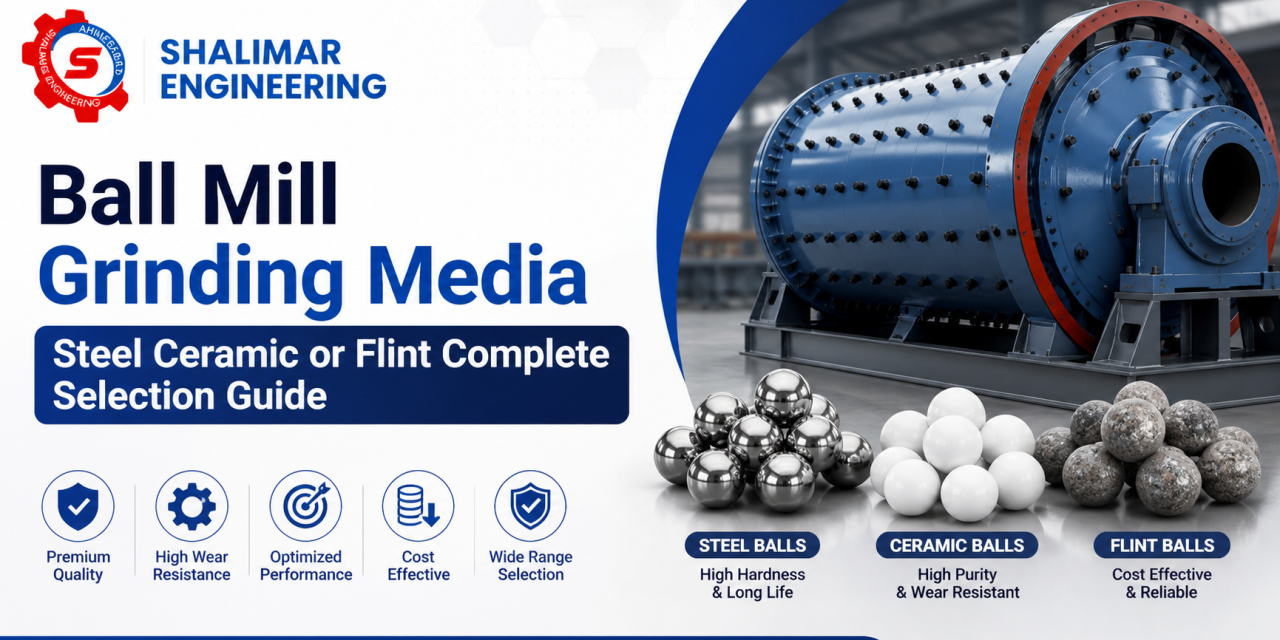
Ball Mill Grinding Media Steel Ceramic or Flint Complete Selection Guide
Most plant engineers spend a lot of time selecting the right ball mill. Far fewer spend the same attention on what goes inside it.
Grinding media the balls that do the actual grinding directly determine your output particle size, contamination level, energy consumption, and how quickly your mill liner wears out. Two plants running the same ball mill machine with different grinding media can get completely different results from the same material.
This guide covers every major grinding media type used in industrial ball mills steel, ceramic, alumina, flint pebbles, and rubber what each one does well, what it does not, and exactly which industries and materials it suits.
What is Grinding Media in a Ball Mill?
Grinding media are the balls or cylinders loaded into a ball mill that physically break down the feed material through impact and attrition as the mill rotates. They are the core consumable in any ball mill operation.
Grinding media selection affects:
- Output particle size Smaller, denser media produce finer output
- Contamination Media material transfers traces into the ground product
- Mill liner wear Hard media against a soft liner increases replacement frequency
- Energy consumption Denser media carry more impact energy per ball
- Operating cost Media wear rate determines how often and how much you spend on replacement
Getting grinding media selection right is as important as getting the mill size and speed right. A qualified ball mill supplier will always discuss grinding media as part of the mill specification not as an afterthought.
Types of Grinding Media Used in Ball Mills
1. Forged Steel Balls
Forged steel balls are the most widely used grinding media in industrial ball mills globally. They are made by hot forging steel billets into spherical shapes and are available in diameters from 20 mm to 150 mm.
Key properties:
- Density: 7.8–7.9 g/cm³ among the highest of all media types
- Hardness: 55–65 HRC depending on grade
- Wear rate: Moderate typically 100–600 g per tonne of material ground
- Cost: Low to moderate widely available in India
Best for:
- Mining and ore grinding iron ore, copper ore, gold ore, manganese
- Cement clinker grinding
- Coal grinding
- Hard mineral processing where maximum impact energy is required
Not suitable for:
- Contamination-sensitive applications steel traces transfer into the product
- Pharmaceutical, food-grade, or white pigment grinding where iron contamination ruins product quality
- Corrosive wet grinding without stainless steel upgrade
Forged steel balls work because their high density delivers maximum kinetic energy when they fall inside the rotating ball mill. For hard materials that need impact-based breakage, nothing delivers more energy per ball than forged steel.
2. Cast Steel Balls (High Chrome)
High chrome cast steel balls are an upgraded version of standard steel grinding media. They are produced by casting molten steel alloyed with 10–30% chromium, which significantly improves hardness and wear resistance.
Key properties:
- Density: 7.6–7.8 g/cm³
- Hardness: 60–68 HRC
- Wear rate: 30–50% lower than forged steel in the same application
- Cost: Higher than forged steel offset by longer service life
Best for:
- Cement grinding where media wear cost is a major operating expense
- Hard rock mining where grinding circuit runs continuously 24/7
- Any high-throughput application where media replacement downtime is costly
High chrome balls last longer than standard forged steel, which reduces media consumption cost and mill downtime for media top-up. For large continuous ball mills in cement or mining plants, the cost savings over a year of operation are significant.
3. Stainless Steel Balls
Stainless steel grinding balls typically SS 304 or SS 316 are used when the ground material must not be contaminated with iron or carbon. They offer corrosion resistance, chemical inertness, and easy cleaning between product batches.
Key properties:
- Density: 7.9 g/cm³ (similar to carbon steel)
- Hardness: Lower than forged steel 30–45 HRC
- Wear rate: Higher than forged or high chrome steel
- Cost: Significantly higher than standard steel
Best for:
- Food-grade material grinding
- Chemical intermediates where iron contamination affects reaction chemistry
- Pharmaceutical applications where SS 316 contact parts are mandatory
- White pigment and specialty chemical grinding
Not suitable for:
- High-throughput, high-abrasion applications wear rate makes operating cost too high
- Materials harder than Mohs 5 the balls wear too quickly
If your ball mill is being used in a pharmaceutical or food application, stainless steel grinding media is often the minimum requirement set by regulatory standards. Any reliable ball mill manufacturer in India supplying to pharma will offer SS 316 media as standard for those applications.
4. Ceramic Grinding Balls (Alumina)
Alumina ceramic balls typically 92% or 95% Al₂O₃ are the preferred grinding media when contamination must be zero and the material is of moderate hardness. They are white, chemically inert, and produce no metallic contamination in the ground product.
Key properties:
- Density: 3.6–3.9 g/cm³ lower than steel
- Hardness: 9 Mohs extremely hard surface, very low wear
- Wear rate: Very low often 5–10x lower than steel in comparable applications
- Cost: Higher per kg offset by very low wear rate and elimination of contamination issues
Best for:
- White pigment grinding titanium dioxide, zinc oxide, lithopone
- Ceramic raw material grinding feldspar, quartz, kaolin for tile and sanitaryware
- Pharmaceutical API grinding where metallic contamination is not acceptable
- Electronic materials and advanced ceramics
- Any application where product colour, purity, or reactivity would be damaged by metal traces
Not suitable for:
- Very hard materials above Mohs 8 alumina balls crack under extreme impact
- High-capacity, low-value material grinding the cost premium over steel does not justify the investment
Alumina ceramic balls are the right choice when what comes out of the ball mill must be chemically pure. For white pigments especially, a single iron contamination event can ruin an entire batch ceramic media eliminates this risk entirely.
5. Flint Pebbles
Flint pebbles are naturally occurring silica-rich stones used as grinding media in ball mills particularly in the traditional ceramics industry. They are not manufactured but sourced and sized from natural deposits.
Key properties:
- Density: 2.5–2.6 g/cm³ significantly lower than steel or alumina
- Hardness: 7 Mohs
- Wear rate: Moderate flint wears and breaks, but the silica contamination is often acceptable in ceramic applications
- Cost: Very low natural material, no manufacturing cost
Best for:
- Traditional ceramics porcelain, fine earthenware, bone china
- Glaze grinding for ceramic tile
- Applications where silica contamination is acceptable or even desirable
- Low-budget, low-throughput wet grinding operations
Not suitable for:
- Any application where silica contamination is a problem
- High-intensity dry grinding flint pebbles break under high impact
- Large-scale, high-throughput operations where consistent media size matters
Flint pebbles were the original grinding media for ceramic ball mills before alumina became widely available. They remain in use in traditional ceramics because the silica they release is compatible with most ceramic formulations and because their cost is negligible compared to manufactured media.
6. Rubber Balls and Cylpebs
Rubber grinding media and cylindrical media (cylpebs) are used in specific wet grinding applications particularly for soft to medium-hard materials where noise reduction and liner protection are priorities.
Key properties:
- Density: 1.1–1.5 g/cm³ — very low
- Hardness: Soft — not suitable for hard materials
- Key advantage: Very low noise, protects mill liner from impact damage
- Cost: Moderate
Best for:
- Soft mineral wet grinding talc, gypsum, soft limestone
- Applications where noise levels are regulated
- Mills where liner protection is more important than grinding intensity
Need the Right Industrial Machinery for Your Process?
Whether you’re planning a new plant or upgrading existing equipment, Shalimar Engineering provides reliable machinery and technical guidance tailored to your production requirements.
Grinding Media Selection — Quick Reference by Industry
| Industry | Recommended Media | Reason |
|---|---|---|
| Iron ore / copper mining | Forged steel or high chrome steel | Maximum impact, high throughput |
| Cement grinding | High chrome steel | Low wear cost at high throughput |
| White pigment (TiO‐2, ZnO) | 95% alumina ceramic | Zero iron contamination |
| Ceramic tile (feldspar, quartz) | Alumina or flint pebbles | No metallic contamination in slip |
| Pharmaceutical API | SS 316 or 95% alumina | Regulatory compliance, zero contamination |
| Food-grade materials | SS 304 / SS 316 | FDA/FSSAI compliance |
| Coal grinding | Forged steel | High impact, low cost |
| Calcium carbonate (GCC) | High chrome or alumina | Depends on whiteness requirement |
| Paint pigments | Alumina ceramic | Colour purity critical |
| Chemical intermediates | SS 316 or alumina | Reaction chemistry protection |
How Grinding Media Size Affects Ball Mill Output
Media diameter is as important as media material. Here is how size affects grinding:
Larger balls (60–100 mm):
- Higher impact energy per ball
- Better for coarse grinding and hard materials
- Produces coarser output particle size
Medium balls (30–60 mm):
- Balanced impact and attrition
- Most common size range for industrial grinding
- Good for medium-hard materials at 200–325 mesh target
Small balls (10–30 mm):
- More contact points per unit volume
- Better for fine and ultra-fine grinding
- Used in the second compartment of multi-compartment cement mills
Most industrial ball mills use a graded charge a mix of two or three ball sizes to optimize both coarse breakage and fine grinding in a single pass through the mill.
The Cost of Getting Grinding Media Wrong
Selecting the wrong grinding media is one of the most common and costly mistakes in ball mill operation. Here is what it leads to:
Using steel in a contamination-sensitive application — Product fails quality checks, entire batches are rejected. The cost of rework and lost product far exceeds the cost of alumina or stainless media.
Using alumina in a high-hardness mining application — Ceramic balls crack under impact from hard ore. Rapid media consumption, broken media in the product, and damaged mill lining.
Oversized balls for fine grinding — Insufficient contact points, coarse output, high energy consumption per tonne.
Undersized balls for coarse, hard material — Balls do not have enough mass to break coarse particles. Mill runs long, throughput drops, motor draws excess current.
Working with an experienced ball mill manufacturer from the specification stage before you order the mill ensures the correct media type and size is part of the original design, not a correction made after commissioning.
How Shalimar Engineering Specifies Grinding Media
At Shalimar Engineering, grinding media selection is part of every ball mill inquiry process not a separate decision left to the buyer.
When a client shares their material, required output particle size, and production volume, our engineering team specifies:
- Media material (steel, high chrome, SS, alumina, flint)
- Media diameter — single size or graded charge
- Fill level — percentage of mill volume
- Initial charge quantity — kg or tonnes for first load
- Replacement schedule — estimated consumption per tonne of product
This ensures the ball mill machine we supply performs to the agreed output specification from the first day of operation.
View our complete Ball Mill range including batch and continuous mills for wet and dry grinding across all industries.
Frequently Asked Questions
Q1. Which grinding media is best for a ball mill used in ceramic grinding?
Alumina ceramic balls (92% or 95% Al₂O₃) are the standard choice for ceramic raw material grinding feldspar, quartz, and kaolin. They produce zero metallic contamination in the ceramic slip and have very low wear rates. Flint pebbles are also used in traditional ceramics where silica addition is acceptable.
Q2. Can I use steel balls in a pharmaceutical ball mill?
Standard carbon steel balls are not acceptable in pharmaceutical grinding due to iron contamination and regulatory requirements. SS 316 stainless steel or 95% alumina ceramic balls are the correct choice for pharmaceutical ball mill applications.
Q3. How often do I need to replace grinding media in a ball mill?
Replacement frequency depends on media type, material hardness, and throughput. Forged steel balls in a mining application may need top-up every 2–4 weeks. Alumina ceramic balls in a ceramic plant may last 6–12 months before significant replacement is needed. Your ball mill supplier should provide an estimated media consumption rate (grams per tonne of material ground) at the time of equipment specification.
Q4. Does grinding media size affect particle size output?
Yes, significantly. Larger balls produce coarser output they deliver high impact energy that breaks large particles but do not generate enough contact points for ultra-fine grinding. Smaller balls produce finer output. Most industrial ball mills use a graded charge a mix of sizes for the best balance of coarse and fine grinding.
Q5. Which ball mill manufacturers in India supply grinding media along with the mill?
Several ball mill manufacturers in India supply grinding media as part of the mill package. Shalimar Engineering specifies and supplies the correct grinding media type, size, and initial charge quantity as part of every mill order, so clients do not need to source media separately.
Get the Right Ball Mill with the Right Grinding Media
The ball mill is only as good as what you put inside it. Selecting the correct grinding media matched to your material, required output, and contamination tolerance is the difference between a mill that performs and one that disappoints.
Shalimar Engineering is a trusted ball mill manufacturer and exporter based in Ahmedabad, India with 20+ years of experience specifying and manufacturing ball mills for mining, cement, ceramics, chemicals, and pharmaceutical industries across 30+ countries.
Share your material and production details with our team we will recommend the right mill, the right lining, and the right grinding media for your exact process.
View our Ball Mill range or contact Shalimar Engineering for a free technical consultation and grinding media recommendation today.