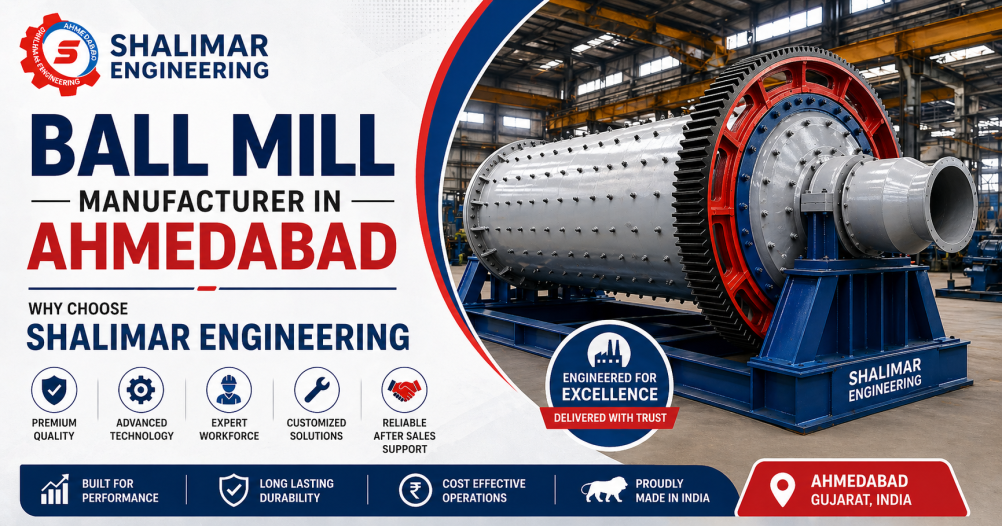
When industries across India and the world search for a reliable ball mill manufacturer in Ahmedabad, one name consistently appears at the top Shalimar Engineering. With over 20 years of manufacturing experience, a state-of-the-art production facility in Ahmedabad, and an active export network spanning 30+ countries, Shalimar Engineering has built a well-earned reputation as India’s most trusted ball mill manufacturer and exporter.
This guide explains what makes Shalimar Engineering the preferred choice for cement plants, mining companies, chemical manufacturers, pharmaceutical producers, and ceramic industries across India and worldwide and why Ahmedabad has become a hub for high-quality ball mill manufacturing.
Why Ahmedabad is a Hub for Ball Mill Manufacturing in India
Ahmedabad, Gujarat is one of India’s most important industrial manufacturing centers particularly for processing equipment, chemical machinery, and mineral processing equipment. Several factors make Ahmedabad the right location for a ball mill manufacturer in India:
Raw material availability: Gujarat has excellent access to high-grade steel, alloy materials, and precision components through its well-developed industrial supply chain, enabling manufacturers to source quality materials at competitive costs.
Engineering talent: Ahmedabad has a strong base of mechanical and process engineers with deep experience in designing industrial grinding equipment.
Port connectivity: Proximity to Kandla Port, Mundra Port, and JNPT gives Ahmedabad-based manufacturers a significant logistical advantage for export — allowing faster, more cost-effective shipment to international clients in the Middle East, Africa, Southeast Asia, and beyond.
Industrial cluster: Gujarat’s GIDC industrial estates provide world-class manufacturing infrastructure, enabling Ahmedabad manufacturers to produce heavy industrial equipment at scale.
These advantages are why Shalimar Engineering as a leading ball mill manufacturer in Ahmedabad is able to offer internationally competitive quality and pricing with faster delivery timelines than manufacturers in many other Indian states.
About Shalimar Engineering Ball Mill Manufacturer in Ahmedabad
Shalimar Engineering is headquartered in Ahmedabad, Gujarat, with its manufacturing facility at Plot No. 31, Tirth Bhumi Industrial Estate, Bakrol Village, Daskroi, Ahmedabad. The company has been manufacturing and exporting industrial grinding equipment, drying systems, material handling equipment, and complete processing plants for over two decades.
As a ball mill manufacturer and exporter, Shalimar Engineering serves industries including cement, mining, chemicals, pharmaceuticals, ceramics, paint, pigments, fertilizers, and food processing — with clients spread across India and 30+ countries in the Middle East, Southeast Asia, Africa, and South Asia.
The company’s manufacturing philosophy centers on three core principles: precision engineering, high-grade material selection, and full customization to match each client’s specific process requirements. No two ball mills from Shalimar Engineering are identical — every machine is designed and built for its intended application.
Types of Ball Mills Manufactured by Shalimar Engineering in Ahmedabad
Continuous Ball Mill
A continuous ball mill is designed for large-scale, uninterrupted grinding operations where material is continuously fed at one end and discharged at the other. This is the standard choice for cement plants, mineral processing facilities, and large-scale chemical plants that require consistent high-throughput grinding around the clock.
Capacity range: 1 TPH to 25 TPH and above (custom). These mills are engineered for long continuous run hours with minimal maintenance downtime.
Batch Ball Mill
A batch ball mill operates in cycles — material is loaded, ground to the required fineness, and then discharged before the next batch begins. It is the preferred choice for research and development, pilot-scale trials, small production quantities, and multi-product facilities that require frequent material changeovers between grinding runs.
Cement Grinding Ball Mill
The cement grinding ball mill is specifically engineered for the cement manufacturing industry. It grinds clinker, gypsum, limestone, and fly ash into fine cement powder at high throughput. These mills are built for continuous heavy-duty operation under the extreme abrasion conditions of cement grinding, with hardened liners and robust drive systems.
Iron Ore Crushing Ball Mill
The iron ore crushing ball mill handles the grinding of iron ore, hard minerals, and other abrasive ores used in mining, steel manufacturing, and mineral beneficiation. Heavy-duty construction with high-hardness grinding media and manganese steel liners ensures long service life in demanding mining applications.
Sand Grinding Ball Mill
The sand grinding ball mill is used for wet grinding of silica sand, quartz, and similar materials for the glass, foundry, construction, and ceramic industries. The wet grinding process produces uniform particle size slurry directly usable in downstream processes.
Ball Mill with Micronizing Plant
The ball mill with micronizing plant combines coarse ball mill grinding with air classification to produce ultra-fine powder at micron-level particle sizes (200 to 400 mesh and finer). This advanced system is used in pharmaceutical API grinding, specialty chemical production, and high-purity mineral powder manufacturing.
Ball Mill Working Principle and Key Components
The ball mill working principle is based on impact and attrition. A cylindrical shell partially filled with grinding media steel balls, ceramic balls, or flint pebbles rotates about its axis. As the shell rotates, the balls are lifted along the inside wall and then cascade down, striking the material at the base and grinding it through repeated impact and abrasive contact between balls and material.
The grinding efficiency depends on the rotation speed (optimally 65–75% of critical speed), the size and filling level of the grinding media, the diameter-to-length ratio of the drum, and the physical properties of the feed material.
Material exits the mill through a screen or overflow discharge at the end of the drum. In a continuous ball mill, new feed enters as ground material exits, maintaining steady-state operation. In a batch ball mill, all material is loaded at the start and discharged when the target fineness is reached.
Key Components:
- Cylindrical Shell heavy-duty MS or SS construction with replaceable lining
- Grinding Media forged steel balls, ceramic balls, or flint pebbles selected by material and application
- Lining Material rubber, manganese steel, ceramic, or alumina lining to protect the shell and control grinding efficiency
- Drive System gear drive, direct drive, or chain drive motor and gearbox
- Discharge System overflow, grate, or screen discharge based on required product fineness
Ball Mill Technical Specifications Shalimar Engineering
| Parameter | Details |
|---|---|
| Capacity | 50 kg/hr to 50,000 kg/hr (customizable) |
| Drum Material | Mild Steel / SS304 / SS316 |
| Lining Options | Rubber / Steel / Ceramic / Alumina |
| Drive Type | Gear Drive / Direct Drive / Chain Drive |
| Operation Mode | Batch or Continuous |
| Grinding Media | Forged Steel / Ceramic / Flint Pebbles |
| Critical Speed | 65–75% of critical speed |
| Output Fineness | 200 mesh to 325 mesh (customizable) |
| Grinding Mode | Dry Grinding or Wet Grinding |
All specifications are fully customizable. As a custom ball mill manufacturer, Shalimar Engineering designs and builds every machine based on the client’s material type, required output fineness, production capacity, and operating conditions.
Industries Shalimar Engineering Serves from Ahmedabad
Shalimar Engineering’s ball mills manufactured in Ahmedabad serve a wide range of industries across India and internationally:
Cement Industry Grinding clinker, limestone, and gypsum in cement plants across India and the Middle East. The ball mill for cement industry is one of the company’s most exported products.
Mining and Mineral Processing Iron ore, bauxite, copper ore, limestone, and other mineral grinding for beneficiation and processing plants in India, Africa, and Southeast Asia.
Chemical Industry Fine powder production of pigments, dyes, titanium dioxide, calcium carbonate, and other industrial chemicals. The ball mill for chemical industry is a standard machine in chemical processing plants.
Pharmaceutical Industry Grinding of APIs, excipients, and herbal extracts to precise micron-level fineness standards.
Ceramic Industry Grinding feldspar, quartz, kaolin, and other ceramic body materials for tile, sanitaryware, and refractory product manufacturing.
Paint and Pigment Industry Ultra-fine grinding of pigments and fillers for high-quality coating formulations.
Fertilizer Industry Grinding limestone, phosphate rock, and other minerals used in fertilizer production.
Why Choose Shalimar Engineering as Your Ball Mill Manufacturer in Ahmedabad
There are several ball mill manufacturers in India, but Shalimar Engineering stands apart for a combination of reasons that directly benefit buyers:
20+ Years of Manufacturing Experience
Shalimar Engineering has been designing and manufacturing industrial ball mills for over two decades. This depth of experience means every machine benefits from years of real-world process knowledge, application-specific design refinements, and proven reliability across diverse industries.
Complete In-House Manufacturing
The entire ball mill from shell fabrication and lining installation to drive system assembly and testing is manufactured at Shalimar Engineering’s Ahmedabad facility. In-house manufacturing ensures quality control at every stage and eliminates subcontracting delays.
Every Machine is Custom Engineered
Shalimar Engineering does not sell standard, off-the-shelf ball mills. Every custom ball mill is designed after evaluating the client’s material properties, feed size, required output fineness, production capacity, and plant layout. This ensures optimal grinding performance from day one.
High-Grade Materials and Precision Engineering
All ball mills are manufactured using high-grade MS or SS materials, precision-machined components, and branded bearings and drives. Premium construction materials directly translate to long equipment life and reduced operating costs for the client.
Ahmedabad Location Advantage
Being based in Ahmedabad gives clients from across Gujarat, Rajasthan, Maharashtra, and other Indian states easy access to the manufacturing facility for site visits, inspections, and technical consultations. For export clients, proximity to Gujarat’s ports means faster, more cost-effective international shipping.
Active Global Export Network
As a trusted ball mill exporter in India, Shalimar Engineering has shipped machines to UAE, Saudi Arabia, Oman, Qatar, Bahrain, Kuwait, Iran, Iraq, Bangladesh, Malaysia, Indonesia, South Korea, Turkey, Israel, Jordan, Pakistan, Philippines, and more. Export-ready packaging, documentation, and after-sales support are standard for every international order.
Complete After-Sales Support
From installation supervision and operator training to spare parts supply and maintenance guidance Shalimar Engineering provides full lifecycle support for every ball mill supplied, whether installed in India or abroad.
Competitive Direct Manufacturer Pricing
As a direct manufacturer with no intermediaries, Shalimar Engineering offers the most competitive pricing for ball mills in India without compromising on engineering quality, material grade, or after-sales support.
Dry Grinding Ball Mill vs Wet Grinding Ball Mill Which Do You Need
One of the most common questions from buyers is whether they need a dry grinding ball mill or a wet grinding ball mill. Here is a clear guide:
Dry Grinding Ball Mill Used when the output must be a dry powder. Hot air or ambient air is used to carry out the ground powder from the mill. Used in cement grinding, mineral grinding, and chemical powder production where a dry product is required.
Wet Grinding Ball Mill Used when the output is a slurry — water or another liquid is added to the mill along with the feed material, and the ground material exits as a liquid slurry. Used in sand grinding, ceramic body preparation, and mineral processing where the slurry feeds a downstream wet process.
The choice between dry and wet grinding depends entirely on your downstream process requirements. Shalimar Engineering’s engineers evaluate this during the project consultation phase to recommend the correct configuration.
Frequently Asked Questions
Q1. Why should I choose a ball mill manufacturer in Ahmedabad over other cities?
Ahmedabad has excellent steel and component supply chains, strong engineering talent, world-class industrial manufacturing infrastructure, and strategic port connectivity for export. These factors allow ball mill manufacturers in Ahmedabad like Shalimar Engineering to offer internationally competitive quality, pricing, and delivery timelines compared to manufacturers in many other locations.
Q2. Does Shalimar Engineering manufacture custom ball mills?
Yes. Every ball mill from Shalimar Engineering is custom-engineered based on the client’s material, required output fineness, production capacity, and operating conditions. The company does not supply standard off-the-shelf machines — every unit is designed specifically for its application.
Q3. What is the ball mill capacity range available from Shalimar Engineering?
Shalimar Engineering manufactures ball mills with capacities from 50 kg/hr for small batch and laboratory applications to 50,000 kg/hr and above for large industrial and cement plant applications. Custom capacities are engineered as needed.
Q4. Does Shalimar Engineering export ball mills from Ahmedabad?
Yes. Shalimar Engineering is an active ball mill exporter in India with shipments to 30+ countries across the Middle East, Southeast Asia, Africa, and South Asia. International orders include export-grade packaging, technical documentation, and after-sales support.
Q5. What types of grinding media does Shalimar Engineering use in its ball mills?
Shalimar Engineering uses forged steel balls, stainless steel balls, ceramic balls, alumina balls, and flint pebbles depending on the material being ground and contamination control requirements. The grinding media type is selected during the engineering phase based on material hardness and product purity requirements.
Q6. Can I visit Shalimar Engineering’s manufacturing facility in Ahmedabad?
Yes. Shalimar Engineering welcomes client visits to its Ahmedabad manufacturing facility for project consultations, equipment inspections, and factory acceptance testing. The factory is located at Plot No. 31, Tirth Bhumi Industrial Estate, Bakrol, Daskroi, Ahmedabad.
Q7. What is the difference between a continuous ball mill and a batch ball mill?
A continuous ball mill feeds and discharges material simultaneously without stopping ideal for large-scale, high-throughput production. A batch ball mill loads, grinds, and discharges in separate cycles ideal for small quantities, pilot production, and multi-product facilities requiring frequent product changeovers.
Q8. Does Shalimar Engineering provide installation and commissioning support?
Yes. Shalimar Engineering provides complete installation supervision, operator training, and commissioning support for all ball mills supplied both for Indian clients and international export orders.
Contact Shalimar Engineering — Ball Mill Manufacturer in Ahmedabad
If you are looking for a trusted ball mill manufacturer in Ahmedabad for your cement, mining, chemical, pharmaceutical, ceramic, or mineral processing application Shalimar Engineering is ready to engineer the right solution for you.
With 20+ years of manufacturing experience, complete in-house production, global export capability, and full after-sales support, Shalimar Engineering is the partner you can rely on for your ball mill requirements.
Send an Enquiry Now and our engineering team will respond with a detailed technical proposal and competitive quote within 24 hours.