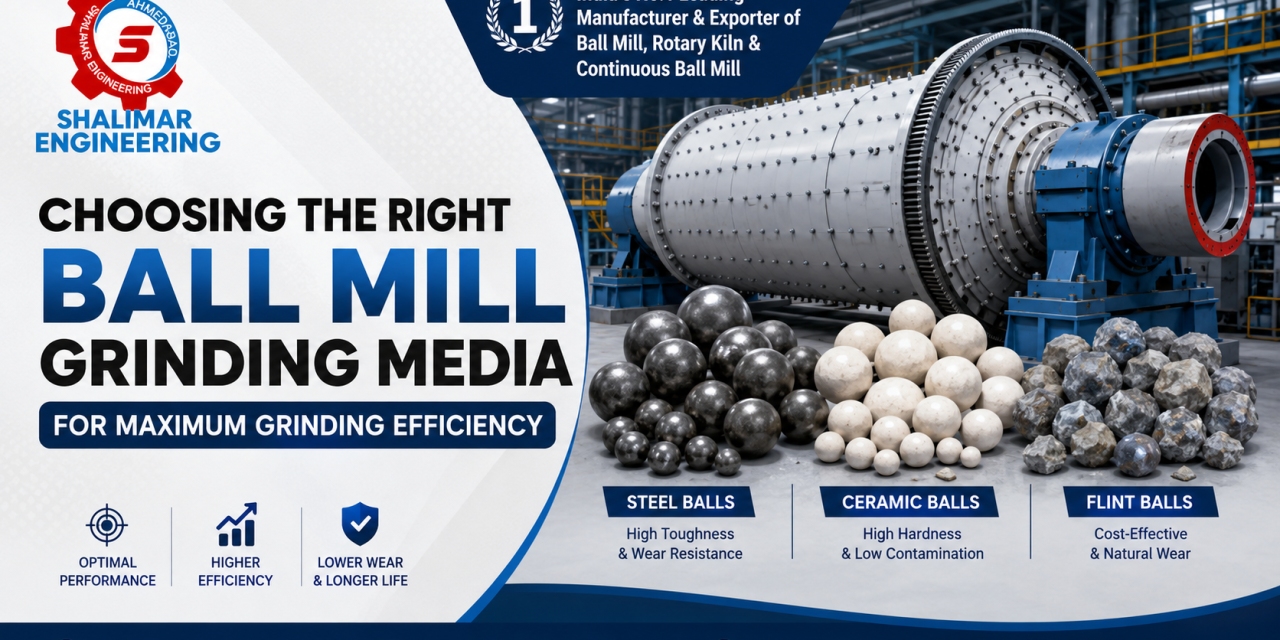
Choosing the Right Ball Mill Grinding Media for Maximum Grinding Efficiency
Grinding media is the single most important consumable in any ball mill operation. Yet it is also the variable that receives the least structured attention during equipment setup. Most plant managers inherit whatever media type was already in use, and very few conduct a systematic review of whether that choice actually fits their material, their output targets, or their cost structure.
This guide gives you the complete picture. By the time you finish reading, you will know exactly which grinding media type suits your application, why it matters, and what happens when the wrong choice stays in your mill too long.
What Is Ball Mill Grinding Media and Why Does It Matter So Much?
Grinding media refers to the hard, dense objects loaded inside a ball mill that do the actual work of size reduction. As the mill rotates, these objects cascade and tumble, creating impact and attrition forces that break down feed material into progressively finer particles.
The media type you use determines:
- Grinding efficiency — how quickly and uniformly the material reduces
- Final particle size — whether you reach your target micron range consistently
- Contamination risk — whether trace elements from the media enter your product
- Energy consumption — how much power your mill draws to achieve a given output
- Media wear rate — how often you top up or replace the charge, and at what cost
These five variables interact with each other. A media type that produces fast grinding may also introduce contamination. One that keeps wear low may grind unevenly. The right choice balances all five against the specific demands of your process.
To understand how media interacts with mill mechanics at a deeper level, the guide on ball mill working principles and types provides useful foundational context before going further into media selection.
The Three Primary Types of Ball Mill Grinding Media
Steel Grinding Media — High Impact, High Throughput
Steel grinding balls are the most widely used media type across industrial ball mill applications. They come in forged steel, cast steel, and high-chrome cast iron variants, each offering a different balance of hardness, toughness, and wear resistance.
Forged steel balls are manufactured by heating and hammering steel billets into shape. The forging process produces a uniform grain structure, high surface hardness, and excellent impact toughness. They are the preferred choice for hard, abrasive materials like iron ore, coal, and clinker.
Cast steel balls are formed by pouring molten steel into spherical moulds. While generally less impact-resistant than forged balls, they are more economical to produce and suitable for moderately abrasive materials at medium grinding intensities.
High-chrome cast iron balls contain between 10% and 30% chromium, which creates a hard carbide structure throughout the ball. They offer exceptional wear resistance, making them cost-effective over long production runs despite higher unit prices. High-chrome media is widely used in cement plants, mineral processing operations, and chemical grinding applications where wear costs dominate the economics.
When to choose steel media:
- Processing hard minerals (iron ore, quartz, limestone, clinker)
- High-throughput continuous grinding operations
- Applications where contamination with small amounts of iron is acceptable or irrelevant
- Cement and construction material grinding where high impact energy is required
When steel media is the wrong choice:
- Processing white pigments, titanium dioxide, or other products where iron contamination causes visible discoloration
- Food-grade or pharmaceutical grinding where metal trace elements are prohibited
- Applications requiring ultra-clean grinding environments
For facilities running a Cement Grinding Ball Mill, high-chrome steel balls are almost universally the correct media choice due to the abrasive nature of clinker and the high throughput demands of cement production.
Ceramic Grinding Media — Purity, Precision, and Contamination-Free Output
Ceramic grinding media encompasses several material variants, including alumina (Al₂O₃), zirconia (ZrO₂), silicon nitride, and mixed-oxide compositions. Each variant offers different hardness, density, and wear characteristics, but all share the fundamental advantage of producing contamination-free grinding output.
Alumina ceramic balls (typically 92% to 99% Al₂O₃ content) are the most commonly used ceramic media type. They combine moderate density with good hardness and extremely low iron contamination output, making them suitable for white pigments, food ingredients, pharmaceutical excipients, and high-purity specialty chemicals.
Zirconia ceramic balls offer higher density than alumina (approximately 6.0 g/cm³ vs 3.6 g/cm³ for alumina), which translates to greater grinding energy per ball at the same mill speed. They are the preferred choice when you need fine grinding with minimal contamination and where budget allows for the higher unit cost of zirconia media.
Silicon carbide and silicon nitride media represent specialty options for extreme wear resistance and chemical inertness. These are used in semiconductor materials processing, advanced ceramics production, and highly corrosive chemical environments where even trace amounts of contamination are unacceptable.
When to choose ceramic media:
- Grinding white pigments, titanium dioxide, calcium carbonate for coatings
- Processing food-grade materials, spices, or nutraceuticals
- Pharmaceutical active ingredient grinding under GMP conditions
- Any application where product purity specifications prohibit metal contamination
- Fine to ultra-fine grinding targets below 10 microns
When ceramic media is the wrong choice:
- High-impact applications involving hard, coarse feed material that would fracture ceramic balls
- Applications requiring the density advantage of steel for efficient coarse grinding
- Cost-sensitive operations where ceramic unit prices cannot be justified by product value
If you are running a Ball Mill With Micronizing Plant setup aimed at ultra-fine output for specialty chemicals or high-purity minerals, ceramic media — particularly alumina or zirconia — is almost always the right specification.
Flint Pebbles and Natural Stone Media — Traditional, Clean, and Gentle
Flint pebbles are one of the oldest forms of grinding media still in active industrial use. Sourced from natural flint deposits (primarily in Denmark, France, and Belgium), they offer a unique combination of hardness, low contamination output, and gentle grinding action that no synthetic alternative fully replicates.
Flint has a Mohs hardness of approximately 7, making it hard enough to grind most soft to medium-hard materials while being softer than most minerals it processes — which minimizes contamination of the ground product with media wear particles.
Key characteristics of flint pebble media:
- Near-zero iron contamination (natural silica composition)
- Smooth, irregular surface that produces a characteristic grinding action different from spherical balls
- Self-sharpening wear pattern — as flint erodes, it maintains irregular edges that continue grinding effectively
- Lower density than steel or alumina (approximately 2.6 g/cm³), requiring larger media charges to achieve comparable impact energy
When to choose flint pebbles:
- Traditional ceramics and porcelain body grinding where contamination from synthetic media could affect fired color
- Glaze and slip grinding in fine ceramics production
- Processing materials where the natural silica composition of flint is compatible with the product
- Small to mid-scale operations processing soft materials to moderate fineness
When flint pebbles are the wrong choice:
- High-throughput operations where flint’s lower density reduces grinding efficiency
- Hard mineral processing where flint would wear rapidly and generate excessive silica contamination
- Applications requiring precisely spherical media for predictable mill dynamics
Flint media is also increasingly rare and subject to supply variability, which is a practical consideration for operations that need assured media availability for continuous production.
Need the Right Industrial Machinery for Your Process?
Whether you’re planning a new plant or upgrading existing equipment, Shalimar Engineering provides reliable machinery and technical guidance tailored to your production requirements.
How to Match Grinding Media to Your Specific Application
The right media type is never a generic answer — it is the result of matching media properties to four specific process variables. Work through each one before making a decision.
Variable 1 — Feed Material Hardness
Use the Mohs hardness scale as your first filter:
- Mohs 1 to 3 (talc, gypsum, coal): Flint or low-density alumina ceramic is sufficient. Steel would be overkill and may cause unnecessary wear or size reduction instability.
- Mohs 3 to 6 (limestone, calcium carbonate, feldspar, barite): Alumina ceramic or cast steel, depending on contamination requirements.
- Mohs 6 to 9 (quartz, iron ore, alumina, silicon carbide): Forged steel or high-chrome steel for standard applications; zirconia ceramic for contamination-sensitive applications.
- Mohs above 9: Specialty media such as tungsten carbide balls for laboratory or pharmaceutical processing. Industrial scale processing of ultra-hard materials typically uses steel with engineered mill liners.
Variable 2 — Product Purity Requirements
This is the contamination question. Ask yourself: if my grinding media wears by 0.1% per tonne of product processed, what does that 0.1% contamination look like in my final product?
For iron-sensitive products (white pigments, food ingredients, pharmaceuticals, electronics materials): ceramic media is mandatory regardless of cost premium.
For iron-tolerant products (cement, coal, iron ore, construction aggregates): steel media is appropriate and economically optimal.
For products sensitive to silica contamination but tolerant of alumina: specify alumina ceramic media and avoid flint.
Variable 3 — Target Particle Size
Grinding media size affects the finest particle achievable in a given mill. Smaller media produces finer output through more frequent, lower-energy contact events. Larger media produces coarser output through fewer, higher-energy impacts.
General sizing guidance:
- Coarse grinding (500 microns to 2mm output): 50 to 100mm diameter steel or high-chrome balls
- Medium grinding (50 to 500 microns): 25 to 50mm steel or alumina ceramic balls
- Fine grinding (10 to 50 microns): 10 to 25mm alumina or zirconia ceramic balls
- Ultra-fine grinding (below 10 microns): 1 to 10mm zirconia or silicon nitride beads in stirred or agitated mills
For context on how ultra-fine grinding equipment pairs with media selection, the Ball Mill With Micronizing Plant configuration is specifically designed for fine-to-ultra-fine output ranges where smaller ceramic media is the correct pairing.
Variable 4 — Economic Constraints and Wear Cost
Media selection has a total cost of ownership calculation that goes beyond unit price:
Media wear rate determines how often you replenish the charge. Steel wears faster than high-chrome, which wears faster than ceramic. But ceramic costs significantly more per kilogram. The crossover point depends on throughput volume and product value.
Liner wear interaction must also be considered. Harder media wears liners faster. If you switch from standard steel to high-chrome balls without reassessing liner material, you may reduce media costs while increasing liner replacement frequency.
Energy consumption varies with media density and charge weight. Dense media requires more motor energy to cascade; less dense media requires a larger volumetric charge to deliver equivalent grinding energy. Factor this into your operating cost analysis.
For a Batch Ball Mill operation where production runs are intermittent and throughput per cycle is moderate, the economic equation often favors ceramic media — the lower wear rate and contamination-free output justify the higher upfront cost over many production cycles.
Industry-Specific Grinding Media Recommendations
Cement and Construction Materials
Cement clinker is abrasive and hard (Mohs 5 to 7). High-chrome cast iron balls (18% to 30% chromium content) are the standard choice, offering the wear resistance needed for economical long-term operation. First chamber (coarse grinding) typically uses 60 to 90mm balls; second chamber (fine grinding) uses 17 to 40mm balls.
The Cement Grinding Ball Mill is engineered specifically for this application, and media sizing recommendations for cement plants are a standard part of the technical consultation process.
Mineral Processing — Silica, Feldspar, Barite, Calcium Carbonate
For white or off-white mineral products, ceramic media is the standard. High-alumina balls (92% to 99% Al₂O₃) are the workhorse of this segment. Zirconia is reserved for ultra-fine targets or exceptionally purity-sensitive products.
For coloured or non-purity-sensitive mineral grinding (iron ore, coal, manganese), forged or high-chrome steel is both effective and economical. If you are processing a range of minerals across your Minerals Chemicals Grinding Equipments line, segmenting your mills by product type — dedicated ceramic-media mills for white/purity-sensitive materials and steel-media mills for hard minerals — is the most practical operational structure.
Sand Grinding and Silica Processing
Sand and silica grinding presents an interesting media selection challenge. Silica is Mohs 7 — hard enough to cause significant steel wear, yet the product itself is silica, meaning silica contamination from flint pebbles is irrelevant. Steel media is commonly used for industrial sand processing, though high-chrome is preferred for long-run economics.
For fine silica products used in specialty glass, electronics, or photovoltaics, ceramic media ensures that trace metal contamination does not affect optical or electrical performance of the end product.
The Sand Grinding Ball Mill is configured for the specific demands of silica processing, and media selection guidance is part of the specification package provided to buyers.
Chemical and Pharmaceutical Processing
Pharmaceutical and specialty chemical applications require not just contamination-free media but also validated cleaning protocols, wear particle tracking, and sometimes regulatory documentation for the media itself.
Zirconia (yttria-stabilized) is the gold standard for pharmaceutical grinding media. It combines exceptional wear resistance with chemical inertness, minimizing the risk of wear-particle accumulation across production batches.
For industrial chemical processing — pigments, dyes, agrochemical intermediates — high-alumina ceramic media is typically sufficient and more cost-effective than zirconia.
Iron Ore and Hard Rock Minerals
Iron ore, copper ore, gold ore, and similar hard rock minerals are processed with steel media almost universally. The contamination concern is irrelevant (iron ore already contains iron), and the hardness and abrasiveness of the material demands the impact toughness and density that only steel provides.
For iron ore processing context, the iron ore pelletizing plant technology guide explains how upstream grinding feeds downstream pelletizing processes — which helps clarify the particle size targets that should guide media selection for ore processing operations.
Common Mistakes in Grinding Media Selection and How to Avoid Them
Mistake 1 — Choosing based on price per kilogram alone The cheapest media per kilogram is rarely the cheapest option per tonne of product processed. Always calculate total cost of ownership including wear rate, energy consumption, and any contamination-related product losses.
Mistake 2 — Using oversized media for fine grinding targets Large balls generate high-energy impacts suited to coarse reduction. For fine grinding, they create too few contact events per unit time and result in poor efficiency and uneven size distribution. Match ball diameter to your target particle size range.
Mistake 3 — Mixing media types in the same mill without understanding the interaction Some facilities mix media types to approximate a size distribution. This is sometimes effective but can also create unpredictable wear patterns and contamination mixing. Any blended media charge should be deliberately specified, not assembled from leftover stock.
Mistake 4 — Ignoring mill liner compatibility Harder media accelerates liner wear. If you upgrade from standard steel to high-chrome balls, revisit your liner specification at the same time.
Mistake 5 — Not reviewing media performance periodically Media wear is not linear — balls lose efficiency as they reduce in diameter. Establish a regular charge monitoring and top-up schedule based on mill throughput rather than waiting for visible performance degradation.
A Practical Decision Framework for Selecting Your Grinding Media
Use this structured checklist before finalizing your media specification:
- What is the Mohs hardness of my feed material?
- What particle size (D50/D90) does my downstream process require?
- Does my product have iron contamination limits? If yes, what is the threshold?
- What throughput (tonnes per hour or per batch) does my operation run?
- What is my annual media budget, and do I have flexibility for a higher-cost, lower-wear option?
- What mill type am I using — continuous overflow, batch, or closed-circuit?
- What liner material is currently in my mill?
With clear answers to these seven questions, you can apply the guidance in this article to arrive at a well-supported media specification. If you are unsure about any variable, test data from a material trial on a correctly configured Ball Mill setup is more reliable than any theoretical calculation.
You can also review the full range of grinding solutions available at our industrial equipment to understand how media selection integrates with mill design and configuration choices.
Grinding Media for the 3 Roller Mill Plant — A Brief Note
It is worth clarifying that the 3 Roller Mill Plant does not use ball-type grinding media. Roller mills achieve size reduction through direct compressive contact between rollers and the feed material, not through the cascading impact of media balls. If your grinding process uses a roller mill configuration, the media selection principles in this article do not apply directly. They are specific to tumbling ball mill operations where a media charge is required.
Final Thoughts — Get the Media Right Before You Get the Mill Running
Grinding media selection is not a detail to defer until after your mill is commissioned. The media type shapes everything from your liner design to your product purity specification to your energy budget. Getting it right at the outset saves you from the expensive cycle of retrofitting, retesting, and relining that poorly specified mills eventually require.
Take the time to apply the framework here. Cross-reference it against your actual material and output requirements. And if you are working with a new mill installation or evaluating a media change for an existing operation, bring your supplier into the conversation with specific process data rather than general descriptions.
The more precise your inputs, the more accurate and useful the guidance you will receive back.
Need Help Specifying the Right Grinding Media for Your Ball Mill?
Our engineering team works with mineral processors, chemical manufacturers, and construction material producers to match the right media configuration to each specific grinding operation. Whether you are setting up a new mill or reviewing performance on an existing installation, we are ready to help with technical detail and competitive equipment pricing.
Talk to our technical team and get media and mill recommendations grounded in your actual process requirements.