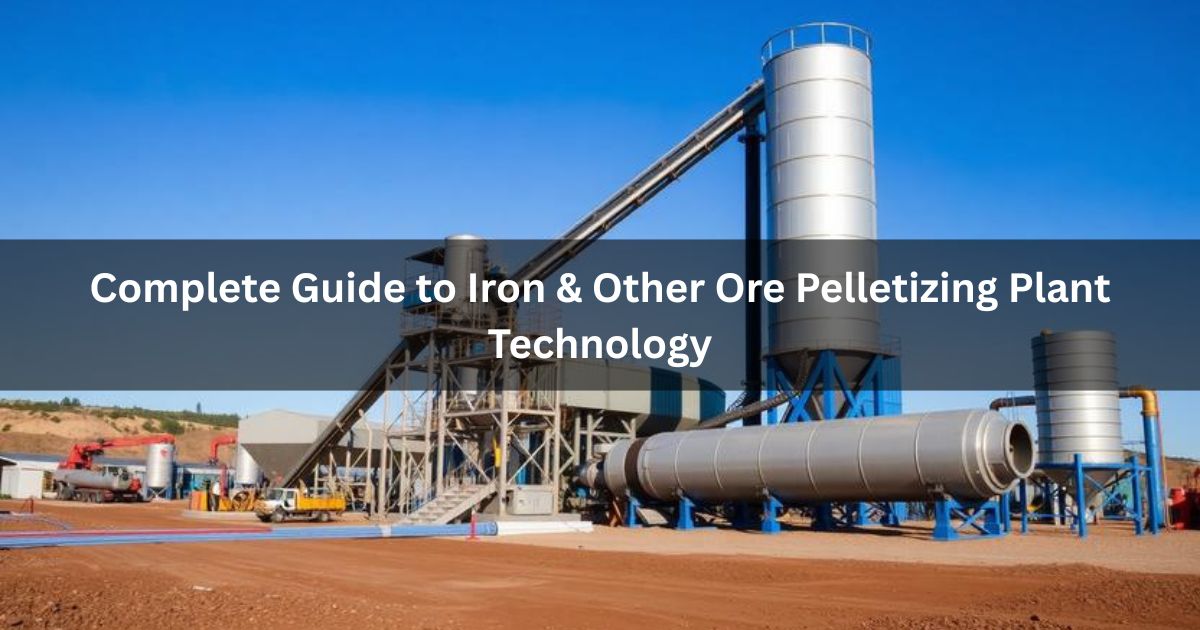
Complete Guide to Iron & Other Ore Pelletizing Plant Technology
The steel industry’s appetite for high-grade iron ore feedstock has transformed how mining operations process raw minerals. Shalimar Engineering has observed that modern steel plants consistently achieve better productivity and lower emissions when using pelletized ore rather than lump ore or sinter. This performance advantage has made iron ore pelletizing plant technology central to integrated steel production worldwide.
Pelletizing converts fine iron ore concentrate into uniform, high-strength spherical pellets typically 8-16mm in diameter. These pellets provide superior permeability in blast furnaces, consistent chemical composition, and handling characteristics that reduce material degradation.
Beyond iron ore, the same pelletizing plant technology processes manganese, chromite, nickel, and other mineral concentrates where particle size and strength matter for downstream metallurgical applications.
What is an Iron & Other Ore Pelletizing Plant?
An iron ore pelletizing plant agglomerates fine mineral concentrate into spherical pellets through mixing, balling, and thermal hardening. The core purpose is converting powdered ore into physically robust, chemically uniform pellets that metallurgical furnaces can process efficiently.
Fine concentrate is mixed with binder (typically bentonite), moistened, and tumbled in rotating disc or drum pelletizers that form green pellets. These soft pellets then undergo induration high-temperature thermal treatment that hardens them into durable spheres capable of withstanding handling, transportation, and furnace charging.
Beyond iron ore, the technology processes manganese ore for ferromanganese production, chromite for ferrochrome manufacturing, nickel laterite for nickel production, and specialty minerals where controlled particle size determines downstream process efficiency.
Why Pelletizing Technology is Important in Modern Mining
Steel demand continues growing globally, and meeting this demand efficiently requires maximizing furnace productivity while minimizing environmental impact. Pelletized ore delivers both objectives. Blast furnaces charged with pellets achieve 10-15% higher productivity through improved gas permeability and faster reduction kinetics.
Environmental benefits extend beyond efficiency. Pellets generate less dust during handling, reducing fugitive emissions. Modern pellet plants capture and treat exhaust gases more effectively than sintering operations, lowering particulate and sulfur dioxide emissions.
Transportation economics favor pellets, significantly uniform size prevents segregation, and pellets maintain strength through rail, ship, and stockyard handling.
Key Components of an Iron & Other Ore Pelletizing Plant
2026/01/26 at 11:38 am Raw Material Handling System
The pelletizing process begins with ore preparation where concentrates from beneficiation plants undergo final sizing adjustment. Crushing equipment reduces any oversize particles, grinding systems achieve target particle size distribution, and screening units separate material into size fractions optimized for pellet formation. Proper sizing is critical; particles too coarse won’t bond effectively; particles too fine create excess surface area requiring more binder and energy during induration.
Mixing and Balling Equipment
Disc pelletizers and drum pelletizers are the primary balling devices where fine ore, binder, and moisture combine to form green pellets. Disc pelletizer inclined rotating pans offer excellent size control and the ability to recycle undersize pellets continuously. Drum pelletizers rotating cylinders handle higher capacities but with less precise size control.
The choice depends on plant capacity requirements, desired pellet size distribution, and ore characteristics. Both systems rely on careful moisture and binder addition to achieve optimal green pellet strength before thermal hardening.
Induration Furnace
The induration furnace is the heart of any pelletizing plant, where green pellets undergo controlled thermal treatment that transforms weak agglomerates into extremely hard, durable pellets. Modern plants employ grate-kiln systems, straight grate technology, or traveling grate configurations each offering different advantages in energy efficiency, pellet quality, and operational flexibility.
Temperatures reach 1200-1350°C during firing, driving off moisture, oxidizing magnetite to hematite, and creating ceramic-like bonds between particles that give finished pellets their characteristic strength.
Cooling System
Pellets exiting the induration furnace at elevated temperatures must be cooled before handling and storage. Cooling systems use ambient air, sometimes with heat recovery to preheat combustion air for the induration furnace improving overall plant thermal efficiency. Controlled cooling rates prevent thermal shock that could crack pellets, ensuring the product maintains strength through subsequent handling.
Pellet Screening and Storage
Finished pellets undergo screening to separate product-size material from oversize and undersize fractions. Oversize pellets are crushed and recycled; undersize material returns to the balling circuit. Product pellets flow to storage facilities designed for efficient loading into rail cars, ships, or trucks for delivery to steel plants. Material handling systems throughout the plant must minimize pellet degradation that would reduce furnace performance at customer facilities.
Step-by-Step Pelletizing Process
The ore pelletizing process transforms fine concentrate into metallurgical feedstock through systematic stages. Crushing and grinding prepare raw concentrate to target particle size. Mixing with binders follows, where bentonite or organic binders blend with ore concentrate.
The balling process in rotating disc or drum pelletizers agglomerates particles into 8-16mm green pellets. Induration provides controlled thermal treatment, drying removes moisture, firing at peak temperature creates ceramic bonds, and cooling returns pellets to ambient temperature. Finally, screening separates finished product from off-spec material.
Types of Pelletizing Technologies Used in Plants
Straight grate technology processes pellets entirely on a continuous traveling grate that moves through drying, preheating, firing, and cooling zones in sequence. This configuration offers simplicity and lower capital cost but typically consumes more energy than alternative designs.
Grate-kiln technology combines a traveling grate for drying and preheating with a rotary kiln for high-temperature firing, achieving better thermal efficiency and producing higher-strength pellets. The grate-kiln configuration dominates modern large-scale pellet plants due to superior energy economics and product quality.
Types of Ores Used in Pelletizing Plants
While iron ore represents the largest application by volume, pelletizing plant technology processes various mineral concentrates. Manganese ore pelletizing supports ferromanganese production for steel alloying. Chromite pellets feed ferrochrome furnaces producing stainless steel inputs. Nickel laterite pelletizing enables hydrometallurgical nickel extraction.
Even bauxite undergoes pelletizing in certain alumina production routes. Each mineral requires process parameter adjustments, induration temperatures, binder selection, atmosphere control but the fundamental technology remains consistent across applications.
Advantages of Using Iron & Other Ore Pelletizing Plants
Blast furnace productivity increases 10-15% when using pellets versus sinter. Raw material waste decreases because pelletizing converts fine concentrate into usable feedstock. Ore quality improves through controlled chemistry and consistent physical properties. Transportation costs drop because pellets don’t generate handling fines. Environmental compliance becomes more manageable with modern emission controls.
Latest Innovations in Pelletizing Plant Technology
Automation transforms operations through advanced process control optimizing binder addition, moisture control, and induration temperatures in real-time. AI-based monitoring predicts equipment maintenance needs and optimizes energy consumption. Energy-efficient furnace designs recover waste heat more effectively. Low-emission technologies including improved dust collection help plants meet environmental standards while maintaining productivity.
Conclusion
Iron & other ore pelletizing plant technology has become indispensable for modern steel production and mineral processing. The ability to convert fine ore concentrates into high-quality, uniform pellets enables efficient furnace operation, reduces environmental impact, and improves raw material utilization across the metallurgical industry.
As steel demand continues growing and environmental standards tighten, pelletizing technology’s advantages, higher productivity, lower emissions, better resource efficiency position it as the preferred agglomeration method for the industry’s future.
Shalimar Engineering provides complete iron ore pelletizing plant solutions and mineral processing equipment for operations requiring proven technology, reliable performance, and long-term support. Whether upgrading existing facilities or developing new pellet production capacity, the right engineering partner ensures projects deliver the productivity and efficiency that modern metallurgical operations demand.
Frequently Asked Questions
1. What is an iron ore pelletizing plant?
A: An iron ore pelletizing plant is an industrial facility that converts fine iron ore concentrate into spherical pellets through mixing with binders, balling in rotating equipment, and high-temperature induration that hardens the pellets for blast furnace use.
2. How does the pelletizing process work?
A: The ore pelletizing process involves grinding ore to fine powder, mixing with binder, forming green pellets in disc or drum pelletizers, and hardening through high-temperature induration that creates strong ceramic bonds between particles.
3. What are the advantages of pelletized ore?
A: Pelletized ore offers higher blast furnace productivity, consistent chemical composition, better gas permeability, reduced transportation fines, and superior environmental performance compared to sinter or lump ore feedstocks.
4. Which ores can be pelletized?
A: Besides iron ore, pelletizing plant technology processes manganese, chromite, nickel, and other mineral concentrates where controlled particle size and strength benefit downstream metallurgical operations.
5. What is grate-kiln pelletizing technology?
A: Grate-kiln technology uses a traveling grate for pellet drying and preheating followed by a rotary kiln for high-temperature firing, offering superior energy efficiency and pellet quality compared to straight grate systems.