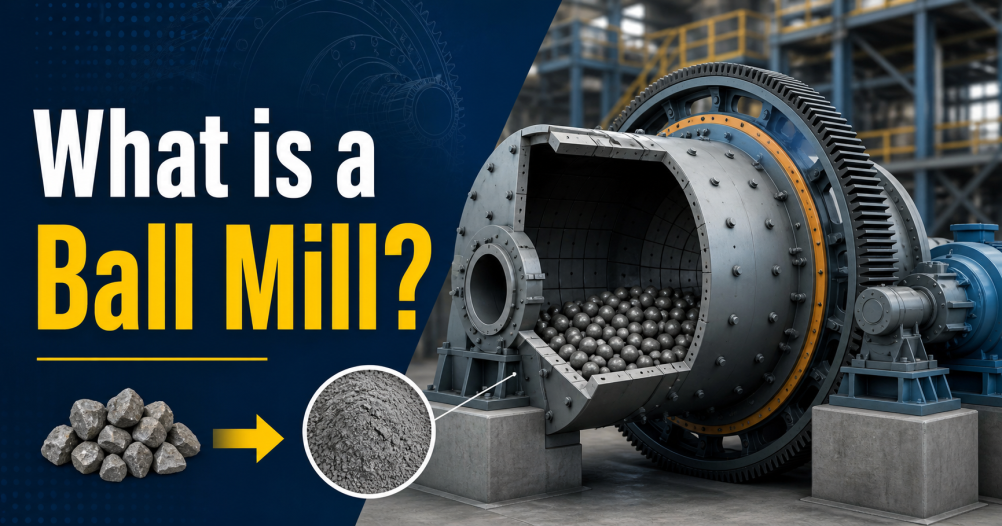
A ball mill is one of the most widely used grinding machines in industrial processing. From cement plants to pharmaceutical factories, the ball mill machine has been a core part of size reduction operations for decades. If you are looking to understand what a ball mill is, how it works, and which type suits your production needs this guide covers everything in one place.
What is a Ball Mill?
A ball mill is a cylindrical grinding machine that uses steel, ceramic, or rubber balls as grinding media to reduce material into fine powder. The cylinder rotates around a horizontal axis, and as it turns, the balls inside lift and fall crushing and grinding the material through a combination of impact and attrition.
The result is a finely ground powder that industries use in cement production, chemical processing, mineral beneficiation, paint manufacturing, and many other applications.
In simple terms: if you need to grind a solid material into a fine, consistent powder a ball mill is one of the most reliable and cost-effective machines for the job.
How Does a Ball Mill Work?
The working principle of a ball mill machine is straightforward. A hollow cylindrical shell is mounted on a horizontal axis and partially filled with grinding media balls made of steel, ceramic, alumina, or rubber depending on the application.
When the cylinder rotates, the balls are carried up along the shell wall and then cascade down under gravity, striking the material at the bottom. This repeated impact and friction breaks the material into finer particles with each rotation cycle.
Two key factors control grinding efficiency:
- Critical speed — The speed at which centrifugal force holds the balls against the wall and grinding stops. A ball mill must run at 65–75% of critical speed for effective grinding.
- Grinding media size — Larger balls are used for coarse grinding; smaller balls produce finer output particle sizes.
The ground material exits the mill through a discharge system either overflow type or grate type depending on the mill design and application.
Types of Ball Mills
Not every industry has the same grinding requirements. Shalimar Engineering, a leading ball mill manufacturer in India, designs and supplies multiple types of ball mills to match different production needs:
1. Batch Ball Mill
A batch ball mill loads material, grinds it for a set duration, and then discharges the output. It is ideal for small-scale production, R&D applications, and industries that need batch-by-batch traceability. Ceramic, pharmaceutical, and specialty chemical industries commonly use batch ball mills.
2. Continuous Ball Mill
A continuous ball mill feeds material at one end and discharges ground product at the other without stopping the machine. It is designed for high-throughput, non-stop production in industries like cement, mining, and bulk chemical processing where output consistency and productivity are critical.
3. Wet Grinding Ball Mill
In a wet grinding ball mill, water or another liquid is added to the feed material during grinding. This reduces dust, improves heat dissipation, and produces a slurry output. It is widely used for mineral processing, ore beneficiation, and paint pigment grinding.
4. Dry Grinding Ball Mill
A dry grinding ball mill processes material without any liquid addition. The fine powder is collected through a dust collection system attached to the mill. Cement, limestone, and chemical industries commonly use dry grinding ball mills.
5. Cement Grinding Ball Mill
Specifically designed for grinding clinker, limestone, slag, and fly ash in cement plants. These mills are built for high-capacity, heavy-duty operation with energy-efficient drive systems and robust construction.
6. Ball Mill with Micronizing Plant
This advanced system combines ball milling with air classification to produce micron-level particle sizes. It is used in pharmaceutical, specialty chemical, and advanced material applications where ultra-fine output is required.
Ball Mill Grinding Media — What Goes Inside?
The grinding media used inside a ball mill directly affects the output quality, contamination level, and mill wear rate. Choosing the right media is as important as choosing the right mill design.
| Grinding Media | Best For |
|---|---|
| Forged steel balls | Mining, cement, iron ore grinding |
| Stainless steel balls | Food-grade and chemical applications |
| Ceramic / alumina balls | Pharmaceutical, pigment, contamination-sensitive grinding |
| Flint pebbles | Traditional wet grinding, ceramics industry |
A reputable ball mill supplier like Shalimar Engineering will help you select the right media based on your material, required particle size, and contamination tolerance.
Industries That Use Ball Mills
The ball mill machine serves a remarkably wide range of industries. Here is where you will find ball mills at the core of production:
- Mining and mineral processing — Grinding ore, beneficiation of iron, copper, gold, and other minerals
- Cement industry — Clinker grinding, raw meal preparation, slag processing
- Chemical industry — Pigments, dyes, fertilizers, industrial chemicals
- Pharmaceutical industry — Active pharmaceutical ingredients, excipients, fine chemicals
- Ceramic industry — Feldspar, quartz, kaolin, and raw ceramic material grinding
- Paint and ink industry — Pigment dispersion and fine particle production
- Food industry — Grinding food-grade and nutraceutical materials
- Glass industry — Silica sand and glass raw material processing
This wide applicability is why ball mill manufacturers in India serve clients across so many sectors both domestically and in export markets.
Key Specifications to Check Before Buying a Ball Mill
When evaluating a ball mill for your production line, these are the specifications that matter most:
- Capacity — Measured in kg/hr or TPH. Match this to your production volume.
- Drum material — Mild steel, SS 304, or SS 316 depending on material compatibility
- Lining type — Rubber, steel, ceramic, or alumina based on abrasion and contamination needs
- Drive type — Gear drive, direct drive, or chain drive
- Output particle size — Typically 200 to 325 mesh; ultra-fine options available with micronizing attachment
- Operation mode — Batch or continuous based on your production process
- Motor power — HP rating based on capacity and material hardness
Always request a detailed technical proposal from your ball mill manufacturer with these parameters clearly specified before finalizing a purchase.
Why Ball Mills Are Still the Industry Standard
With newer grinding technologies available in the market, one question often comes up: why is the ball mill still the preferred choice?
The answer lies in three things versatility, reliability, and operating cost.
A ball mill machine can handle materials ranging from very soft (talc, calcium carbonate) to very hard (iron ore, quartz) without fundamental design changes. The same machine, with different linings and grinding media, can process pharmaceutical ingredients one month and mineral ore the next.
The mechanical design is simple a rotating cylinder, bearings, a drive system, and grinding media. Few moving parts means fewer failure points and lower maintenance costs over the machine’s life, which typically spans 15–25 years with proper maintenance.
Operating costs are among the lowest of any fine grinding technology. Grinding media (balls) are inexpensive, widely available, and easy to replace. Drive components are standard engineering parts available anywhere.
These factors make ball mills the practical, proven choice for industries that need consistent fine grinding at industrial scale which is why companies across 30+ countries continue to source them from ball mill manufacturers in India like Shalimar Engineering.
What Makes a Good Ball Mill Manufacturer?
Choosing the right ball mill supplier is as important as choosing the right mill type. Here is what to look for:
- Design and engineering capability — Can they customize the mill to your exact material and capacity?
- Build quality — What grade of steel and components do they use?
- After-sales support — Do they offer installation, commissioning, and operator training?
- Export experience — Have they supplied to international clients with strict quality requirements?
- References — Can they provide client references from your industry?
Shalimar Engineering has been manufacturing and exporting ball mills for 20+ years, supplying to clients across Asia, Africa, the Middle East, and Europe. Every ball mill is custom-engineered to match the client’s material, capacity, and output size requirements.
Frequently Asked Questions
Q1. What is the difference between a batch ball mill and a continuous ball mill?
A batch ball mill grinds material in separate load-grind-discharge cycles, making it suitable for small quantities and varied products. A continuous ball mill feeds and discharges simultaneously for non-stop, high-volume production.
Q2. Can a ball mill handle both wet and dry grinding?
Yes. A ball mill machine can be configured for either wet grinding (with liquid added) or dry grinding (powder output with dust collection). The choice depends on your material and downstream process requirements.
Q3. What particle size can a ball mill achieve?
Most industrial ball mills produce output between 200 mesh and 325 mesh. Ultra-fine grinding down to micron level is possible with a ball mill with micronizing plant attachment.
Q4. Which industries use ball mills the most?
Cement, mining, chemicals, pharmaceuticals, ceramics, and paint industries are the largest users of ball mills globally. Ball mill manufacturers in India serve all of these sectors.
Q5. How do I get a quote for a ball mill?
Contact a reliable ball mill supplier with your material name, required capacity (kg/hr or TPH), output particle size, and operation mode (batch or continuous). A good manufacturer will send a detailed technical and commercial proposal based on your specific requirements.
Get a Custom Ball Mill Quote from Shalimar Engineering
Shalimar Engineering is a trusted ball mill manufacturer and exporter based in Ahmedabad, India. With 20+ years of experience and active exports to 30+ countries, we manufacture custom ball mill machines for mining, cement, chemical, pharmaceutical, ceramic, and many other industries.
Whether you need a small batch ball mill for laboratory use or a large continuous ball mill for industrial-scale production our engineering team will design the right solution for your process.
View our complete Ball Mill range or contact us for a free custom quotation today.