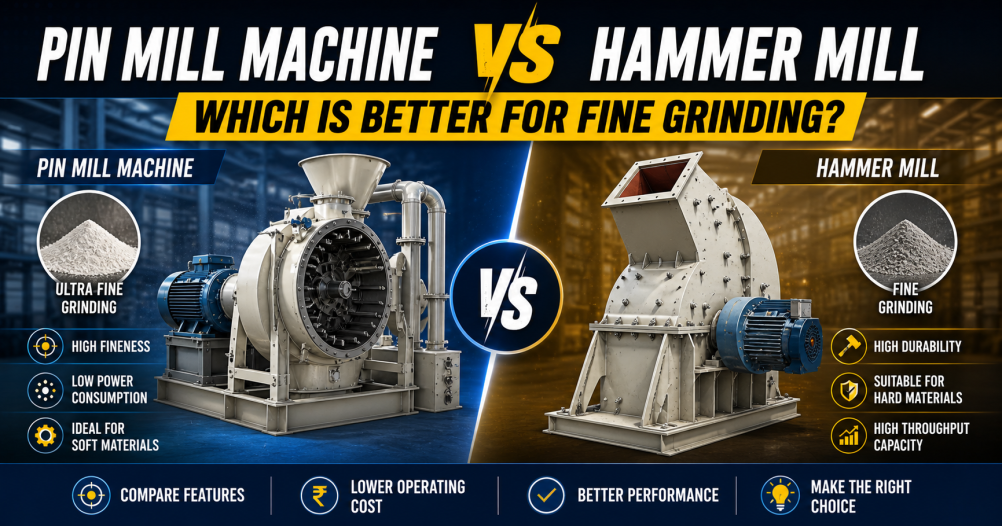
Two machines. Both grind. Both are widely used across Indian industries. But a pin mill and a hammer mill are built on completely different working principles and choosing the wrong one for your material can cost you product quality, energy, and money.
If you are evaluating grinding equipment for spices, chemicals, pharmaceuticals, food processing, or any fine grinding application, this guide gives you a straight comparison what each machine does, where it performs best, and how to decide which one your process actually needs.
What is a Pin Mill?
A pin mill is an impact grinding machine where size reduction happens between two rotating disc sets one fixed and one rotating fitted with rows of intermeshing cylindrical pins. Feed material enters through the centre of the discs and travels outward by centrifugal force, passing through multiple rows of pins that strike the particles repeatedly at high velocity.
The result is a fine, uniform particle size with a narrow distribution meaning most particles come out at a similar size rather than a wide mix of coarse and fine.
Pin mills operate at high tip speeds typically 80 to 160 m/s which allows them to grind heat-sensitive, friable, and soft to medium-hard materials without excessive temperature rise when properly configured.
Shalimar Engineering manufactures pin mill machines for food, spice, chemical, pharmaceutical, and agricultural processing industries with single-disc and counter-rotating disc configurations available based on fineness and throughput requirements.
What is a Hammer Mill?
A hammer mill is an impact grinding machine where size reduction happens by the repeated striking of material by rotating hammers rectangular or T-shaped steel bars mounted on a high-speed rotor. The material is fed into the grinding chamber, struck repeatedly by the hammers, and forced through a perforated screen at the bottom or sides of the chamber. The screen opening size determines the maximum output particle size.
Hammer mills are robust, high-capacity machines that handle a wide range of materials from soft agricultural products to medium-hard minerals and are among the most common grinding machines in Indian food processing, chemical, and mineral industries.
Shalimar Engineering manufactures hammer mill machines for grinding grains, spices, chemicals, biomass, and minerals with screen sizes from 0.5 mm to 10 mm and capacities from small batch units to large continuous production mills.
How They Work — Core Difference in One Line
- Pin mill — Material is ground by impact between intermeshing pins on high-speed rotating discs. No screen. Particle size controlled by pin gap and rotor speed.
- Hammer mill — Material is ground by impact from rotating hammers and forced through a fixed perforated screen. Screen size controls maximum output particle size.
This fundamental difference in working mechanism determines everything else particle size distribution, heat generation, material suitability, and cleaning requirements.
Pin Mill vs Hammer Mill — Complete Side by Side Comparison
| Parameter | Pin Mill | Hammer Mill |
|---|---|---|
| Grinding mechanism | Pin impact between rotating discs | Hammer impact + screen classification |
| Particle size control | Rotor speed + pin configuration | Screen perforation size |
| Output particle size | 50–500 microns (finer range) | 200 microns–5 mm (coarser range) |
| Particle size distribution | Narrow — very uniform | Wider — mix of fine and coarse |
| Heat generation | Low to moderate | Moderate to high |
| Throughput | Moderate | High |
| Material hardness | Soft to medium | Soft to medium-hard |
| Fibrous materials | Not suitable | Handles well |
| Sticky or moist materials | Not suitable | Limited suitability |
| Screen required | No | Yes |
| Cleaning between batches | Easier — fewer parts | More involved — screen removal |
| Energy per kg | Slightly higher | Lower at same capacity |
| Capital cost | Moderate to high | Lower |
| Best for | Spices, pharma, fine chemicals, sugar | Grains, biomass, minerals, coarse chemicals |
Where Pin Mills Perform Better
Fine and Uniform Particle Size
When your process demands a tight, narrow particle size distribution meaning most particles fall within a specific micron range a pin mill machine is the right choice. The intermeshing pin arrangement creates multiple impact zones that progressively reduce particle size uniformly across the entire material stream.
A hammer mill produces a wider distribution some particles pass the screen quickly after minimal impacts, others get over-ground. For applications where particle size uniformity directly affects product quality pharmaceutical excipients, colour pigments, spice blends this inconsistency is a problem.
Heat-Sensitive Materials
Because pin mills do not rely on a screen and the material passes through quickly, residence time in the grinding zone is short. This reduces frictional heat buildup. With proper air purging or jacketed cooling, pin mills handle heat-sensitive materials volatile spices, sugar, certain APIs without degrading aroma, colour, or chemical structure.
Hammer mills generate more heat due to longer material residence time in the grinding chamber as material bounces around until it passes through the screen. For heat-sensitive materials, this is a significant disadvantage.
Pharmaceutical and Food-Grade Applications
Pin mill machines are easier to clean between product batches a critical requirement in pharmaceutical manufacturing under cGMP and in food processing under FSSAI guidelines. The disc and pin assembly can be removed, cleaned, and reassembled quickly with no specialized tools.
Most pin mill manufacturers in India supplying to pharma offer SS 316 contact parts, mirror-finish internal surfaces, and validation documentation as standard features for regulatory compliance.
Sugar and Confectionery Grinding
Icing sugar, powdered sugar, and confectionery sugar grinding is almost always done in a pin mill machine. The narrow particle size distribution, low heat generation, and ease of cleaning make it the standard choice for sugar grinding in the food industry.
Where Hammer Mills Perform Better
High Throughput Grinding
For large-volume, continuous grinding operations grain milling, biomass processing, mineral grinding, cattle feed a hammer mill machine delivers higher throughput at lower capital and operating cost than a pin mill. The screen-based classification means the mill self-regulates output size without speed adjustments.
Fibrous and Coarse Materials
Hammer mills handle fibrous materials agricultural stalks, wood chips, dried herbs, and biomass that would wrap around or jam a pin mill’s disc assembly. The hammers tear and shred fibrous structures effectively before forcing them through the screen.
Dried chilli stems, turmeric root pieces, and coarse herb material are examples where a hammer mill handles the pre-grinding stage before a pin mill takes the material to final fineness.
Mineral and Chemical Pre-Grinding
For medium-hard minerals and chemicals in the 200-micron to 2-mm output range, a hammer mill is the more economical choice. The lower capital cost, simpler maintenance, and higher capacity at this particle size range make it the practical first choice for mineral processing pre-grinding.
Variable Screen Sizes for Flexible Output
A hammer mill with interchangeable screens gives operators the ability to change output particle size range without changing the machine just swap the screen. This flexibility is useful for plants that process multiple products with different fineness requirements.
Two-Stage Grinding — The Best of Both Machines
Many sophisticated processing plants in India use hammer mills and pin mills in series a two-stage grinding system that combines the strengths of both machines.
Stage 1 — Hammer mill: Coarse material is reduced from 5–10 mm feed size to 500 microns–1 mm. The hammer mill handles the heavy work at high throughput and low energy cost per kg.
Stage 2 — Pin mill: The pre-ground material from the hammer mill is fed into the pin mill machine for final fine grinding to the target particle size typically 100–300 microns with narrow distribution.
This approach is widely used in spice processing, food ingredient manufacturing, and specialty chemical production. It gives plants the throughput capacity of a hammer mill combined with the fineness and uniformity of a pin mill without overloading either machine.
Shalimar Engineering designs and supplies both pin mills and hammer mills and can configure complete two-stage grinding systems for clients who need both coarse reduction and fine finishing in a single production line.
Industry-Wise Recommendation — Pin Mill or Hammer Mill?
| Industry | Recommended Machine | Reason |
|---|---|---|
| Spice grinding (fine) | Pin mill | Uniform particle size, low heat, aroma retention |
| Grain milling (wheat, maize) | Hammer mill | High throughput, screen-based size control |
| Pharmaceutical API | Pin mill | cGMP compliance, SS 316, narrow PSD |
| Sugar / icing sugar | Pin mill | Fine uniform powder, low heat generation |
| Biomass / agricultural waste | Hammer mill | Fibrous material handling |
| Chemical intermediates (fine) | Pin mill | Tight particle size for reaction chemistry |
| Mineral pre-grinding | Hammer mill | Hard material, coarser output, high capacity |
| Ayurvedic / herbal powder | Pin mill + hammer mill | Two-stage for best result |
| Cattle feed | Hammer mill | High volume, coarser output acceptable |
| Pigment grinding | Pin mill | Colour uniformity requires narrow PSD |
Key Buying Factors — What to Ask Your Supplier
Whether you are buying a pin mill machine or a hammer mill machine, these are the questions to ask before finalizing:
- What is the feed material Mohs hardness, moisture content, bulk density?
- What is the required output particle size D50, D90, or mesh specification?
- Is the application food-grade, pharmaceutical, or industrial?
- What is the required throughput kg/hr or TPH?
- Is batch or continuous operation needed?
- What are the cleaning and changeover requirements between products?
- What certifications does the machine carry CE, cGMP, IS standards?
A reliable pin mill manufacturer or hammer mill manufacturer will ask you all of these questions before recommending a machine. If a supplier quotes you a machine without asking about your material and process look elsewhere.
Frequently Asked Questions
Q1. What is the main difference between a pin mill and a hammer mill?
A pin mill grinds material through impact between intermeshing pins on high-speed rotating discs no screen is used and particle size is controlled by speed and pin spacing. A hammer mill grinds through hammer impact and forces material through a perforated screen that controls the maximum output particle size. Pin mills produce finer, more uniform particles; hammer mills offer higher throughput at coarser output sizes.
Q2. Which is better for spice grinding pin mill or hammer mill?
A pin mill machine is the better choice for fine spice grinding where aroma retention, low heat generation, and uniform particle size are priorities. A hammer mill is used for coarse pre-grinding of whole spices before the pin mill takes the material to final fineness. Many spice processing plants use both in series.
Q3. Can a pin mill handle fibrous materials?
No. Fibrous materials dried stalks, wood chips, coarse herb stems are not suitable for a pin mill machine. The fibres wrap around the pin disc assembly and cause blockages. A hammer mill is the correct machine for fibrous material grinding.
Q4. Which machine is easier to clean between batches?
A pin mill is generally easier to clean the disc and pin assembly is accessible and can be removed for thorough cleaning without specialized tools. This makes it the preferred choice for pharmaceutical and food applications where cross-contamination between product batches is a compliance concern.
Q5. Where can I get both pin mills and hammer mills from a single manufacturer in India?
Shalimar Engineering manufactures both pin mill machines and hammer mill machines and can supply complete two-stage grinding systems combining both. As a leading pin mill manufacturer and hammer mill manufacturer in India, we provide full technical support from specification to commissioning.
Get the Right Grinding Machine from Shalimar Engineering
Whether your process needs a pin mill, a hammer mill, or a two-stage system combining both the right choice depends on your material, target particle size, throughput, and industry requirements.
Shalimar Engineering is a trusted manufacturer and exporter of industrial grinding equipment including pin mill machines and hammer mill machines based in Ahmedabad, India. With 20+ years of experience and exports to 30+ countries, we engineer grinding solutions matched to your exact process requirements.
Share your material, required output particle size, and production capacity with our team and we will recommend the right machine with full technical specifications.
View our Pin Mill range | View our Hammer Mill range | Contact Shalimar Engineering for a free consultation today.