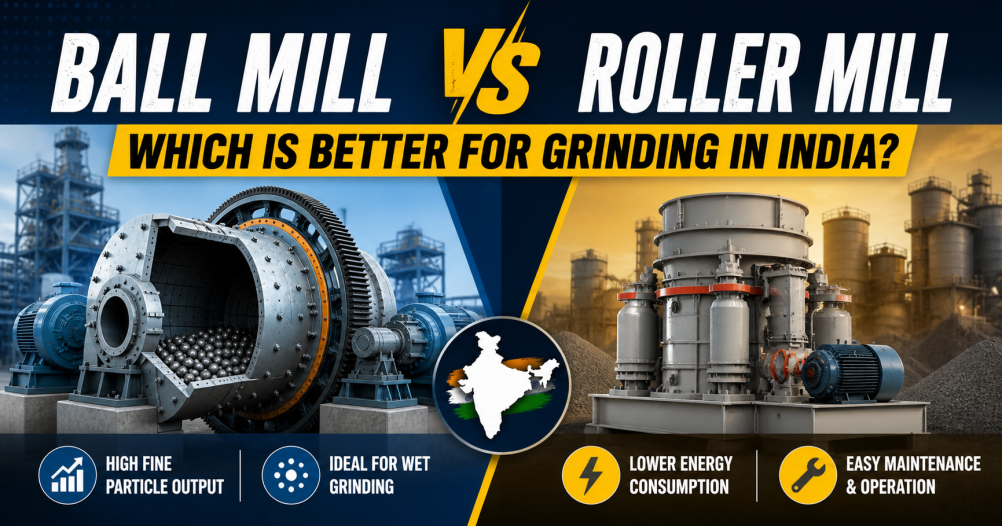
When it comes to industrial grinding, two machines dominate the conversation the ball mill and the roller mill. Both are used for size reduction, both are widely available, and both have loyal users across Indian industries. But they are fundamentally different machines built for different jobs.
If you are evaluating grinding equipment for your production line, this guide gives you a straight, practical comparison no marketing language, just the facts you need to make the right call.
What is a Ball Mill?
A ball mill is a cylindrical rotating drum filled with grinding media steel, ceramic, or rubber balls that crushes and grinds material through impact and attrition. As the drum rotates, balls lift and fall, repeatedly striking the feed material until it reaches the target particle size.
Ball mills handle a wide range of materials from soft minerals like calcium carbonate and talc to hard materials like quartz, iron ore, and clinker. They work in both wet and dry grinding modes and are available in batch and continuous configurations.
Shalimar Engineering manufactures ball mills for capacities ranging from 50 kg per batch to large continuous mills for industrial-scale production serving cement, mining, chemical, ceramic, and pharmaceutical industries across India and 30+ countries.
What is a Roller Mill?
A roller mill uses two or more cylindrical rollers that rotate against each other or against a flat grinding table to crush and grind material through compression. The feed material passes between the rollers and gets compressed into fine powder.
Roller mills are commonly used in flour milling, cement raw meal grinding, and coal pulverization. They are efficient for medium-hard, non-abrasive materials at high throughput but have significant limitations when it comes to material versatility and wet grinding.
Ball Mill vs Roller Mill — Side by Side Comparison
| Parameter | Ball Mill | Roller Mill |
|---|---|---|
| Grinding mechanism | Impact + attrition | Compression |
| Material hardness | Soft to very hard | Soft to medium-hard |
| Wet grinding | Yes | No |
| Dry grinding | Yes | Yes |
| Particle size range | 200 mesh to micron level | 100–200 mesh |
| Contamination risk | Low (with ceramic media) | Medium |
| Maintenance | Simple, low cost | Complex, higher cost |
| Capital cost | Lower | Higher |
| Best for | Mining, chemicals, ceramics, pharma | Flour, coal, cement raw meal |
| Batch operation | Yes | No |
| Continuous operation | Yes | Yes |
Where Ball Mills Win — Clear Advantages
1. Material Versatility
A ball mill machine handles everything from soft talc (Mohs hardness 1) to hard quartz and iron ore (Mohs 6–7) without needing a different machine. Roller mills are limited to medium-hard, non-abrasive materials anything too hard wears out the rollers rapidly and increases maintenance costs significantly.
If your plant processes multiple materials or switches between product grades, a ball mill gives you that flexibility without equipment changes.
2. Wet Grinding Capability
Wet grinding is essential in mineral processing, ore beneficiation, ceramic slip preparation, and paint pigment manufacturing. A ball mill handles wet grinding efficiently producing a consistent slurry output with controlled particle size.
Roller mills cannot handle wet grinding at all. This is a hard limitation for industries that need liquid-assisted processing.
3. Ultra-Fine Particle Size
When your process demands output finer than 200 mesh especially micron-level grinding for pharmaceutical or specialty chemical applications a ball mill with a micronizing plant attachment delivers. Most roller mills top out at 100–200 mesh and cannot achieve finer output without significant design changes.
4. Low Maintenance and Operating Cost
A ball mill machine has few moving parts a rotating drum, bearings, a drive system, and grinding media. Grinding media (balls) are inexpensive and easy to replace. A typical ball mill from a reliable ball mill manufacturer runs for 15–25 years with routine maintenance.
Roller mills have complex hydraulic systems, precision-ground rollers, and grinding tables that wear out under abrasive materials. Replacement parts are expensive and often have long lead times.
5. Batch Processing
Many industries pharmaceutical, specialty chemicals, ceramics require batch-by-batch production for quality traceability and small-lot processing. Ball mills are available in batch configurations specifically for this use case.
Roller mills are continuous-only machines. They are not designed for batch operation, making them unsuitable for industries that run varied product lines.
Where Roller Mills Win — Being Fair
Roller mills do have genuine advantages in specific scenarios:
- High-volume, single-material grinding — For dedicated flour milling or coal pulverization at large scale, roller mills are more energy-efficient per tonne of output.
- Cement raw meal — Vertical roller mills are well established in large cement plants where power cost per tonne is the dominant consideration.
- Dust generation — Roller mills in closed-circuit systems can produce less airborne dust than open-circuit dry ball mills, though this is managed with proper dust collection in modern ball mill installations.
If your operation is a dedicated, high-volume, single-material process with no wet grinding, no ultra-fine requirement, and no batch need a roller mill can work. For everything else, a ball mill is the more practical choice.
Which Industries in India Choose Ball Mills Over Roller Mills?
India’s industrial base heavily favors ball mills for most grinding applications. Here is why:
Mining and minerals — Iron ore, manganese, bauxite, and mineral processing operations across Rajasthan, Odisha, Jharkhand, and Chhattisgarh rely on ball mills for ore grinding. The ability to handle hard, abrasive materials in wet mode makes roller mills impractical for most mining applications.
Chemical industry — Gujarat’s large chemical manufacturing cluster uses ball mills for grinding pigments, dyes, fillers, and specialty chemicals. Contamination control and wet grinding capability are the key reasons.
Ceramic industry — Morbi’s ceramic tile industry the world’s largest depends almost entirely on ball mills for grinding feldspar, quartz, and kaolin into ceramic slip. Wet grinding is non-negotiable for ceramic slip preparation.
Pharmaceutical industry — Active pharmaceutical ingredient (API) manufacturers and bulk drug producers across Hyderabad, Ahmedabad, and Mumbai use ball mills for fine grinding where contamination must be zero and batch traceability is mandatory.
Cement industry — While large integrated cement plants use vertical roller mills for raw meal, smaller cement and clinker grinding units across India widely use ball mills from ball mill manufacturers in India for their lower capital cost and simpler operation.
Total Cost of Ownership — Ball Mill vs Roller Mill
When Indian buyers evaluate grinding equipment, total cost of ownership matters more than purchase price alone.
| Cost Factor | Ball Mill | Roller Mill |
|---|---|---|
| Purchase price | Lower | Higher (30–50% more) |
| Installation cost | Simple, low | Complex, higher |
| Grinding media replacement | Low cost, local availability | Expensive rollers, imported parts |
| Maintenance labor | Unskilled to semi-skilled | Skilled technicians required |
| Downtime risk | Low | Higher (hydraulic, precision parts) |
| Machine life | 15–25 years | 10–15 years (with wear) |
For most Indian industrial buyers especially mid-size manufacturers the ball mill offers a significantly better return on investment over the machine’s operational life.
How to Choose the Right Ball Mill for Your Process
If you have decided that a ball mill is the right fit, the next step is selecting the correct type and specification. Here is a quick decision guide:
- Small batches, varied products → Batch ball mill (50 kg to 2,000 kg capacity)
- Non-stop production, single material → Continuous ball mill
- Mineral ore, slurry output → Wet grinding ball mill
- Cement, limestone, chemicals → Dry grinding ball mill
- Micron-level output → Ball mill with micronizing plant
- Food-grade or pharma → SS 304/316 lined ball mill with ceramic grinding media
A qualified ball mill supplier will review your material specifications, required output particle size, and production volume before recommending the correct configuration. Do not size a ball mill on capacity alone material hardness, moisture content, and downstream process requirements all affect the correct specification.
Frequently Asked Questions
Q1. Can a ball mill replace a roller mill completely?
In most Indian industrial applications mining, chemicals, ceramics, pharma yes. A ball mill handles a broader range of materials, works in both wet and dry mode, and supports batch operation. The only scenarios where a roller mill holds an advantage are high-volume, single-material, dry grinding applications like flour milling or large-scale cement raw meal.
Q2. Which is cheaper to operate — ball mill or roller mill?
A ball mill is cheaper to operate for most applications. Grinding media (balls) are inexpensive and locally available. Roller mill consumables precision-ground rollers and grinding tables are expensive and often imported.
Q3. Do ball mills work for cement grinding?
Yes. Ball mills are widely used for clinker and cement grinding in India, especially in smaller and mid-size cement plants. Large integrated plants may use vertical roller mills for raw meal, but ball mills remain the most common choice for finish grinding.
Q4. What is the minimum capacity available in a ball mill?
Ball mill manufacturers in India like Shalimar Engineering supply batch ball mills starting from 50 kg capacity suitable for laboratory, R&D, and small-scale production. Continuous mills start from approximately 500 kg/hr and go up to several TPH.
Q5. How do I get the right ball mill for my application?
Share your material name, required output particle size (mesh or micron), production capacity needed, and wet or dry preference with a reliable ball mill manufacturer. They will recommend the correct mill type, lining, grinding media, and drive configuration for your process.
The Verdict — Ball Mill is the Right Choice for Most Indian Industries
For the majority of Indian grinding applications, a ball mill is the more versatile, lower-cost, easier-to-maintain, and longer-lasting solution. Roller mills serve a narrow band of high-volume, single-material, dry grinding applications and even there, the cost and complexity tradeoffs are significant.
If you are sourcing grinding equipment for mining, chemicals, ceramics, pharmaceuticals, or any material that requires wet grinding or ultra-fine particle size a ball mill from a trusted ball mill manufacturer in India is the practical, proven choice.
Get a Custom Ball Mill Quote from Shalimar Engineering
Shalimar Engineering is a leading ball mill manufacturer and exporter based in Ahmedabad, India with 20+ years of experience and active exports to 30+ countries.
We design and manufacture custom ball mill machines for mining, cement, chemical, pharmaceutical, ceramic, and paint industries. Every mill is engineered to your material and production requirements not a standard catalog specification.
View our complete Ball Mill range or contact us for a free technical consultation and quotation today.