If your ball mill is not grinding efficiently or worse, if it is not grinding at all the problem might not be the material, the media, or the motor. It might be the speed.
Critical speed is one of the most important operating parameters of a ball mill, yet it is one of the least understood. Run your mill too slow and the grinding media slides instead of cascades. Run it too fast and centrifugal force pins the balls to the wall and grinding stops completely.
This guide explains exactly what critical speed is, gives you the formula, walks through a real calculation example, and tells you what speed range your mill should actually run at for maximum grinding efficiency.
What is Critical Speed in a Ball Mill?
Critical speed is the rotational speed measured in RPM at which the grinding media inside a ball mill begin to centrifuge rather than cascade. At this speed, centrifugal force acting on the balls equals the gravitational force pulling them down. The balls stop tumbling, pin against the inner wall of the mill, and grinding output drops to zero.
In practical terms:
- Below critical speed — Balls cascade and tumble freely, grinding material through impact and attrition. This is the correct operating zone.
- At critical speed — Balls centrifuge. No relative movement between balls and shell. No grinding.
- Above critical speed — Balls are pinned to the wall by centrifugal force. Complete loss of grinding action.
Every ball mill machine has a specific critical speed determined by its internal diameter. Understanding this value and operating at the correct percentage of it is fundamental to getting the output particle size and throughput your process requires.
Ball Mill Critical Speed Formula
The critical speed of a ball mill is calculated using this standard formula:
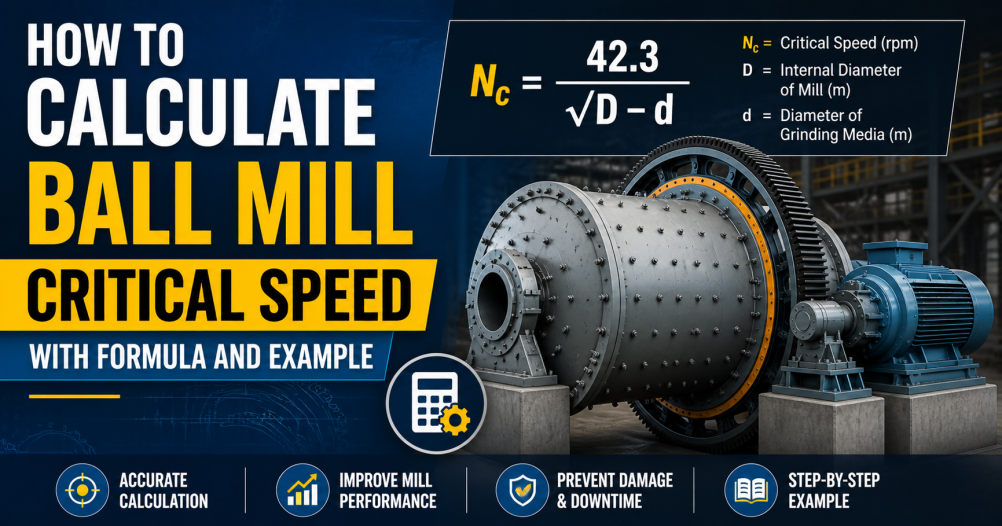
Nc = 42.3 / √D
Where:
- Nc = Critical speed in RPM (revolutions per minute)
- D = Internal diameter of the mill in metres (after subtracting lining thickness)
- 42.3 = A fixed constant derived from gravitational acceleration (g = 9.81 m/s²)
This formula is used by ball mill manufacturers worldwide and is the industry standard for mill speed specification.
Note: D is the effective internal diameter the diameter of the mill shell minus twice the lining thickness. Always use the net grinding diameter, not the outer shell diameter.
Step-by-Step Critical Speed Calculation with Example
Let us work through a real example so the formula is completely clear.
Given:
- Mill shell internal diameter: 1.8 metres
- Lining thickness: 0.1 metres (100 mm) on each side
Step 1 — Calculate effective diameter (D)
D = Shell diameter − (2 × lining thickness)
D = 1.8 − (2 × 0.1)
D = 1.8 − 0.2
D = 1.6 metres
Step 2 — Apply the critical speed formula
Nc = 42.3 / √D
Nc = 42.3 / √1.6
Nc = 42.3 / 1.265
Nc = 33.4 RPM
Result: The critical speed of this ball mill is 33.4 RPM.
Step 3 — Calculate actual operating speed
A ball mill should operate at 65–75% of its critical speed for effective grinding. Using 70% as the target:
Operating speed = 0.70 × 33.4
Operating speed = 23.4 RPM
This mill should be set to run at approximately 23–24 RPM for optimal grinding performance.
Why 65–75% of Critical Speed is the Optimal Range
This is not an arbitrary range. It is the zone where the grinding media behaves in a way that produces maximum impact energy and grinding efficiency.
At 65–75% of critical speed:
- Balls are carried up the mill shell to approximately the 10 o’clock position
- They then break free and follow a parabolic trajectory falling across the diameter of the mill
- This free-fall impact on the material at the bottom delivers maximum energy per collision
- The combination of impact (from falling balls) and attrition (ball-on-ball sliding) produces the most efficient particle size reduction
At below 60% of critical speed:
- Balls roll along the bottom of the mill without significant lift
- Very little impact energy grinding is almost entirely attrition-based
- Output is fine but throughput is very low and energy efficiency drops
At above 80% of critical speed:
- Balls are carried too high and do not have enough time to cascade properly
- Some begin to centrifuge, especially the outermost layer
- Uneven wear on mill lining and grinding media
- Noise and vibration increase significantly
The 65–75% range is the established sweet spot for most industrial ball mill applications. Some fine grinding applications for pharmaceutical or ceramic use 70–75%; coarse grinding for mining and cement may run at 65–70%.
Factors That Affect the Operating Speed of a Ball Mill
Critical speed gives you the ceiling. But several other factors determine exactly where within the 65–75% range your ball mill machine should operate:
Material Hardness
Harder materials quartz, iron ore, clinker benefit from the higher end of the operating range (72–75% of Nc) to maximize impact energy per ball drop. Softer materials like calcium carbonate, talc, and limestone grind efficiently at the lower end (65–70% of Nc).
Grinding Media Size and Fill Level
Larger balls need to fall from greater height to deliver significant impact energy. Running slightly higher in the speed range compensates for larger media. Fill level also matters — mills filled at 30–35% of volume run efficiently; overfilling reduces the cascade height and grinding efficiency regardless of speed.
Wet vs Dry Grinding
Wet grinding operations typically run at slightly lower speeds than dry grinding because the slurry itself acts as a cushion and assists particle transport. Dry ball mill operations can run at the higher end of the speed range.
Lining Condition
As lining wears, the effective diameter (D) increases slightly which lowers the actual critical speed of the mill. A ball mill that has been in operation for years may need its speed recalculated based on the current effective diameter to maintain optimal performance.
Critical Speed for Different Ball Mill Sizes — Reference Table
| Mill Internal Diameter (m) | Critical Speed Nc (RPM) | Optimal Operating Range (RPM) |
|---|---|---|
| 0.6 m | 54.6 RPM | 35–41 RPM |
| 0.9 m | 44.6 RPM | 29–33 RPM |
| 1.2 m | 38.6 RPM | 25–29 RPM |
| 1.5 m | 34.5 RPM | 22–26 RPM |
| 1.8 m | 31.5 RPM | 20–24 RPM |
| 2.4 m | 27.3 RPM | 18–20 RPM |
| 3.0 m | 24.4 RPM | 16–18 RPM |
Values above assume no lining thickness. Always subtract lining thickness from internal diameter before calculating.
This table is a practical reference for plant engineers and procurement teams evaluating ball mills across different capacity ranges. If you are working with a ball mill supplier to specify a new mill, share your required capacity and material data the manufacturer will confirm the correct speed setting for your application.
Common Mistakes in Ball Mill Speed Setting
Even experienced plant operators make these errors. Here is what to watch for:
Mistake 1 — Using outer shell diameter instead of effective diameter The formula requires the internal diameter after lining. Using the outer shell diameter gives a lower critical speed value and leads to under-speeding the mill.
Mistake 2 — Not recalculating after relining New linings are thicker. After a reline, the effective diameter decreases and critical speed increases. The drive speed may need adjustment to stay in the 65–75% operating window.
Mistake 3 — Running at fixed RPM regardless of product change Different materials grind best at different points in the 65–75% range. A variable speed drive (VSD) on the mill motor gives operators the ability to fine-tune speed for each product without mechanical changes.
Mistake 4 — Ignoring fill level when adjusting speed Speed and fill level interact. Reducing fill level while keeping speed constant moves the mill into a higher relative speed condition. Always consider both parameters together.
How Shalimar Engineering Sets Critical Speed on Its Ball Mills
At Shalimar Engineering, every ball mill is engineered with the operating speed calculated for the client’s specific material and production requirements not a generic catalog setting.
Before manufacturing, our engineering team reviews:
- Material Mohs hardness and bulk density
- Required output particle size (mesh or micron)
- Wet or dry grinding mode
- Grinding media type and size
- Lining material and expected thickness
The drive system gearbox, motor, and coupling is then specified to deliver the correct RPM range for that mill’s effective diameter, with provisions for speed adjustment if the client’s product range requires it.
Every ball mill machine leaving our facility is test-run at the specified operating speed before dispatch. This is part of our quality process not an optional check.
View our complete range of ball mills from 50 kg batch mills to large continuous mills for industrial production.
Frequently Asked Questions
Q1. What happens if a ball mill runs above critical speed?
If a ball mill runs at or above critical speed, the grinding media centrifuges against the inner wall. There is no cascading action, no impact on the material, and grinding stops. Running above critical speed also causes excessive wear on the lining and bearings.
Q2. Is the critical speed formula the same for all ball mills?
Yes. The formula Nc = 42.3 / √D applies to all cylindrical ball mills regardless of manufacturer, lining type, or application. The only variable is the effective internal diameter (D) of the mill.
Q3. Can I change the critical speed of my existing ball mill?
The critical speed is fixed by the mill’s internal diameter it cannot be changed without physically modifying the mill. What you can change is your operating speed (the percentage of critical speed you run at) by adjusting the drive system or installing a variable speed drive.
Q4. How do ball mill manufacturers in India specify operating speed?
Reputable ball mill manufacturers in India calculate critical speed from the effective internal diameter, then specify the drive system to deliver 65–75% of that value at the motor’s rated output. The RPM is stated in the technical datasheet for each mill model.
Q5. Where can I get a ball mill with the correct speed specification for my material?
Share your material specifications and required output with a reliable ball mill supplier. Shalimar Engineering provides a complete technical proposal including calculated critical speed, recommended operating RPM, and drive specifications for every inquiry.
Get a Correctly Specified Ball Mill from Shalimar Engineering
Getting the critical speed right is not just a calculation exercise it determines whether your ball mill delivers the output particle size, throughput, and energy efficiency your process needs.
Shalimar Engineering is a trusted ball mill manufacturer in India with 20+ years of experience designing and exporting grinding mills to clients across Asia, Africa, the Middle East, and Europe.
Send us your material name, required capacity, and target particle size and our engineering team will calculate the correct mill size, critical speed, and drive configuration for your application.
View our Ball Mill range or contact Shalimar Engineering for a free technical consultation today.