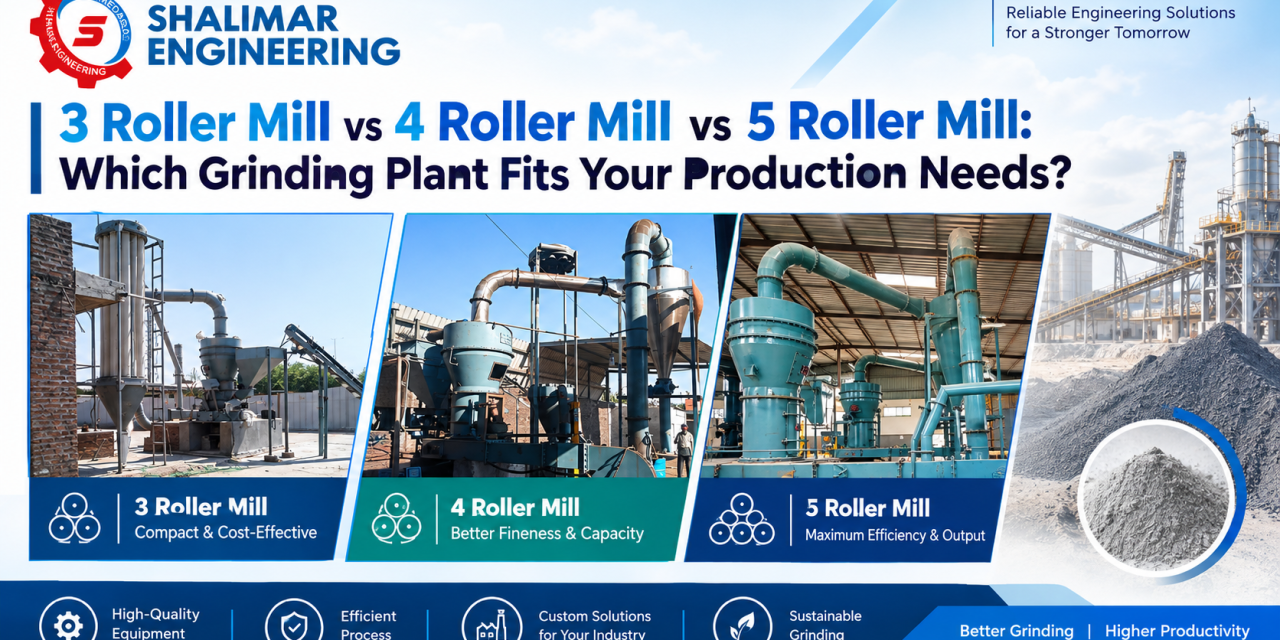
3 Roller Mill vs 4 Roller Mill vs 5 Roller Mill: Which Grinding Plant Fits Your Production Needs?
When you manage a large-scale processing facility, your choice of heavy-duty grinding machinery dictates your overall profitability. The transition from raw extracted minerals into fine, usable powders requires immense mechanical force. If your size reduction equipment is undersized, you face constant bottlenecks. If it is oversized, you waste massive amounts of electricity. Selecting the precise configuration for your daily tonnage, material hardness, and target fineness is absolutely critical for continuous operational success.
The modern industrial landscape relies heavily on advanced compression grinding. A highly efficient Vertical roller mill operates by utilizing hydraulic pressure to force massive crushing elements down onto a rotating steel table. Raw material feeds into the center of the table, and centrifugal force pushes the rocks outward beneath the heavy crushing wheels. Simultaneously, a powerful draft of hot air sweeps upward around the table edge, lifting the pulverized particles into an overhead dynamic classifier. Heavy, oversized particles fall back down for further crushing, while the fine dust passes through to a collection system.
The number of crushing wheels inside the casing drastically changes the machine’s capacity, mechanical balance, and power draw. In this detailed engineering guide, we will analyze the technical differences between three, four, and five-roller configurations. We will also evaluate the supplementary thermal and mixing machinery required to build a fully integrated, high-capacity industrial production line.
The Baseline Powerhouse: Analyzing the 3 Roller System
For most standard industrial applications, a three-wheel configuration provides an excellent balance of power, footprint, and capital expenditure. The three crushing wheels are spaced exactly 120 degrees apart around the central axis. This geometric arrangement provides inherent mechanical stability against the central gearbox. You should deploy this configuration when processing medium-hard materials like limestone, bentonite, or standard industrial clay.
Integrating a 3 Roller Mill Plant into your workflow guarantees steady, reliable fineness. If you operate facilities in the Middle East, establishing a 3 Roller Mill Plant in Iraq offers significant advantages for local infrastructure development. Partnering closely with a specialized 3 Roller Mill Plant manufacturer in Iraq ensures the structural steel housing can withstand high ambient temperatures. Furthermore, establishing a maintenance contract with a local 3 Roller Mill Plant supplier in Iraq provides rapid access to replacement hydraulic seals and wear liners. If your organization moves machinery across borders, utilizing a 3 Roller Mill Plant exporter in Iraq simplifies the heavy freight logistics significantly.
Procurement teams must also consider the overall engineering ecosystem. Collaborating with a reliable vertical roller mill manufacturer in iraq ensures your electrical control panels are calibrated for regional power grids. Maintaining ties with a vertical roller mill supplier in iraq guarantees continuous operation without long lead times for spare parts. Ultimately, working through a certified vertical roller mill exporter in iraq protects your heavy asset investment during international transit.
Scaling Up Operations: When to Choose the 4 Roller System
As your daily production quotas increase, or if you begin processing harder minerals like barite or heavy cement clinker, you must upgrade your crushing force. A four-wheel setup spaces the crushing elements 90 degrees apart. This symmetrical layout distributes the immense downward hydraulic pressure more evenly across the main thrust bearing. The even load distribution reduces mechanical vibration, allowing the main drive motor to operate at higher efficiencies while crushing significantly more rock per hour.
Deploying a 4 Roller Mill Plant drastically increases your output capacity without doubling your factory footprint. For expanding industrial sectors, setting up a 4 Roller Mill Plant in Iran meets the rising demand for high-volume mineral powders. You will need to coordinate with a dedicated 4 Roller Mill Plant manufacturer in Iran to cast the specific high-chrome wear tires required for abrasive materials. Securing a reliable 4 Roller Mill Plant supplier in Iran ensures your facility never stops due to a lack of consumable parts. To manage the delivery of this massive equipment, you must contract a specialized 4 Roller Mill Plant exporter in Iran.
To support this upgraded infrastructure, your procurement network must scale accordingly. Relying on an experienced vertical roller mill manufacturer in iran provides the heavy-duty gearboxes needed for high-torque grinding. A local vertical roller mill supplier in iran will help you optimize your hydraulic tensioning systems over time. When shipping complete turnkey systems, a vertical roller mill exporter in iran manages the heavy transport requirements seamlessly.
Maximum Industrial Throughput: Deploying the 5 Roller System
For the most extreme, high-volume production environments in the world, standard configurations simply cannot keep up. When you need to process hundreds of tons of raw material per hour, you require the ultimate in size reduction technology. A five-wheel layout spaces the rollers 72 degrees apart. This configuration maximizes the total crushing surface area interacting with the material bed at any given microsecond. It requires a massive foundation, a highly specialized gear drive, and an incredibly robust structural housing.
Investing in a 5 Roller Mill Plant secures your position at the top of the industrial output chain. Operating a 5 Roller Mill Plant in Iran allows mega-facilities to process vast quantities of iron ore, slag, and raw cement continuously. Building this infrastructure demands a partnership with a highly advanced 5 Roller Mill Plant manufacturer in Iran capable of machining these massive components. You must also retain a 5 Roller Mill Plant supplier in Iran for immediate technical interventions, while a 5 Roller Mill Plant exporter in Iran handles the complicated customs and heavy-lift shipping requirements.
Traditional Alternatives for Ultra-Fine Grinding
While advanced vertical systems excel at energy-efficient bulk reduction, certain metallurgical and chemical processes strictly require ultra-fine, wet grinding. In these specific scenarios, the traditional tumbling cylinder remains the industry standard. A Ball Mill utilizes heavy forged steel spheres tumbling inside a rotating drum to smash particles through continuous impact and attrition.
Setting up a Ball Mill Plant in Iran provides operators with extreme flexibility for both wet and dry processing. You must consult a specialized Ball Mill Plant manufacturer in Iran to ensure the internal steel liners are designed for your specific mineral hardness. A dedicated Ball Mill Plant supplier in Iran guarantees a steady flow of replacement steel grinding media. For international logistics, a Ball Mill Plant exporter in Iran ensures the heavy steel shell arrives intact. To make the best procurement decision, you should read technical insights from the biggest manufacturer and supplier of ball mills in india and thoroughly analyze exactly what is ball mill working principle types to match the machinery to your raw feed.
Essential Material Handling and Plant Infrastructure
Moving thousands of tons of heavy rock and fine dust between crushers, silos, and kilns requires uncompromising transport infrastructure. You must integrate heavily reinforced Material Handling Equipments to prevent costly spillage and operational blockages. Bucket elevators lift abrasive materials vertically, while enclosed screw conveyors transport fine, hazardous powders horizontally without creating airborne dust. A properly designed conveyance system ensures a steady, metered feed rate into your grinding equipment. You must view your entire facility holistically, ensuring all Minerals Chemicals Grinding Equipments communicate seamlessly with the transport network.
Precision Mixing for Chemical and Mineral Formulations
After minerals are pulverized, they often require precise blending with chemical additives before further processing. Achieving a perfectly homogeneous mixture is critical. An Industrial Ribbon Blender utilizes a horizontal trough and a double-helical agitator to fold heavy powders together gently. The Ribbon Blender Machine prevents material degradation while ensuring uniform batch consistency.
When sourcing mixing equipment for Middle Eastern facilities, a Ribbon Blender manufacturer in Iran provides the heavy steel fabrication necessary for abrasive dust. A Ribbon Blender supplier in Iran assists in integrating the mixer into your automated packing line, and a Ribbon Blender exporter in Iran handles the freight. Incorporating a high-quality Ribbon Blender eliminates chemical inconsistencies in your final product formulation.
Expanding into Agricultural Chemical Granulation
The mechanical principles used in mineral processing transfer perfectly to the lucrative agricultural chemical sector. Water Dispersible Granules (WDG) safely deliver active crop protection ingredients without creating explosive dust clouds. Constructing a complete Sulphur WDG Plant involves highly complex wet milling, controlled spray agglomeration, and strict environmental safety controls.
Operating a Suplhur WDG Plant in Iraq requires explosion-proof electrical systems because raw sulfur dust is highly combustible. You must collaborate with a specialized Suplhur WDG Plant Manufacturer in Iraq and a Suplhur WDG Plant Supplier in Iraq to install inert nitrogen blanketing systems. A Suplhur WDG Plant Exporter in iraq supplies the specialized pressure valves needed for safe operation. For cross-border projects, a Suplhur WDG Plant Manufacturer & Supplier in Iran can provide complete turnkey solutions for safe agricultural chemical production. A dedicated Suplhur WDG Plant guarantees high-yield, safe fertilizer manufacturing.
Agglomeration: The Iron Ore Pelletizing Process
In the steel industry, ultra-fine mineral dust cannot enter a blast furnace directly because it blocks the upward flow of combustion gases. The fine powder must be formed into small, hardened spheres. An iron-ore beneficiation plant in iraq first purifies the raw extracted rock. The refined powder then enters the iron ore pelletizing process, where precise moisture and rotation cause the particles to bind together.
Constructing a dedicated Iron Ore Pelletizing plant in Iraq requires massive agglomeration discs. You must work with an Iron Ore Pelletizing plant manufacturer in Iraq to calibrate the rotation speed to your specific mineral chemistry. A local Iron Ore Pelletizing plant supplier in Iraq ensures continuous operation, while an Iron Ore Pelletizing Exporter in Iraq manages the procurement of the heavy steel structures.
This mechanical shaping technology applies to other extracted resources as well. An Other Ore Pelletizing Plant in Iraq processes diverse minerals for various industrial applications. Collaborating with an Other Ore Pelletizing Plant manufacturer in Iraq, an Other Ore Pelletizing Plant supplier in Iraq, and an Other Ore Pelletizing Plant exporter in Iraq delivers customized engineering for distinct chemical profiles. Integrating a comprehensive Iron & Other Ore Pelletizing Plant directly into your workflow guarantees high structural strength for all exported minerals. The broader iron ore pelletizing plant infrastructure relies entirely on consistent raw feed from your primary grinding mills.
Controlling Moisture with Thermal Machinery
Before raw materials can be accurately ground or formed into pellets, you must eliminate excess free moisture. If the raw feed is too wet, it clogs the grinding tables; if it is too dry, it creates severe dust hazards. An Industrial Rotary Dryer passes hot combustion gases through a rotating cylinder to evaporate water continuously.
Sourcing a rotary dryer in iraq demands equipment built with extreme insulation. Choosing a reliable Rotary Dryer manufacturer in iraq ensures the burner systems are calibrated for regional natural gas. A trusted rotary dryer supplier in Iraq provides replacement trunnion rollers, and a rotary dryer exporter in iraq guarantees safe delivery of the massive cylinder. Integrating a perfectly calibrated Rotary Dryer stabilizes your entire production line.
High-Temperature Calcination Solutions
Once pellets are formed, they require extreme heat to fuse their chemical bonds permanently. This process, known as calcination, utilizes temperatures exceeding 1,200 degrees Celsius. A lime kiln represents a common calcination application, converting raw limestone into reactive quicklime.
For continuous, massive-scale thermal hardening, operators use a Rotary Kiln. Installing a Rotary Kiln in Iraq requires specialized refractory brick linings to prevent the outer steel shell from melting. Partnering with a specialized Rotary Kiln manufacturer in Iraq, a Rotary Kiln supplier in iraq, and a Rotary Kiln exporter in iraq ensures your massive thermal vessel operates safely and efficiently year-round.
Frequently Asked Questions (FAQs)
How does hydraulic tensioning improve grinding efficiency?
Hydraulic cylinders apply immense, consistent downward pressure onto the rotating table. Unlike older spring-loaded systems, hydraulics can automatically adjust to variations in material hardness, maintaining maximum crushing force while absorbing severe mechanical shocks.
Why is an integrated air classifier necessary for modern mills?
The dynamic air classifier sits directly above the grinding zone. It spins rapidly, creating a physical barrier. Only particles that are light and fine enough can pass through the spinning blades. Heavy, oversized rocks hit the blades and fall back down to the table for further crushing, guaranteeing strict product uniformity.
What causes mechanical vibration during the crushing process?
Vibration typically occurs when the raw material feed rate fluctuates, leaving portions of the steel table bare. Without a consistent bed of material to act as a cushion, the heavy crushing wheels grind directly against the steel table, causing severe harmonic vibration and potential gearbox damage.
Can a single facility utilize both impact tumbling and hydraulic compression systems?
Yes. Many massive mining operations use hydraulic compression systems for high-volume primary and secondary size reduction, followed by impact tumbling cylinders for the final stage of ultra-fine, wet slurry processing required for chemical flotation.
Final Thoughts and Next Steps
Selecting the correct Vertical roller mill directly influences your factory output, your energy consumption, and your overall market competitiveness. Whether you require a three, four, or five-wheel configuration depends entirely on your raw material hardness and your daily production targets. By integrating these systems with high-quality agglomeration, mixing, and thermal calcination equipment, you create a seamless, highly profitable industrial ecosystem.
When planning your facility layout, partner with a leading Industrial Spray Dryer & Evaporator Manufacturer & Supplier to review an extensive comprehensive industrial product range. Shalimar Engineering possesses the deep technical expertise required to fabricate, install, and optimize heavy-duty machinery for your specific application. To discuss your exact capacity requirements or request engineering drawings, please Contact us. If you are ready to formally upgrade your production line, submit a detailed Enquiry today, and our technical team will assist you immediately.