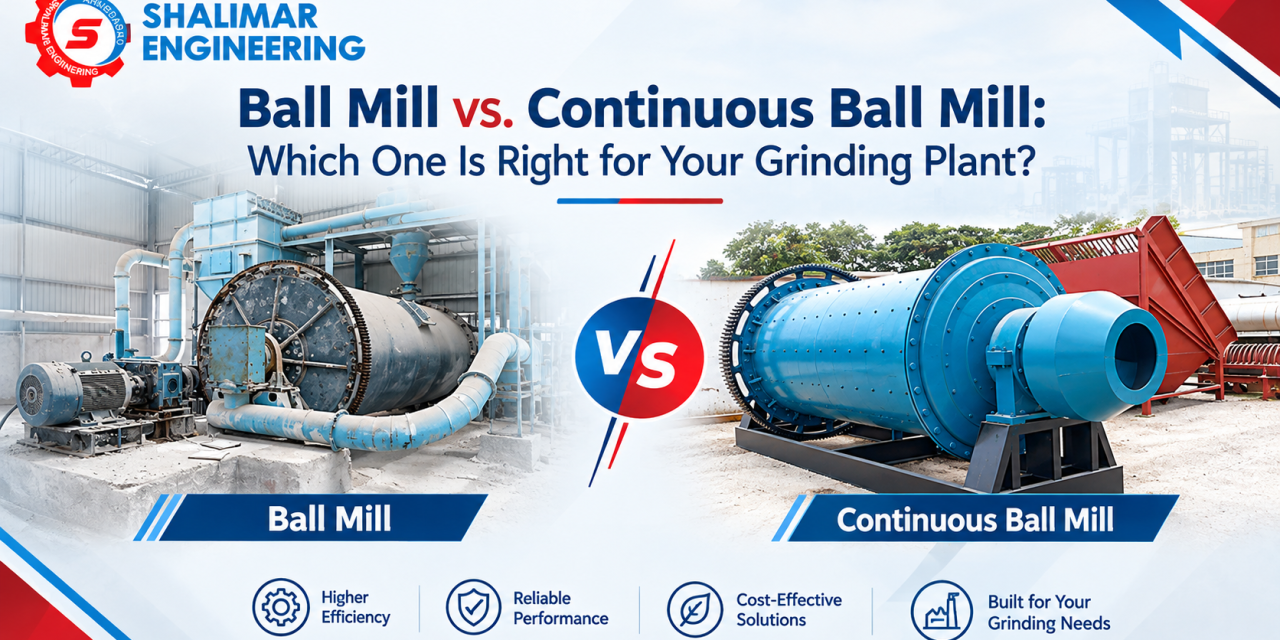
Ball Mill vs. Continuous Ball Mill: Which One Is Right for Your Grinding Plant?
Selecting the right grinding equipment can shape the entire economics of a processing plant. Whether you run a small pilot facility or a high-tonnage mineral processing operation, the choice between a batch system and a continuous system directly affects your throughput, energy consumption, and product consistency. If you have been weighing options for your next grinding setup, this comparison breaks down everything you need to know before signing a purchase order.
Grinding mills sit at the heart of mineral, chemical, ceramic, and pigment industries. The debate between batch and continuous operation is not just technical jargon. It influences capital investment, operating labour, maintenance cycles, and even the quality of your end product. Let us walk through how each system works, where each one shines, and how to match the machine to your production goals.
Grasping the Core Role of Industrial Grinding Mills
Industrial grinding is the backbone of size reduction in bulk material processing. From cement clinker to industrial pigments, nearly every powder-based product passes through a milling stage at some point. The equipment used must handle hardness, abrasiveness, moisture, and particle distribution demands without compromising uptime.
A grinding mill works on the simple principle of impact and attrition. Steel or ceramic media tumble inside a rotating drum, striking the feed material and reducing it to the required mesh size. The design appears straightforward, but the operational style, whether cyclical or non-stop flow, changes nearly every aspect of plant layout and workflow. Companies like Shalimar Engineering have engineered both styles for decades, serving industries that demand consistency at scale.
What Is a Batch Grinding System and How Does It Work?
A batch system processes one defined quantity of material at a time. You load the drum, close it, run the grinding cycle for a set duration, stop the mill, and unload the finished powder. The cycle then repeats with the next charge.
Operating Mechanics of Cyclical Grinding
In cyclical operation, the operator weighs the raw feed, loads the grinding media, and seals the chamber. The drum rotates for a predetermined period, often ranging from a few hours to a full shift depending on the hardness and target fineness. Once the cycle completes, the powder is discharged, inspected for mesh quality, and sent for packing or further processing.
This method gives operators tight control over each production run. If one batch requires a slightly different particle size or a modified media load, adjustments happen without disturbing a continuous flow. A Batch Ball Mill suits laboratories, pilot plants, and manufacturers who switch between product grades frequently.
Industries That Rely on Batch Systems
Pharmaceutical intermediates, specialty chemicals, ceramic glazes, and small-tonnage pigment units often prefer cyclical grinding. The ability to isolate each run prevents cross-contamination between formulations. Research laboratories also depend on batch units when developing new formulations where repeatability of a single mix matters more than high throughput.
What Is a Continuous Grinding System?
A continuous system feeds raw material in at one end and discharges finished powder at the other, without stopping. The chamber remains loaded with grinding media and material at all times, maintaining a steady state throughout the production shift.
Flow Pattern in Non-Stop Grinding Operations
Feed enters the inlet through a screw conveyor or vibrating feeder. As the drum rotates, material travels along its length while being ground. By the time it reaches the discharge end, it has achieved the target mesh. The output is then classified, with coarser particles sometimes recirculated back into the mill via a closed-circuit arrangement with a classifier.
A properly engineered Continuous Ball Mill delivers predictable tonnage per hour, which simplifies downstream planning. There is no idle time between cycles, so energy use per tonne of finished product tends to be lower than in cyclical systems.
Industries Benefiting from Continuous Operation
High-volume producers of cement raw meal, iron ore concentrate, silica sand, limestone powder, and refractory materials gravitate toward continuous equipment. When daily output requirements run into hundreds of tonnes, stopping and restarting a batch unit becomes impractical. Pelletising plants, calcination lines, and large chemical units typically pair continuous grinding with downstream equipment such as a Rotary Kiln or dryer to maintain uninterrupted throughput.
Side-by-Side Comparison: Key Differences
Here is a direct comparison of the two systems across the parameters that matter most in plant decision-making:
| Parameter | Batch System | Continuous System |
|---|---|---|
| Throughput | Lower, cycle-dependent | High, non-stop |
| Flexibility | High, easy grade switching | Limited, best for single product |
| Capital Cost | Lower initial investment | Higher upfront expenditure |
| Operating Labour | Higher per tonne | Lower per tonne |
| Energy Efficiency | Lower in idle cycles | Better at full load |
| Product Consistency | Varies between batches | Highly uniform |
| Maintenance Access | Easier between cycles | Requires scheduled shutdowns |
| Space Requirement | Compact | Larger footprint with classifier |
| Automation Level | Semi-automatic | Fully automated typically |
| Ideal Scale | Small to medium plants | Medium to large plants |
Reading this comparison, you can already see that neither system is universally superior. The right choice depends on the specific needs of your production environment.
Choosing the Right Grinding Equipment for Your Plant
Rather than asking which is better in general, the smarter question is which fits your plant. Several practical factors should guide your decision.
Production Volume and Shift Patterns
If your plant runs three shifts and demands a steady tonnage per hour, continuous equipment pays for itself through sheer uptime. For plants running a single shift or producing varied small lots, a cyclical setup wastes less energy during changeovers.
Material Properties and Fineness Targets
Abrasive feeds such as silica, alumina, and certain ores demand robust liner designs. A Sand Grinding Ball Mill is specifically built with wear-resistant internals for siliceous materials, while a Cement Grinding Ball Mill handles clinker with specialized media gradation. Fineness targets below 400 mesh often require integrated classification, which pairs naturally with continuous operation.
Space, Power, and Budget Considerations
Continuous systems need room for feeders, classifiers, cyclones, and bag filters. Batch systems occupy less floor area but may need more labour per tonne. Power connections should match the motor rating, and your budget must account for not just the mill itself but also auxiliary equipment such as a Ribbon Blender for pre-mixing or a Rotary Dryer for moisture control upstream.
Specialized Variants for Industry-Specific Needs
Not every grinding task fits a standard drum. For ultra-fine powders used in paints, cosmetics, or advanced ceramics, a Ball Mill with Micronizing Plant achieves sub-micron particle distribution with air classification integrated into the circuit.
For pelletising operations handling ferrous or non-ferrous ores, grinding is just one stage in a larger process train that includes an Iron & Other Ore Pelletizing Plant and dedicated indurating equipment. Similarly, agro-chemical producers running a Sulphur WDG Plant rely on fine grinding as a critical step before granulation.
Roller-based alternatives also exist for materials unsuited to tumbling action. A 3 Roller Mill Plant, 4 Roller Mill Plant, or 5 Roller Mill Plant offers compact alternatives for soft to medium-hard minerals where moisture is a factor.
Quality Factors When Sourcing Grinding Equipment
The reputation of your supplier matters as much as the mill specification. When evaluating a ball mill machine manufacturer, examine their shell plate thickness, bearing design, gear reduction quality, and liner options. Reliable ball mill manufacturers in India typically offer third-party inspection reports, test runs at their fabrication yard, and transparent material certificates.
A credible Ball Mill Manufacturer will provide clear drawings, foundation details, and commissioning support. Ask about after-sales service response time, availability of spare liners, and whether the ball mill balls suppliers they recommend meet hardness and chemical composition standards suited to your material.
Ball mill machine manufacturers in India often outperform imported alternatives on cost, delivery lead time, and local service. Before finalising, visit the fabrication shop or request video documentation of similar units in production. Reviewing projects commissioned by established ball mill machine manufacturers helps verify their track record on larger installations.
Why Indian Manufacturing Hubs Lead in Grinding Technology
Gujarat and Maharashtra host some of the most experienced ball mill manufacturers in Ahmedabad and surrounding industrial corridors. These regions combine skilled fabrication labour, access to quality steel, and proximity to major mineral processing clusters, making them ideal sourcing locations for buyers across Asia, Africa, and the Middle East.
A reliable Ball Mill Supplier in this belt will typically offer customisation on drum size, motor rating, lining material, and discharge arrangement. Buyers can specify alumina, rubber, manganese steel, or ceramic linings depending on the feed material. This flexibility is one reason Indian manufacturers continue to win repeat orders from international clients.
For companies planning end-to-end plant installations, pairing grinding equipment with suitable Material Handling Equipments ensures smooth feed and discharge flow between process stations.
Operational Costs: The Long-Term View
Capital expenditure captures headlines, but operating cost over ten years tells the real story. Continuous systems typically consume 10 to 20 per cent less energy per tonne of finished product compared with cyclical operation at equivalent output levels. However, this advantage disappears if the continuous unit runs below 70 per cent of its rated capacity.
Media wear is another ongoing cost. Hardness, chemical compatibility, and sizing of grinding media directly affect wear rates. Working with reputable ball mill balls suppliers who can match media to your specific feed material prevents premature liner damage and keeps consumption predictable.
Labour cost favours continuous systems once the plant reaches a certain scale. One operator can supervise a fully automated continuous circuit, while cyclical systems often need loading and unloading support each cycle.
Making the Final Decision
Ask yourself three questions before placing an order. First, what is your sustained daily tonnage requirement? Second, how often will you switch between product grades? Third, what is your tolerance for downtime during changeovers?
If daily tonnage sits below ten tonnes and you handle multiple grades, cyclical operation makes practical sense. If daily tonnage crosses thirty tonnes and you produce a single consistent grade, continuous operation delivers better economics. For plants in the middle range, hybrid arrangements with multiple cyclical units in parallel can offer flexibility without sacrificing total output.
Visit our full catalogue of Minerals Chemicals Grinding Equipments to compare specifications across both operational styles before shortlisting your preferred configuration.
Frequently Asked Questions (FAQs)
Q1. What is the main difference between a batch and continuous grinding system?
A batch system processes material in discrete cycles with loading and unloading between each run. A continuous system feeds material in and discharges finished powder without stopping, maintaining steady-state operation throughout the shift.
Q2. Which operation is more energy-efficient?
Continuous grinding is more energy-efficient per tonne when operated at or near rated capacity. Cyclical operation loses energy during start-up, cool-down, and idle periods between runs.
Q3. Can one mill handle multiple product grades?
Cyclical operation is far better suited to multi-grade production because each batch can be isolated. Continuous mills work best when producing a single consistent product over long runs.
Q4. What capacity range do these mills cover?
Capacities typically range from 100 kg per batch for laboratory-scale units up to 50 tonnes per hour for large continuous installations. Custom configurations are available for specialised applications.
Q5. How long do grinding mill liners last?
Liner life depends on feed hardness, media type, and operating hours. Hardened steel liners handling moderate-abrasion materials typically last 12 to 24 months, while rubber liners in less abrasive duty can exceed three years.
Q6. What type of foundation does a grinding mill require?
Reinforced concrete foundations with embedded anchor bolts are standard. The exact depth and reinforcement depend on mill size, motor rating, and soil bearing capacity at the installation site.
Q7. Which industries use these systems most?
Mineral processing, cement, ceramics, paints and pigments, pharmaceuticals, agro-chemicals, and refractories are the major users. Each industry selects between cyclical and continuous based on throughput and product variety.
Ready to Match the Right Mill to Your Plant?
Choosing the right grinding system is a long-term commitment that affects every tonne of product leaving your plant for the next two decades. Get in touch with our team to review your feed material, target fineness, and daily tonnage goals. A tailored recommendation ensures your capital works harder from day one.
For a technical consultation, project drawings, or a detailed quotation, Contact Us today. Our engineering team serves clients across India and overseas, with fabrication facilities located in Ahmedabad, Gujarat, offering nationwide delivery and installation support.