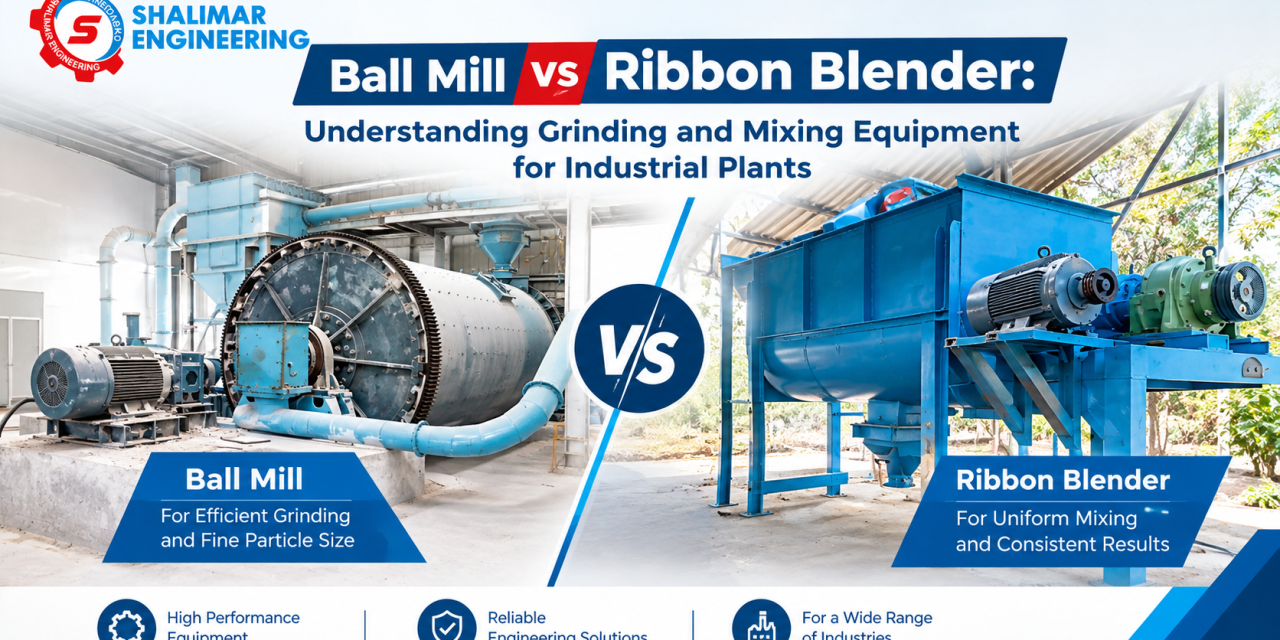
Ball Mill vs. Ribbon Blender: Understanding Grinding and Mixing Equipment for Industrial Plants
In heavy industrial manufacturing, operators frequently confuse the physical processes of size reduction and chemical blending. Crushing solid rocks into fine powder requires immense mechanical impact and attrition. In contrast, combining already powdered materials into a perfectly uniform mixture demands gentle, continuous folding. Applying the wrong mechanical force ruins product consistency, wastes massive amounts of electricity, and severely damages expensive machinery.
Understanding the stark mechanical differences between heavy impact crushers and horizontal powder mixers dictates the success of your entire production line. If you manufacture cement, you need impact force. If you formulate agricultural fertilizers, you need precise blending. In this highly detailed engineering analysis, we will contrast traditional tumbling impact cylinders with horizontal double-helical agitators. We will also explore how these distinct machines fit into a broader ecosystem of thermal drying, mineral agglomeration, and chemical granulation.
The Mechanics of Impact Size Reduction
When raw materials like limestone, quartz, or heavy cement clinker require ultra-fine size reduction, engineers turn to traditional tumbling equipment. A Ball Mill consists of a massive, horizontally mounted steel cylinder filled partially with forged steel or ceramic grinding media. As the drum rotates, internal lifter bars carry the heavy balls upward. When gravity overcomes centrifugal force, the balls cascade downward, crushing the raw feed trapped beneath them through sheer impact.
This continuous tumbling action is incredibly effective for both wet and dry processing. Establishing a Ball Mill Plant in Iran provides regional metallurgical facilities with the brute force necessary to process abrasive ores. Constructing this massive infrastructure requires close collaboration with a dedicated Ball Mill Plant manufacturer in Iran to ensure the internal wear liners can survive constant pounding. Procuring spare forged steel media through a reliable Ball Mill Plant supplier in Iran ensures your production never stalls. When sourcing the entire setup, utilizing a Ball Mill Plant exporter in Iran guarantees the heavy steel shell crosses borders safely.
To fully understand the engineering behind these crushers, operators often review technical literature from the biggest manufacturer and supplier of ball mills in india. Deeply analyzing exactly what is ball mill working principle types allows plant managers to optimize the rotation speed and grinding media charge specifically for their raw feed hardness.
The Mechanics of Precision Powder Blending
Once raw materials are successfully pulverized, the next stage often involves combining them with specific chemical additives. This phase strictly requires blending, not further crushing. An Industrial Ribbon Blender utilizes a stationary horizontal U-shaped trough containing a rotating double-helical agitator.
The Ribbon Blender Machine operates by pushing material in two opposing directions simultaneously. The outer ribbon moves powder toward the center of the trough, while the inner ribbon pushes it back toward the ends. This continuous, intersecting flow creates a highly uniform, homogeneous mixture without generating excessive heat or physically degrading fragile particles.
For the chemical and pharmaceutical sectors in the Middle East, a Ribbon Blender manufacturer in Iran offers heavy-duty stainless-steel fabrication to prevent chemical corrosion. A Ribbon Blender supplier in Iran assists in integrating the horizontal mixer perfectly into your automated bagging lines. Contracting a Ribbon Blender exporter in Iran simplifies the complex freight logistics of moving these wide, awkwardly shaped machines. By installing a high-quality Ribbon Blender, you eliminate batch inconsistencies in dry food products, agrochemicals, and specialized cement grouts.
Alternative Grinding Technologies: Vertical Compression
While tumbling impact cylinders excel at ultra-fine reduction, they consume massive amounts of electricity. For high-volume primary and secondary grinding of medium-hard materials, modern facilities increasingly deploy hydraulic compression. A Vertical roller mill utilizes hydraulic rams to force heavy crushing wheels down onto a rotating steel table, crushing rocks efficiently through continuous pressure rather than chaotic impact.
Sourcing this advanced machinery locally is vital. A vertical roller mill manufacturer in iraq ensures your equipment is designed to operate in extreme ambient temperatures. A vertical roller mill supplier in iraq provides rapid access to hydraulic tensioning spares, and a vertical roller mill exporter in iraq manages the heavy transport. Similarly, securing a vertical roller mill manufacturer in iran, a vertical roller mill supplier in iran, and a vertical roller mill exporter in iran provides identical localized support for neighboring industrial zones.
Matching Roller Configurations to Production Quotas
The number of crushing wheels inside a vertical setup dictates its output capacity. A 3 Roller Mill Plant offers standard industrial capacity. Setting up a 3 Roller Mill Plant in Iraq requires a 3 Roller Mill Plant manufacturer in Iraq to calibrate the dynamic air classifier. You must secure a 3 Roller Mill Plant supplier in Iraq for maintenance support, utilizing a 3 Roller Mill Plant exporter in Iraq for initial delivery.
For higher production demands, a 4 Roller Mill Plant provides increased throughput. Establishing a 4 Roller Mill Plant in Iran relies on a dedicated 4 Roller Mill Plant manufacturer in Iran, a 4 Roller Mill Plant supplier in Iran, and a 4 Roller Mill Plant exporter in Iran to handle the upgraded equipment requirements.
For maximum output in mega-facilities, a 5 Roller Mill Plant is mandatory. Constructing a 5 Roller Mill Plant in Iran requires a highly specialized 5 Roller Mill Plant manufacturer in Iran, a dependable 5 Roller Mill Plant supplier in Iran, and a 5 Roller Mill Plant exporter in Iran to manage the immense scale of the machinery. Regardless of the configuration you choose, ensuring all Minerals Chemicals Grinding Equipments integrate seamlessly is critical.
Preparing Material: Thermal Drying Systems
Neither impact crushing nor precision blending functions correctly if the raw material holds excessive moisture. Wet material severely clogs grinding tables and turns blended powders into useless sludge. To strictly control moisture content, operators utilize an Industrial Rotary Dryer.
A Rotary Dryer tumbles wet material continuously through a stream of hot combustion gases inside a massive inclined cylinder. When installing a rotary dryer in iraq, extreme environmental temperatures must dictate the thickness of the thermal insulation. Collaborating with a competent Rotary Dryer manufacturer in iraq ensures the burner is optimized for regional fuel types. A rotary dryer supplier in Iraq supplies necessary replacement trunnion wheels, and a rotary dryer exporter in iraq ensures the massive shell arrives intact.
Agglomeration: The Mineral Pelletizing Workflow
In the metallurgical sector, finely ground mineral dust cannot be processed directly; it must be formed into small, solid spheres. This requires an iron-ore beneficiation plant in iraq to purify the raw material first. The refined dust then enters the iron ore pelletizing process, where moisture and rotation cause the particles to agglomerate.
Building an Iron Ore Pelletizing plant in Iraq involves installing massive rotating discs. You must consult an Iron Ore Pelletizing plant manufacturer in Iraq to calibrate the angle and speed for your specific mineral. An Iron Ore Pelletizing plant supplier in Iraq ensures continuous operation, while an Iron Ore Pelletizing Exporter in Iraq manages equipment procurement.
This exact mechanical shaping applies to other resources. An Other Ore Pelletizing Plant in Iraq manages diverse chemical profiles. Collaborating with an Other Ore Pelletizing Plant manufacturer in Iraq, an Other Ore Pelletizing Plant supplier in Iraq, and an Other Ore Pelletizing Plant exporter in Iraq delivers specialized engineering. A complete Iron & Other Ore Pelletizing Plant ensures your exported minerals maintain high structural integrity. This entire iron ore pelletizing plant infrastructure relies heavily on the initial particle size generated by your primary crushers.
High-Temperature Calcination Solutions
Once mineral pellets are formed, they require extreme heat to harden permanently. This calcination phase utilizes a lime kiln or a similar heavy-duty thermal cylinder to reach temperatures exceeding 1,200 degrees Celsius.
A Rotary Kiln subjects the material to sustained, intense heat. Building a Rotary Kiln in Iraq demands highly specialized refractory fire-brick linings. Partnering with a specialized Rotary Kiln manufacturer in Iraq, a Rotary Kiln supplier in iraq, and a Rotary Kiln exporter in iraq guarantees your thermal vessel operates safely under extreme continuous stress.
Specialized Agricultural Granulation
The mechanical principles used to blend and agglomerate minerals apply directly to agricultural fertilizers. Water Dispersible Granules (WDG) are the industry standard for delivering crop protection chemicals without creating explosive dust hazards. Constructing a complete Sulphur WDG Plant involves wet milling, mixing, and controlled spray agglomeration.
Operating a Suplhur WDG Plant in Iraq strictly requires explosion-proof safety systems due to the volatile nature of sulfur dust. You must work with a certified Suplhur WDG Plant Manufacturer in Iraq and a Suplhur WDG Plant Supplier in Iraq to install inert gas blanketing. A Suplhur WDG Plant Exporter in iraq supplies the required safety release valves. Cross-border projects benefit from a Suplhur WDG Plant Manufacturer & Supplier in Iran, providing turnkey solutions for a dedicated Suplhur WDG Plant that guarantees safe, high-yield agricultural chemical manufacturing.
Integrating Operations with Material Conveyance
A massive processing facility cannot operate without robust transport infrastructure. Moving abrasive rocks, blended powders, and hot pellets requires heavily reinforced Material Handling Equipments. Belt conveyors move material horizontally, while bucket elevators feed the tops of silos and kilns. Enclosed screw conveyors are mandatory for moving fine, toxic powders without creating airborne respiratory hazards for plant personnel. A properly designed conveyance network prevents bottlenecks and ensures a metered feed rate into all your crushing and mixing machinery.
Frequently Asked Questions (FAQs)
Why should I use a horizontal agitator instead of a tumbling drum for powder blending?
A tumbling drum crushes material through violent impact, which will physically destroy fragile crystalline powders and generate unwanted heat. A horizontal double-helical agitator folds the powders together gently, maintaining particle integrity while achieving a perfectly uniform chemical mixture.
What determines the optimal rotation speed for a heavy impact cylinder?
The rotation speed must be precisely calculated to achieve a cascading effect. If it spins too slowly, the internal media merely slides, causing no impact. If it spins too fast, centrifugal force pins the media to the outer walls, completely halting all crushing action.
How do I prevent sticky powders from accumulating on the agitator blades?
Operators must maintain strict environmental moisture control prior to blending. Additionally, utilizing polished stainless steel for the trough and agitator drastically reduces surface friction, preventing material buildup and cross-contamination between different product batches.
Can a single production line incorporate both impact crushing and precise blending?
Absolutely. In fact, most complex chemical and metallurgical facilities follow a strict workflow: primary hydraulic compression, followed by secondary impact tumbling for ultra-fine size reduction, concluding with gentle horizontal blending to combine the pulverized dust with specific chemical binders.
Finalizing Your Equipment Procurement Strategy
Choosing between heavy impact crushing and gentle precision blending is not a matter of preference; it is dictated entirely by your raw material physics and final product requirements. By deeply understanding the mechanical differences and how these systems integrate with thermal drying, calcination, and material handling networks, you can design a highly profitable, bottleneck-free facility.
When planning your industrial expansion, partnering with a proven Industrial Spray Dryer & Evaporator Manufacturer & Supplier ensures you select the perfect equipment from a diverse, high-quality comprehensive industrial product range. Shalimar Engineering possesses the technical expertise to fabricate and install heavy-duty machinery tailored precisely to your application. To discuss your exact capacity requirements or request engineering drawings, please Contact us. If you are ready to formally upgrade your production line, submit a detailed Enquiry today, and our technical team will assist you immediately.