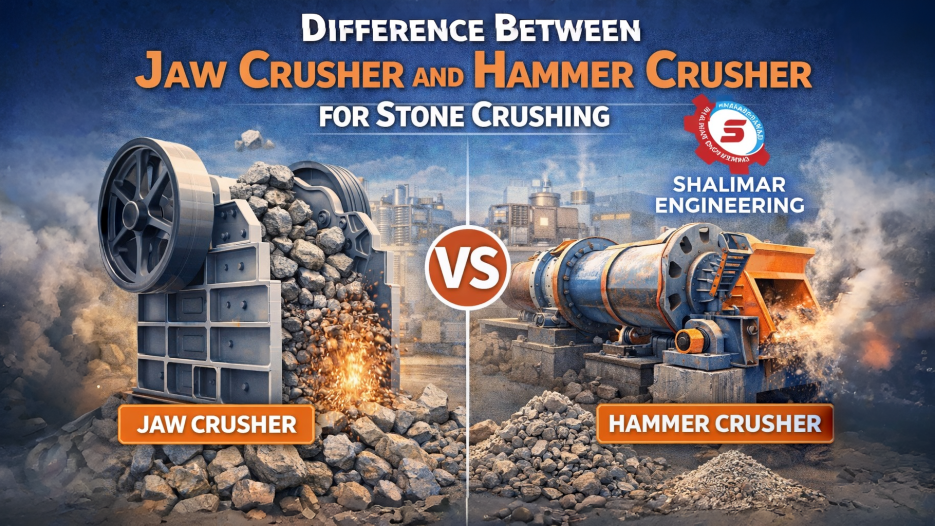
Choosing the right crusher for your stone crushing plant is one of the most critical decisions in setting up or upgrading a processing line. The two most commonly used crushers in the industry are the jaw crusher and the hammer crusher and while both are designed to reduce large materials into smaller pieces, they work on completely different principles and are suited for entirely different applications.
Shalimar Engineering is a trusted jaw crusher manufacturer and exporter based in Ahmedabad, India, supplying heavy-duty crushing equipment to mining, quarrying, cement, and construction industries across India and worldwide.
This guide gives you a clear, practical comparison between jaw crushers and hammer crushers so you can make the right selection for your specific application.
What is a Jaw Crusher
A jaw crusher is a primary crushing machine that uses two jaw plates one fixed and one moving to apply compressive force on the material fed between them. As the moving jaw swings back and forth, it crushes the material against the fixed jaw, breaking it into smaller pieces that fall through the gap at the bottom.
The jaw crusher working principle is based entirely on compression. No impact, no shear just pure compressive force applied between two heavy-duty manganese steel jaw plates. This makes the jaw crusher exceptionally well suited for very hard, abrasive, and tough materials like granite, basalt, quartzite, iron ore, and hard limestone.
Key Characteristics of a Jaw Crusher
- Crushing mechanism: Compression between fixed and moving jaw plates
- Material type: Hard to very hard, abrasive rocks and ores
- Feed size: Accepts very large feed — up to 630 mm and above
- Output size: Coarse to medium — typically 80 mm to 180 mm
- Position in plant: Used as a primary crusher for stone and ore
- Crushing ratio: Typically 4:1 to 6:1
- Moisture sensitivity: Can handle wet and dry materials
- Wear parts: Fixed jaw plate, swing jaw plate, toggle plate
What is a Hammer Crusher
A hammer crusher is a crushing machine that uses high-speed rotating hammers mounted on a rotor to strike the material with impact force, breaking it into smaller pieces. The crushed material exits through a screen or grate at the bottom once it reaches the required particle size.
The hammer crusher working principle is based on impact, not compression. High-speed hammers typically made from high manganese or chrome steel — strike the material repeatedly, causing it to fracture along natural grain boundaries and break into fine pieces quickly. A bottom discharge screen controls the output particle size.
Key Characteristics of a Hammer Crusher
- Crushing mechanism: High-speed impact by rotating hammers
- Material type: Medium-hard, brittle, and non-abrasive materials
- Feed size: Moderate feed size typically up to 300 mm
- Output size: Fine to medium can achieve finer output than jaw crushers
- Position in plant: Used as a secondary crusher machine or standalone fine crusher
- Crushing ratio: High up to 10:1 or more in a single pass
- Moisture sensitivity: Best for dry materials; wet and sticky materials cause clogging
- Wear parts: Hammers (blow bars), liners, screen/grate bars
Jaw Crusher vs Hammer Crusher — Full Comparison
This side-by-side comparison covers all the key technical and operational differences between a jaw crusher and a hammer crusher for stone crushing applications.
| Parameter | Jaw Crusher | Hammer Crusher |
| Crushing Principle | Compression | Impact |
| Suitable Material | Hard, abrasive rock and ore | Medium-hard, brittle material |
| Max Feed Size | Up to 630 mm+ | Up to 300 mm |
| Output Size | 80 mm to 180 mm (coarse) | 5 mm to 50 mm (fine) |
| Crushing Ratio | 4:1 to 6:1 | Up to 10:1 |
| Position in Plant | Primary crusher | Secondary / tertiary crusher |
| Moisture Tolerance | High — handles wet material | Low — not suitable for wet/sticky material |
| Abrasion Resistance | High — handles abrasive rock | Low — hammer wear increases with abrasive material |
| Maintenance Frequency | Lower | Higher (hammer replacement) |
| Energy Consumption | Moderate | Lower per tonne for soft material |
| Noise and Dust | Moderate | Higher |
| Product Shape | Irregular, coarse | More uniform, finer |
| Applications | Mining, quarry, hard rock | Coal, limestone, cement, gypsum |
When to Use a Jaw Crusher
The jaw crusher is the right choice when:
1. Material is very hard or abrasive
Granite, basalt, river pebbles, quartzite, iron ore, copper ore, and hard limestone all require the compressive crushing action of a jaw crusher. A hammer crusher would wear out rapidly on these materials due to the abrasive nature of the rock.
2. You need a primary crusher for large feed
The jaw crusher accepts the largest feed sizes — directly from a quarry blast or from a dump truck — making it the standard first-stage machine in any stone crushing plant. It handles feed sizes up to 630 mm and beyond without pre-sizing.
3. The material is wet or has high moisture content
Jaw crushers handle wet, sticky, and clay-bearing materials without clogging. Hammer crushers tend to block up with wet or sticky feed, causing operational problems.
4. You are processing ore for mining or mineral processing
The jaw crusher for mining and jaw crusher for quarry applications processes hard rock ore in the first stage before secondary and tertiary reduction. It is used in gold, copper, iron ore, and other mineral processing plants worldwide.
5. You want lower maintenance costs on wear parts
Jaw crusher jaw plates have a long service life compared to hammer crusher hammers, especially when processing hard and abrasive materials. The jaw plates can often be reversed to use both sides before replacement, reducing operating costs.
When to Use a Hammer Crusher
The hammer crusher is the right choice when:
1. Material is soft to medium-hard and brittle
Coal, gypsum, limestone, salt, chalk, and similar brittle materials are ideal for hammer crusher for limestone and hammer crusher for coal applications. The impact action breaks these materials quickly and efficiently with lower energy consumption per tonne.
2. You need a higher crushing ratio in one stage
When a finer output is required directly from a single crushing stage, the hammer crusher delivers a much higher crushing ratio than a jaw crusher. This can eliminate the need for a secondary crushing stage in certain applications.
3. You are processing material for cement or chemical industry
Cement plants, chemical plants, and fertilizer plants often use hammer crushers to prepare limestone, gypsum, and other raw materials because the output size and fines generated by hammer crushing match the requirements of subsequent grinding operations.
4. Product shape and fines content are acceptable
Hammer crushing generates more fines than jaw crushing. If the downstream process uses fine material like a cement grinding mill or a chemical reactor the fines produced by hammer crushing are not a problem and may actually be beneficial.
5. You need compact equipment with simple structure
Hammer crushers have a simpler structure, smaller footprint, and lower initial cost compared to jaw crushers of equivalent capacity. For applications where abrasion is low and material is brittle, the hammer crusher offers a cost-effective solution.
Jaw Crusher and Hammer Crusher in a Stone Crushing Plant
In a complete stone crushing plant, jaw crushers and hammer crushers often work together in series:
Stage 1 — Primary Crushing (Jaw Crusher) Large feed material from quarry blasting or mining enters the jaw crusher first. The jaw crusher reduces it from 300–600 mm feed to 80–180 mm output.
Stage 2 — Secondary Crushing (Hammer Crusher or Other) The jaw crusher output feeds into a secondary crusher which may be a hammer crusher, cone crusher, or impact crusher to reduce the material further to 10–50 mm for further screening or processing.
This two-stage setup is widely used in quarries, mining operations, cement plants, and aggregate production plants where a range of product sizes is required.
Why Choose Shalimar Engineering as Your Jaw Crusher Manufacturer and Exporter
Shalimar Engineering is a well-established jaw crusher manufacturer and exporter with a strong manufacturing track record and a growing global customer base.
Heavy-Duty Construction Our jaw crushers are built with Cr40 forged eccentric shafts, high manganese steel jaw plates, and branded bearings — all selected for maximum durability and long service life in continuous heavy-duty operation.
High Crushing Performance With a feed opening of 800×1060 mm and capacity up to 240 T/h, our MPE series single toggle jaw crusher delivers reliable, high-throughput crushing performance suited for demanding quarry and mining applications.
Complete Crushing Equipment Range Beyond jaw crushers, Shalimar Engineering also manufactures and supplies a complete range of crushing equipment including hammer crushers, roller crushers, lump breakers, and shredder machines — giving clients a single source for their entire crushing line.
Global Export Capability As a trusted jaw crusher exporter, Shalimar Engineering has supplied crushing machines to clients in the Middle East, Southeast Asia, Africa, and other regions. Our export-ready designs comply with international engineering standards.
Customized Solutions Every crushing application is different. Our engineering team evaluates your material properties, feed size, required output size, and production capacity to recommend the right crusher configuration for your project.
Full After-Sales Support From installation and commissioning to spare parts supply and maintenance guidance — Shalimar Engineering supports its clients throughout the full equipment lifecycle.
Frequently Asked Questions About Jaw Crusher and Hammer Crusher
Q1. What is the main difference between a jaw crusher and a hammer crusher?
A jaw crusher crushes material using compressive force between two jaw plates, making it suitable for very hard and abrasive rock. A hammer crusher crushes material using high-speed impact from rotating hammers, making it suitable for soft to medium-hard, brittle materials like coal, limestone, and gypsum.
Q2. Which crusher is better for hard rock like granite or basalt?
A jaw crusher is the correct choice for hard, abrasive rock like granite, basalt, and quartzite. The compressive crushing action handles high hardness materials efficiently, while hammer crushers would wear out quickly on such abrasive feed.
Q3. Which crusher gives finer output — jaw crusher or hammer crusher?
A hammer crusher gives finer output than a jaw crusher. The high crushing ratio of a hammer crusher (up to 10:1) produces finer particles in a single pass. A jaw crusher typically gives coarser output (80–180 mm) and is used as a primary crusher before secondary reduction.
Q4. Can a hammer crusher process wet material?
No. Hammer crushers are not suitable for wet, sticky, or high-moisture material as the wet feed tends to stick to the hammers and block the screen, causing operational problems. A jaw crusher handles wet material much better.
Q5. What is a single toggle jaw crusher?
A single toggle jaw crusher uses one toggle plate to drive the swing jaw. This design is simpler, lighter, and more economical than a double toggle jaw crusher, while still delivering high throughput. Shalimar Engineering’s MPE series is a single toggle jaw crusher designed for high-capacity primary crushing.
Q6. What materials are best suited for hammer crushers?
Hammer crushers are best suited for coal, limestone, gypsum, salt, chalk, clay, cement clinker, and other medium-hard, brittle, non-abrasive materials. They are widely used in cement plants, coal handling plants, and chemical processing industries.
Q7. Do you supply complete stone crushing plants?
Yes. Shalimar Engineering supplies complete stone crushing plants and ore crushing plants including jaw crushers, secondary crushers, vibrating screens, conveyors, and dust control systems fully integrated and ready for installation.
Q8. What is the jaw crusher capacity offered by Shalimar Engineering?
Shalimar Engineering’s MPE-3242 jaw crusher delivers a capacity of 115 to 240 T/h with a feed opening of 800×1060 mm and a maximum feed size of 630 mm. Custom sizes and capacities are available based on project requirements.
Get a Quote from India’s Trusted Jaw Crusher Manufacturer and Exporter
Whether you need a heavy-duty jaw crusher for primary stone crushing, a hammer crusher for limestone or coal processing, or a complete stone crushing plant with all equipment integrated — Shalimar Engineering has the manufacturing capability and application expertise to deliver the right solution.
We are India’s trusted jaw crusher manufacturer and exporter, building robust crushing equipment for industries across the globe.
Send an Enquiry Now and our engineering team will respond with a detailed technical proposal and competitive quote within 24 hours.