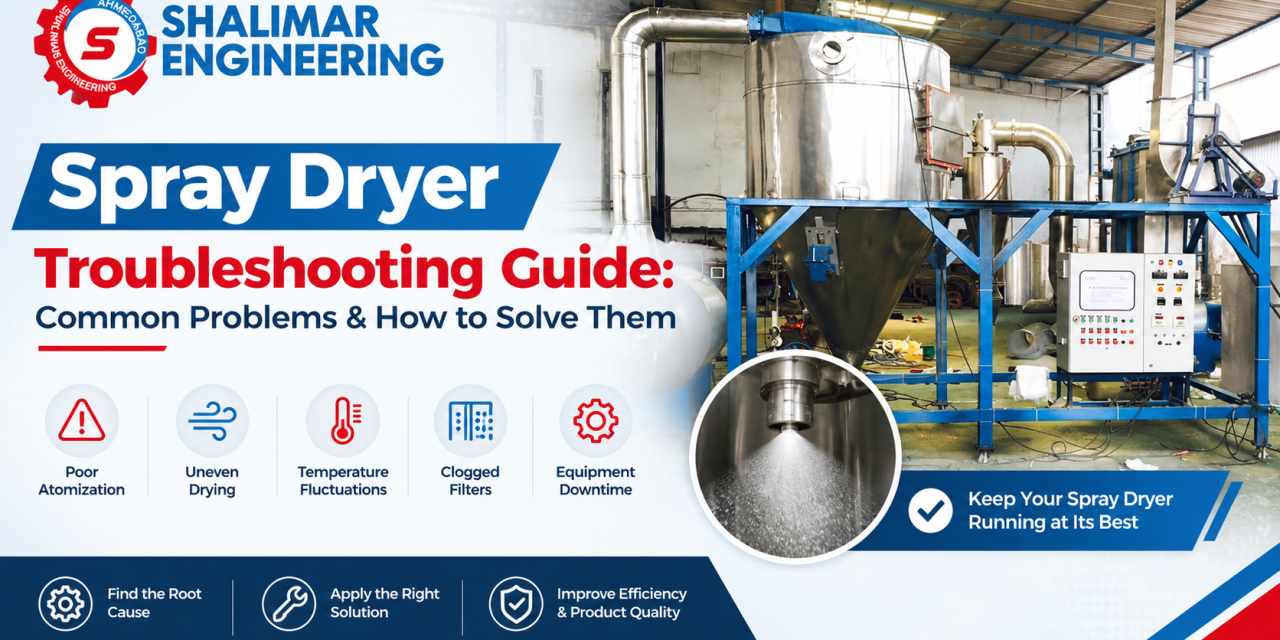
Spray Dryer Troubleshooting Guide: Common Problems & How to Solve Them
A smooth-running drying tower is a quiet one. The moment you hear uneven airflow, see powder sticking to the chamber walls, or notice moisture creeping into your finished product, something inside the system has shifted. For plant engineers in food, pharma, ceramics, dairy, and chemical processing, these early warning signs often decide whether you meet the day’s production target or spend hours cleaning down.
This guide walks through the problems that most often appear during drying operations, what triggers them, and the practical fixes that get the chamber back to steady state. If you have ever opened an inspection door to see a brown crust lining the cone or watched outlet humidity climb for no obvious reason, the solutions ahead will give you a clear path forward.
Why Drying Chambers Underperform: The Common Culprits
Drying towers are precision-balanced systems. Three variables govern their performance: inlet air temperature, atomised droplet size, and feed concentration. When any one of these drifts outside its design window, the whole process reacts.
The chamber itself is a controlled environment where hot gas and atomised liquid meet in milliseconds. A properly engineered Spray Dryer is designed to handle a specific feed with a specific moisture profile. When operators change the recipe, scale up throughput, or let maintenance slip, performance suffers in predictable ways. Recognising which variable has shifted is the first step toward getting output back on specification.
Problem 1: Wet Powder at the Outlet
Wet powder exiting the collection cone is one of the most frequent complaints raised by production teams. The issue affects flowability, storage life, and often forces secondary drying.
Likely Causes
Insufficient inlet air temperature tops the list. If the burner or hot air generator is undersized or underperforming, incoming gas cannot carry enough thermal energy to evaporate the entire droplet before it reaches the wall or cone. Feed rate running above design capacity has the same effect: too much liquid, too little heat per kilogram.
Atomiser wear is another frequent cause. As wheel vanes or pressure nozzle orifices erode, droplet size increases, slowing evaporation and raising residual moisture.
Practical Fixes
Verify that theHot Air Generator is delivering design temperature at the chamber inlet. Check for air leaks between the heater and the chamber. Inspect the atomiser for wear patterns, and replace worn components. If feed solids content has risen, reduce feed rate until the chamber reaches equilibrium at the required outlet moisture.
Problem 2: Wall Deposits and Build-Up
Material sticking to the chamber walls is both a product loss issue and a safety concern. Thick deposits can collapse during cleaning or carry residual moisture that supports microbial growth in food applications.
Why Deposits Form
Wall deposits usually trace back to droplets hitting the chamber surface before they are fully dry. This happens when the atomised spray cone is too wide for the chamber diameter, or when secondary airflow patterns push partially dried particles outward.
Sticky feeds containing high sugar content, hygroscopic salts, or thermoplastic polymers also contribute. These materials remain tacky above their glass transition temperature and adhere wherever they touch.
Corrective Actions
Adjust atomiser speed or nozzle pressure to narrow the spray cone. Verify that the air distributor at the top of the chamber delivers uniform downward flow. For sticky feeds, consider lowering outlet temperature just below the material’s sticky point, or add anti-caking agents to the formulation.
Chamber wall cooling using a double-jacket design is standard for difficult materials. Many plants also install chamber wall air sweeps that create a thin film of dry air between the deposit zone and the material.
Problem 3: Nozzle or Atomiser Clogging
A clogged atomiser is one of the fastest ways to stop production. Pressure nozzles with orifice diameters below 1 mm are particularly vulnerable to blockage from undissolved solids, scale particles, or crystallisation.
Sources of Blockage
Partial crystallisation in the feed line, especially with saturated salt solutions, builds up slowly and eventually blocks flow entirely. Temperature drops in the feed delivery line accelerate this.
Resolution Steps
Install high-efficiency inline filters sized at roughly 25 per cent of the nozzle orifice diameter. Maintain feed line temperature using heat tracing or jacketed piping. For wheel atomisers, inspect the distribution channels for scale and clean with appropriate solvents during each stop. Keep spare nozzles or wheels on hand so that production can resume quickly while worn components are refurbished.
Problem 4: Fine Particle Loss in Exhaust
Powder escaping through the exhaust stream represents direct yield loss. A well-designed cyclone or bag filter captures 99 per cent or more of the fines, but inefficient recovery drains margins quickly.
Diagnostic Approach
Measure exhaust particulate concentration at the stack. Compare against design values. Rising emissions suggest cyclone vane wear, bag filter leaks, or incorrect fan speed.
Check cyclone geometry for erosion, particularly at the inlet throat and dust discharge. Measure differential pressure across bag filters; abnormal readings indicate blinding, bag failure, or cleaning system malfunction.
Fixes to Apply
Repair or replace worn cyclone components. For bag filters, verify pulse-jet cleaning sequence, pressure, and timing. Many plants benefit from installing a secondary wet scrubber for ultrafine recovery. Adjusting exhaust fan speed to match the designed airflow balance restores cyclone efficiency without over-pulling air through the chamber.
Problem 5: Uneven Particle Size Distribution
Variable particle size affects downstream packing, dissolution, and compaction properties. Buyers in instant food, dairy, and detergent industries reject batches that fall outside specification.
Why Size Varies
Atomiser condition is the primary driver. Worn pressure nozzles produce broader size distributions. For rotary atomisers, speed drift from VFD issues or belt slippage causes immediate changes in mean particle size.
Feed viscosity fluctuations also matter. A thicker feed produces larger droplets at the same atomisation energy. Temperature control in feed tanks and homogenisation of feed concentration both play a role.
Correction Methods
Install feed viscometers for continuous monitoring. Service atomisers on a scheduled basis rather than waiting for failure. For wheel atomisers, check bearing condition and lubrication at every planned shutdown. Verify VFD output stability and belt tension on belt-driven units.
Problem 6: Thermal Degradation of Product
Heat-sensitive materials such as enzymes, probiotics, flavours, and certain pharmaceutical actives degrade when exposed to excessive outlet temperatures or extended residence times.
Identifying Thermal Damage
Loss of activity, colour change, or off-odours in the finished powder usually signal thermal stress. Analytical testing confirms the extent of degradation.
Operating Adjustments
Lower inlet air temperature and compensate by reducing feed rate. For extremely sensitive materials, two-stage drying using a chamber plus a Vibratory Fluid Bed Dryer reduces thermal exposure. The chamber removes bulk moisture at higher temperature, while the fluid bed completes drying at a lower, gentler temperature.
Alternative drying technologies may suit specific materials better. A Belt Dryer handles heat-sensitive granules at low temperatures over longer residence times, while a Tray Dryer suits smaller batch operations where product integrity matters more than throughput.
Problem 7: Capacity Shortfall
Plants often struggle to reach rated throughput, especially after years of operation or when switching to a new product.
Where Capacity Disappears
Air leakage into the chamber dilutes thermal energy. Heat exchanger fouling reduces inlet temperature. Fan wear reduces airflow. Each loss compounds the others.
Recovery Plan
Perform an air balance survey. Seal every identifiable leak point, including seals at the atomiser mounting, inspection doors, and powder discharge valves. Clean the air heater and verify burner tuning. Measure actual airflow at the inlet and exhaust, and compare against design values.
For plants handling slurries or pasty feeds, pre-treatment through a Spin Flash Dryer or feed concentration using an evaporator may increase effective capacity more cost-effectively than modifying the main chamber.
Problem 8: Explosion Risk and Dust Hazards
Dried powders in high concentrations create explosive atmospheres. Starch, dairy proteins, sugar, and many pharmaceutical intermediates have measurable minimum ignition energies.
Risk Factors
Static electricity, hot surfaces, mechanical sparks, and self-heating of accumulated deposits all contribute. Oxygen concentration above the limiting value supports combustion.
Mitigation Strategies
Install explosion suppression systems, pressure relief panels, or inert gas (nitrogen) blanketing for high-risk products. Ground all metal surfaces properly to dissipate static charge. Maintain regular cleaning to prevent deposit accumulation. Train operators on dust hygiene standards and ensure proper electrical classification of all equipment in the drying area.
Comparison: Drying Technology Choices by Application
Not every material suits a single tower design. The table below shows how different drying technologies compare across common parameters.
| Technology | Best For | Residence Time | Thermal Stress |
|---|---|---|---|
| Spray Tower | Liquid feeds, powders | 10 to 30 seconds | Moderate |
| Spin Flash | Pastes, filter cakes | 1 to 5 seconds | Low to moderate |
| Rotary Drum | Granules, lumpy feeds | 10 to 60 minutes | High |
| Tray Oven | Small batches, delicate | 2 to 24 hours | Variable |
| Belt Conveyor | Granular, heat-sensitive | 10 to 90 minutes | Low |
| Fluid Bed | Finishing stage | 5 to 30 minutes | Low |
Preventive Measures That Pay Back
Planned maintenance costs a fraction of unplanned downtime. A quarterly inspection schedule covering atomisers, air filters, heat exchangers, cyclone condition, and instrumentation calibration prevents most of the problems covered above.
Keep a log of every parameter change, feed variation, and quality deviation. Patterns emerge over months that single incidents never reveal. Many plants also benefit from installing data historians that correlate feed properties, operating conditions, and product quality.
Operator training is equally critical. A technician who understands why outlet temperature matters will act on a 5-degree drift before it becomes a quality problem. Suppliers of Drying Equipments often provide on-site training as part of the commissioning package, and this investment pays back many times over.
Choosing a Reliable Equipment Supplier
The quality of your drying tower sets the ceiling on what maintenance can achieve. An experienced Spray Dryer Manufacturer will advise on correct chamber sizing, atomiser selection, and auxiliary equipment during the design phase, long before fabrication begins. Working with Spray Dryer Suppliers who understand your industry prevents the mismatch problems that plague off-the-shelf equipment buyers.
Specialist Spray Drying Equipment designed for pharma or food applications includes CIP systems, stainless steel contact surfaces, and documentation to meet GMP standards. A reliable Spray Dryer Manufacturer in Ahmedabad or elsewhere in India will provide design validation support, factory acceptance tests, and installation supervision.
For international buyers, the credentials of a Spray Dryer Manufacturer in India should include export documentation experience, international shipping arrangements, and a global service network. Shalimar Engineering supports clients across continents with engineering, fabrication, and commissioning services tailored to each project.
Complementary equipment often matters as much as the main tower. A properly sized Ribbon Blender for pre-mixing additives or a Ball Mill for feed preparation ensures consistent input to the drying chamber. Material transport using correct Material Handling Equipments prevents segregation and contamination between process steps.
Specialised plant integrations such as a Sulphur WDG Plant or an Iron & Other Ore Pelletizing Plant often combine drying with downstream processing, and sourcing both systems from one supplier simplifies warranty coverage and spare parts logistics.
Frequently Asked Questions (FAQs)
Q1. How often should atomiser nozzles be inspected?
Pressure nozzles should be inspected every 500 to 1,000 operating hours, depending on feed abrasiveness. Rotary atomiser wheels typically need inspection every 2,000 to 4,000 hours.
Q2. What causes outlet temperature to drop suddenly?
Sudden drops often indicate feed rate spikes, atomiser failure causing coarse droplets, or compressed air loss in air-atomised systems. Check feed pump output and atomiser condition first.
Q3. Can one drying tower handle multiple products?
Yes, with proper cleaning protocols between products. However, materials with widely different drying characteristics may require atomiser changes, airflow adjustments, or inlet temperature changes that take time to stabilise.
Q4. How is yield loss calculated in a drying operation?
Yield loss equals feed solids input minus powder collected, expressed as a percentage. Typical well-run operations achieve 95 to 99 per cent recovery. Lower numbers point to cyclone or bag filter inefficiency.
Q5. What safety certifications apply to drying equipment?
Food applications require 3-A or EHEDG compliance. Pharma applications follow cGMP and often need FDA-compliant materials. Dust explosion safety follows ATEX or NFPA 68/654 standards depending on jurisdiction.
Q6. How long does commissioning typically take?
Mechanical installation takes 3 to 6 weeks for a mid-sized unit. Commissioning and performance testing add another 2 to 4 weeks, including trial runs with actual feed material.
Q7. What spare parts should be stocked for routine operation?
Essential inventory includes spare atomiser nozzles or wheel sets, bag filter cartridges, bearing sets for rotating equipment, instrumentation sensors, and gaskets for inspection doors.
Get Expert Support for Your Drying Operation
Every drying challenge has a solution, but identifying the right one quickly requires experience that only comes from years of plant commissioning and troubleshooting. If your tower is underperforming, if you are planning an upgrade, or if you need engineering support for a new installation, direct consultation delivers faster results than trial and error.
Contact our support experts with your operating data, feed specifications, and current challenges. Our engineering team based in Ahmedabad, Gujarat, serves clients across food, pharma, chemical, dairy, ceramic, and mineral industries throughout India and overseas, with complete fabrication, installation, and after-sales service support.