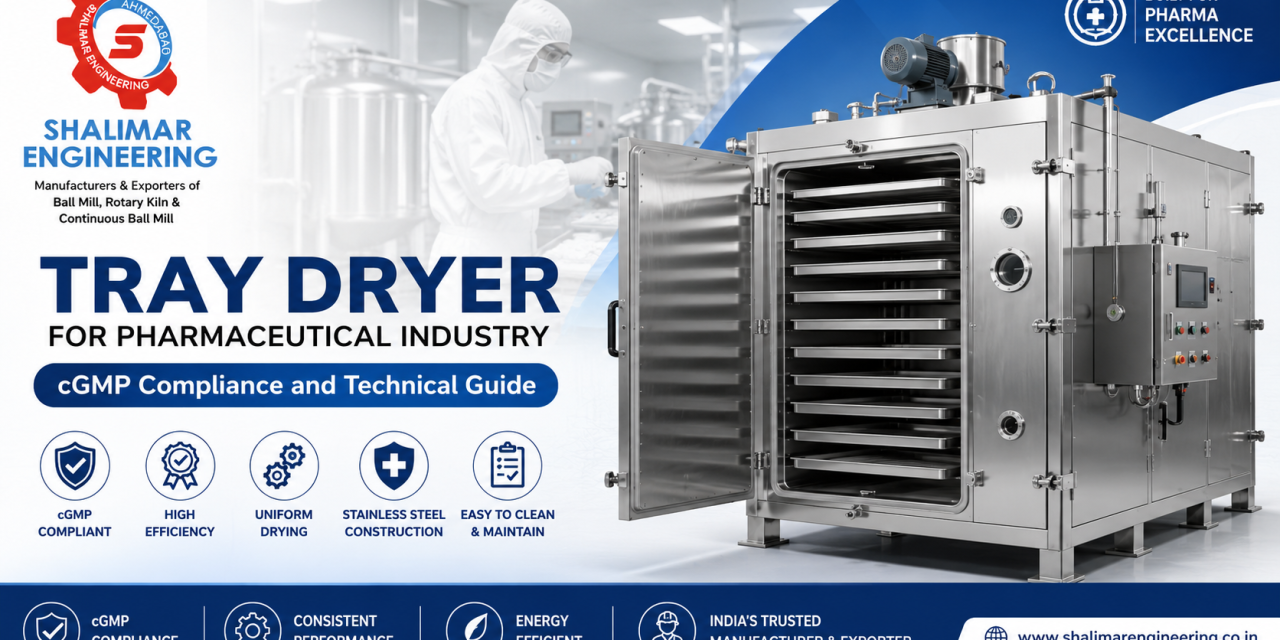
Tray Dryer for Pharmaceutical Industry cGMP Compliance and Technical Guide
In pharmaceutical manufacturing, drying is not just a process step it is a critical quality operation. The wrong drying equipment, incorrect temperature settings, or non-compliant construction materials can result in product degradation, microbial contamination, batch rejection, or regulatory non-compliance.
Among all drying equipment used in pharmaceutical plants, the tray dryer remains the most widely used machine for granule drying, powder drying, API intermediate drying, and herbal material drying. It is simple, validated, easy to clean, and when manufactured to the correct cGMP standard fully compliant with Schedule M, WHO GMP, and US FDA requirements.
This guide covers everything a pharmaceutical plant manager, production engineer, or procurement manager needs to know about tray dryers for pharmaceutical use cGMP construction requirements, validation protocols, temperature and airflow settings, and how to specify the right machine for your plant.
What is a Tray Dryer?
A tray dryer also called a cabinet dryer or shelf dryer is a batch drying machine where wet material is spread on perforated stainless steel trays and placed inside an insulated cabinet. Heated air is circulated across and through the trays by a blower, removing moisture from the material until the target moisture content is reached.
The tray dryer machine operates at controlled temperature typically 40°C to 120°C for pharmaceutical applications with uniform airflow across all tray levels to ensure consistent drying throughout the batch.
Key operating characteristics of a pharmaceutical tray dryer:
- Operation mode: Batch
- Temperature range: 40°C to 120°C (pharmaceutical range)
- Heating medium: Electric elements or steam coils
- Air circulation: Internal recirculation fan with fresh air inlet and exhaust damper
- Tray material: SS 316L perforated trays with mirror finish
- Capacity: 24 trays to 192 trays depending on cabinet size
- Control: PLC-based with data logging for 21 CFR Part 11 compliance in regulated plants
Shalimar Engineering manufactures tray dryer machines for pharmaceutical, chemical, food, and herbal industries with cGMP-compliant construction, full validation documentation support, and custom configurations for regulated manufacturing environments.
Why Tray Dryers Are the Standard Choice in Pharmaceutical Plants
Pharmaceutical plants across India from bulk drug manufacturers in Hyderabad and Ahmedabad to formulation plants in Mumbai and Baddi use tray dryers as the primary batch drying equipment for several clear reasons:
Batch traceability: Every batch loaded onto trays is a discrete, traceable unit. Start time, end time, temperature profile, and moisture readings are recorded for each batch a fundamental GMP requirement.
Gentle drying: Unlike fluidized bed dryers that subject granules to high-velocity air streams, a tray dryer dries material statically on trays. This prevents attrition of fragile granules and is preferred for granules that must maintain specific size and shape for tablet compression.
Flexibility: The same tray dryer handles granules, powders, APIs, intermediates, herbal extracts, and wet cake from filter presses. Tray loading can be adjusted for different materials and moisture levels without equipment changeover.
Validation simplicity: Tray dryers are well-established equipment in pharmaceutical regulatory frameworks. Validation protocols IQ, OQ, PQ are standardized, and regulatory inspectors from CDSCO, WHO, and US FDA are familiar with the equipment and its qualification requirements.
Low capital cost: Compared to fluidized bed dryers, spray dryers, and freeze dryers, a tray dryer machine is significantly lower in capital cost making it the practical first choice for small and mid-size pharmaceutical manufacturers.
Partner With a Trusted Machinery Manufacturer
Get durable and efficient industrial equipment from Shalimar Engineering, designed to meet your production requirements with technical expertise and quality assurance.
| Contact Us ➝ |
cGMP Construction Requirements for Pharmaceutical Tray Dryers
A tray dryer used in pharmaceutical manufacturing must meet specific construction standards to comply with Schedule M (Indian GMP), WHO GMP, and US FDA cGMP requirements. Here are the non-negotiable construction requirements:
Contact Surface Material — SS 316L
All surfaces that come into contact with the product trays, tray supports, interior cabinet walls, air distribution baffles must be constructed from SS 316L stainless steel. SS 316L contains molybdenum, which gives it superior corrosion resistance compared to SS 304 critical for pharmaceutical applications involving organic solvents, acidic intermediates, and high-humidity drying environments.
Surface finish on all contact parts must be 2B or mirror finish Ra ≤ 0.8 microns to prevent product adhesion, facilitate cleaning, and eliminate crevices where microbial contamination could accumulate.
Non-Contact Surfaces — SS 304
Outer cabinet panels, frame, and structural components are typically SS 304 which is acceptable for non-contact surfaces and provides good corrosion resistance in pharmaceutical plant environments.
Gaskets and Seals — Silicone
All door gaskets, access panel seals, and internal seals in a cGMP tray dryer must be pharmaceutical-grade silicone FDA-approved, non-reactive, cleanable, and resistant to the temperature range of the dryer. Rubber gaskets are not acceptable in pharmaceutical tray dryers.
Air Filtration — HEPA at Supply and Exhaust
Inlet air supplied to the drying chamber must pass through HEPA filtration (H13 or H14 grade 99.97% efficiency at 0.3 microns) before entering the product zone. This prevents particulate contamination of the product from the external environment.
Exhaust air must also be filtered before discharge both to prevent cross-contamination between adjacent manufacturing areas and to capture any product dust entrained in the exhaust stream.
Insulation
Cabinet walls must be insulated with pharmaceutical-grade, non-particle-shedding insulation typically mineral wool or polyurethane foam encased in the SS outer and inner panels. This maintains temperature uniformity inside the cabinet and prevents condensation on outer surfaces.
Crevice-Free Fabrication
All internal welds must be continuous no gaps, no overlapping joints, no internal ledges or crevices that could trap product or moisture. Welds are ground smooth and polished to match the surrounding surface finish. This is a fundamental GMP construction requirement for any pharmaceutical equipment.
Temperature Uniformity — The Critical Performance Parameter
In a pharmaceutical tray dryer, temperature uniformity across all tray positions is the single most important performance parameter. Non-uniform temperature means:
- Over-drying of material on trays near the heating elements
- Under-drying of material on trays far from the heat source
- Batch failure moisture content out of specification across the batch
- Potential product degradation at hot spots
Acceptable temperature uniformity for pharmaceutical tray dryers: ±2°C across all tray positions at steady-state operation. This is verified during OQ (Operational Qualification) using calibrated temperature mapping with data loggers placed at every tray position simultaneously.
Factors that affect temperature uniformity in a tray dryer machine:
- Air circulation fan speed and design — Uniform air distribution across all tray levels requires correct fan sizing and internal baffling
- Tray loading — Overfilled trays block airflow. Material depth on trays should not exceed 20–25 mm for most pharmaceutical granules
- Tray spacing — Consistent tray-to-tray spacing maintained by standardized tray supports ensures uniform airflow between all tray levels
- Heating element or steam coil placement — Symmetric heating element layout prevents hot and cold zones inside the cabinet
Validation Requirements for Pharmaceutical Tray Dryers
Any tray dryer installed in a pharmaceutical manufacturing area must be validated through a formal qualification process before use in production. The standard validation sequence is:
Installation Qualification (IQ)
IQ verifies that the tray dryer has been installed correctly according to the manufacturer’s specifications and the plant’s URS (User Requirement Specification). IQ documentation covers:
- Equipment identity — model, serial number, manufacturer details
- Utility connections — electrical supply, steam connection, compressed air (if applicable)
- Material of construction certificates — SS 316L mill certificates for contact parts
- Calibration certificates — temperature sensors, controllers, data loggers
- HEPA filter certificates — efficiency test report
- Drawings — as-installed P&ID and equipment layout
Operational Qualification (OQ)
OQ verifies that the tray dryer machine operates within the specified operating parameters across its operating range. OQ testing includes:
- Temperature mapping — Calibrated data loggers at every tray position record temperature over a minimum 4-hour mapping run at each operating temperature setpoint. Uniformity must be within ±2°C at steady state.
- Airflow verification — Air velocity measurement at tray level confirms adequate and uniform airflow across the cabinet
- Temperature control accuracy — Controller setpoint vs. actual temperature accuracy verification
- Alarm and interlock testing — Over-temperature alarm, door open interlock, blower failure alarm
- HEPA filter integrity — DOP or PAO challenge test at installation and annually thereafter
Performance Qualification (PQ)
PQ verifies that the tray dryer consistently produces product meeting specification when operated with actual product under normal manufacturing conditions. PQ is run with the actual pharmaceutical product granules, powder, or wet cake at the defined process parameters.
PQ documentation records: tray loading weight, initial moisture content, temperature setpoint, drying time, final moisture content, and uniformity across tray positions for a minimum of three consecutive batches.
Temperature and Time Settings — Pharmaceutical Reference Guide
Different pharmaceutical materials require different drying temperatures. Exceeding the correct temperature degrades product quality; insufficient temperature results in under-dried product that fails moisture specifications.
| Material Type | Typical Drying Temperature | Typical Drying Time |
|---|---|---|
| Wet granules (tablet manufacturing) | 50°C – 60°C | 4–8 hours |
| API intermediates | 40°C – 70°C (material-specific) | 6–12 hours |
| Herbal extracts and powders | 50°C – 65°C | 6–10 hours |
| Hygroscopic materials | 40°C – 55°C | 8–16 hours |
| Crystalline APIs | 60°C – 80°C | 4–8 hours |
| Wet cake from filter press | 60°C – 80°C | 6–12 hours |
| Ayurvedic formulations | 50°C – 65°C | 6–12 hours |
These are reference starting points. Actual drying time and temperature for each product must be determined through development studies and validated through the PQ protocol.
Tray Loading — The Most Common Operating Error
The single most common operational error in pharmaceutical tray dryer use is overloading trays. Plant operators spread material too thickly sometimes 40–50 mm depth to maximize batch size per drying cycle.
The consequences:
- The surface layer of material dries while the core remains wet giving a false low moisture reading if only surface samples are tested
- Airflow between tray levels is restricted reducing temperature uniformity across the cabinet
- Drying time extends significantly reducing equipment throughput
- Batch moisture content is non-uniform failing QC specification
Correct tray loading for pharmaceutical granules: 10–20 mm material depth on perforated trays. This allows adequate airflow through the material bed and ensures uniform drying from surface to bottom of the bed.
Tray dryer manufacturers in India should provide recommended tray loading guidelines as part of the equipment documentation and operators must be trained to follow them consistently.
How Shalimar Engineering Builds cGMP Tray Dryers
At Shalimar Engineering, every pharmaceutical tray dryer is manufactured to a defined cGMP construction standard not as a modified industrial dryer but as purpose-built pharmaceutical equipment.
Our pharmaceutical tray dryer machines include:
- SS 316L contact surfaces — mirror finish, Ra ≤ 0.8 microns, crevice-free internal welds
- SS 304 outer cabinet — robust, corrosion-resistant, easy to clean externally
- Pharmaceutical-grade silicone gaskets — FDA-approved, temperature-rated
- HEPA filtration — H13 grade at supply air inlet, pre-filter at exhaust
- PLC-based temperature controller — with digital display, setpoint lock, and data logging output for 21 CFR Part 11 compliant data recording
- Calibrated temperature sensors — PT100 RTD sensors at multiple cabinet positions
- Over-temperature safety cutout — independent of the main controller
- SS 316L perforated trays — uniform perforation pattern, rolled edges, no sharp corners
- Validation documentation package — DQ, IQ, OQ protocols and report templates, material certificates, calibration certificates
We supply tray dryers in standard sizes from 24 trays to 192 trays and manufacture custom sizes for specific batch volume requirements.
View our complete Tray Dryer range — specifications, tray counts, cabinet sizes, and cGMP construction details for pharmaceutical, chemical, and food applications.
Frequently Asked Questions
Q1. What is the acceptable temperature uniformity for a pharmaceutical tray dryer?
Regulatory guidance and industry practice require temperature uniformity of ±2°C across all tray positions at steady-state operation in a pharmaceutical tray dryer. This is verified through temperature mapping during OQ qualification using calibrated data loggers at every tray position simultaneously.
Q2. What material of construction is required for a cGMP tray dryer?
All product-contact surfaces in a pharmaceutical tray dryer must be SS 316L stainless steel with a mirror finish (Ra ≤ 0.8 microns). Gaskets must be pharmaceutical-grade silicone. Non-contact surfaces outer cabinet, frame — are typically SS 304. These requirements apply under Schedule M, WHO GMP, and US FDA cGMP standards.
Q3. How many trays does a pharmaceutical tray dryer typically have?
Pharmaceutical tray dryer machines are available from 24 trays (small batch, R&D, pilot scale) to 192 trays (large-scale production). The correct size depends on batch weight, material bulk density, and required tray loading depth. Tray dryer manufacturers in India size the cabinet based on the client’s batch size and production schedule.
Q4. Does a tray dryer need HEPA filtration for pharmaceutical use?
Yes. A pharmaceutical tray dryer must have HEPA filtration (H13 or H14 grade) on the supply air inlet to prevent particulate contamination of the product. Exhaust air filtration is also required to prevent cross-contamination in the manufacturing area and to capture product dust. HEPA filter integrity must be tested at installation and at defined intervals.
Q5. How do I get a cGMP-compliant tray dryer with validation documentation?
Contact a qualified tray dryer manufacturer in India with your batch size, material type, required temperature range, and regulatory standard (Schedule M, WHO GMP, US FDA). Shalimar Engineering supplies cGMP pharmaceutical tray dryers with complete validation documentation DQ, IQ, OQ protocols and report templates, material certificates, and HEPA filter test reports as standard deliverables.
Get a cGMP Tray Dryer from Shalimar Engineering
A pharmaceutical tray dryer is not a commodity purchase. The construction standard, material certifications, validation documentation, and after-sales support determine whether your equipment passes regulatory inspection and whether your product consistently meets quality specification batch after batch.
Shalimar Engineering is a trusted tray dryer manufacturer and supplier in India with 20+ years of experience manufacturing pharmaceutical-grade drying equipment for bulk drug manufacturers, formulation plants, herbal product manufacturers, and API producers across India and in export markets across Asia, Africa, and the Middle East.
Our engineering team reviews your batch size, material, regulatory requirement, and utility availability and recommends the correct tray dryer specification with full cGMP construction and validation documentation support.
Three Actions to Move Forward Today
View our Tray Dryer specifications — Cabinet sizes, tray counts, cGMP construction details, and standard features for pharmaceutical tray dryer machines from Shalimar Engineering.
Request a cGMP compliance document pack — Ask our team for a sample DQ, IQ, OQ documentation set for the tray dryer model that fits your batch size. We provide this before purchase so your quality team can review compliance before equipment order.
Contact Shalimar Engineering — Speak directly with our pharmaceutical equipment team. Share your batch size, material, and regulatory requirement and receive a technical proposal with pricing within 24 hours.
Your drying equipment must pass regulatory inspection. Make sure it is built by a manufacturer who understands pharmaceutical cGMP not just general industry standards.
Looking for Custom Industrial Machinery Solutions?
Shalimar Engineering provides high-quality industrial machinery with custom designs, expert support, and reliable solutions for diverse processing industries.
| Contact Us ➝ |