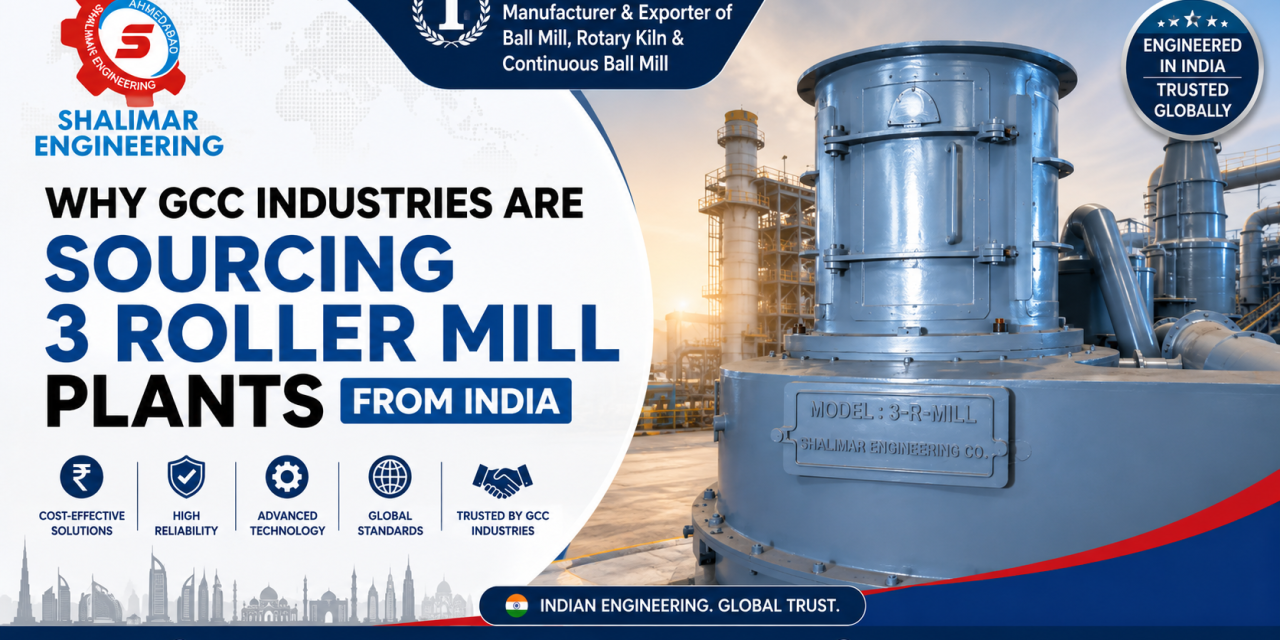
Why GCC Industries Are Sourcing 3 Roller Mill Plants from India
The industrial landscape across the Gulf Cooperation Council (GCC) is evolving rapidly, driven by massive infrastructure expansion and industrial diversification initiatives. As processing plants in Saudi Arabia, Oman, Qatar, Kuwait, UAE, and Bahrain scale up operations, the demand for robust, high-efficiency size reduction machinery has reached an all-time high. Among various grinding setups, the 3 Roller Mill Plant has emerged as the preferred choice for handling minerals, fertilizers, and specialty chemical powders. Sourcing these precision-engineered grinding systems from established Indian manufacturers gives Gulf enterprises the ideal combination of international quality compliance, cost efficiency, and seamless export support.
The Shift Happening in Industrial Procurement Across the Gulf
Over the past decade, procurement teams across Saudi Arabia, UAE, Oman, Qatar, Kuwait, and Bahrain have steadily shifted toward Indian industrial equipment for one practical reason: value without compromise. Indian manufacturers, particularly those operating out of industrial hubs like Ahmedabad, have matured into serious global suppliers capable of delivering precision-engineered machinery at internationally competitive prices.
The 3 Roller Mill Plant is one of the clearest examples of this shift. Processing industries across the GCC region — spanning minerals, fertilizers, chemicals, and specialty powders — require consistent, fine grinding output at high throughput. Indian-manufactured roller mills have become a go-to solution.
But what is actually driving this preference, and what should you know before making a sourcing decision?
Understanding What a 3 Roller Mill Plant Actually Does
Before evaluating suppliers, it helps to understand what the equipment does and why the configuration matters.
A roller mill plant achieves particle size reduction through compressive force between rotating rollers. In a three-roller configuration, the material passes sequentially through two nip zones (the gap between roller pairs), creating a two-stage compression that produces more uniform output than a single-pass design.
This makes the 3 Roller Mill Plant particularly well-suited for:
- Grinding minerals like calcium carbonate, feldspar, talc, and barite
- Processing agricultural chemicals and fertilizer base materials
- Fine grinding of pigments, dyes, and specialty chemicals
- Reducing coal and coke to specific particle sizes for combustion or industrial use
The precision of the output — often measured in microns — depends heavily on the quality of the roller gap control mechanism and the surface finish of the rollers themselves. This is where supplier quality diverges most sharply.
Have Questions About Industrial Machinery?
Get in touch with our engineering experts at Shalimar Engineering to discuss your project requirements, technical specs, or site support.
Why Saudi Arabia and Oman Are Key Markets for This Equipment
Saudi Arabia’s Vision 2030 industrial diversification agenda has triggered significant investment in processing industries, creating fresh demand for reliable grinding and milling infrastructure. Petrochemical by-products, mineral processing, and specialty chemical manufacturing all require consistent particle reduction capabilities.
Oman’s growing industrial base, particularly around the Sohar Industrial Port Area, has similarly created demand for chemical and mineral processing equipment. Local manufacturers increasingly require grinding plants that can handle varied raw materials at consistent quality levels.
For both markets, sourcing from Indian manufacturers makes strong economic sense. Geographic proximity reduces shipping time and cost compared to sourcing from Europe or North America. Cultural familiarity between Indian and Gulf business practices smooths procurement negotiations. And Indian manufacturers increasingly understand GCC-specific documentation requirements.
If you want a broader understanding of how grinding technologies fit within larger plant setups, reading about ball mill working principles and types offers useful comparative context for selecting the right size reduction equipment for your process.
What GCC Buyers Should Demand from Their Roller Mill Supplier
When you are sourcing across international borders, certain requirements become non-negotiable. Here is a concise list of what serious buyers in Saudi Arabia, UAE, Kuwait, Qatar, Oman, and Bahrain should insist on.
Detailed Technical Datasheet Your supplier should provide complete machine specifications including roller dimensions, drive power requirements, throughput range, output particle size achievable, and machine footprint. If these are not available upfront, the supplier is not ready for professional procurement.
Material-Specific Configuration Different materials grind differently. A roller mill optimized for calcium carbonate will have different roller surface treatment and gap settings than one intended for chemical powders. Ask explicitly whether your raw material has been processed on their machines before, and request either test data or the option for a material trial.
Export Documentation Support Ensure your supplier can provide: Commercial Invoice, Packing List, Bill of Lading, Certificate of Origin, and if required, third-party inspection certificates. Suppliers experienced in GCC exports should handle these without prompting.
CIF or FOB Pricing Options Depending on your logistics setup, you may want the supplier to arrange freight (CIF) or prefer to manage your own freight forwarder (FOB). A flexible supplier accommodates both.
Commissioning Support Even the best machine benefits from proper installation and initial calibration. Ask whether commissioning supervision is available, either on-site or through detailed video-based guidance.
Comparing 3-Roller vs Higher-Capacity Configurations
As your production throughput demands grow, you may need to consider whether a 3-roller configuration continues to meet your needs or whether expanding to a 5 Roller Mill Plant offers better long-term economics.
The general rule:
- 3 Roller Mill Plant: Suited for batch or semi-continuous operations, smaller to mid-size output volumes, and materials that benefit from two-stage compression
- 4 and 5 Roller Mill Plants: Better suited for continuous high-throughput operations, materials requiring tighter particle size control, and facilities processing multiple material types on a single production line
When evaluating your long-term grinding strategy, choose a supplier whose product range spans multiple configurations. This allows you to scale equipment without switching suppliers, maintaining consistency in spare parts, operator training, and service relationships.
If you are specifically evaluating a supplier for Iran-based operations, reviewing 4 Roller Mill Iran specifications alongside 3-roller options helps you make a direct capacity comparison.
Shalimar Engineering’s Role in Serving GCC Markets
Shalimar Engineering has built its export capability specifically to serve industries across the GCC and beyond. With a manufacturing base in Ahmedabad and a proven export track record, the company supplies precision grinding equipment to international buyers who need machinery that performs from day one.
The focus is on technical precision, documentation clarity, and post-sale support — the three areas where many industrial equipment suppliers fall short in international transactions.
Frequently Asked Questions (FAQ)
What output particle size (mesh size) can a 3 Roller Mill Plant achieve?
A standard 3 Roller Mill Plant can achieve an output particle fineness ranging from 200 mesh to 400 mesh (approx. 10 to 75 microns), depending on the hardness of the raw material and classifier settings.
How long does it take to export and deliver a roller mill plant to GCC countries?
Manufacturing and pre-dispatch testing usually take 4 to 6 weeks, while sea transit from Nhava Sheva or Mundra port (India) to key GCC ports (like Jeddah, Dammam, Sohar, or Jebel Ali) typically takes 7 to 14 days.
Can Indian suppliers customize the 3 Roller Mill for specific raw materials?
Yes. Top manufacturers like Shalimar Engineering customize roller alloys, surface hardness, motor power, and classifier configurations based on whether you are grinding limestone, talc, chemicals, or fertilizers.
What is the power consumption of a 3 Roller Mill Plant compared to a traditional Ball Mill?
A 3 Roller Mill (or Vertical Roller Mill configuration) is significantly more energy-efficient, often saving up to 30% to 40% power compared to conventional ball mills for similar grinding fineness.
Does Shalimar Engineering provide customs documentation compliance for Saudi Vision 2030 projects?
Yes. All exports to Saudi Arabia, Oman, Qatar, Kuwait, and Bahrain include standard export documentation such as SABER compliance/SABER COCs (for Saudi Arabia), Certificates of Origin, Bills of Lading, and pre-dispatch quality inspection reports.
The Smart Move for Your Next Equipment Cycle
If your operation in Saudi Arabia, UAE, Qatar, Oman, Kuwait, or Bahrain requires grinding equipment for your next production cycle, the sourcing decision you make now will define your operational efficiency for years. Take the time to evaluate suppliers against the criteria outlined here — and do not compromise on technical capability for short-term pricing gains.
Your production consistency, maintenance costs, and long-term throughput targets all depend on the quality of the machine you put on your floor.