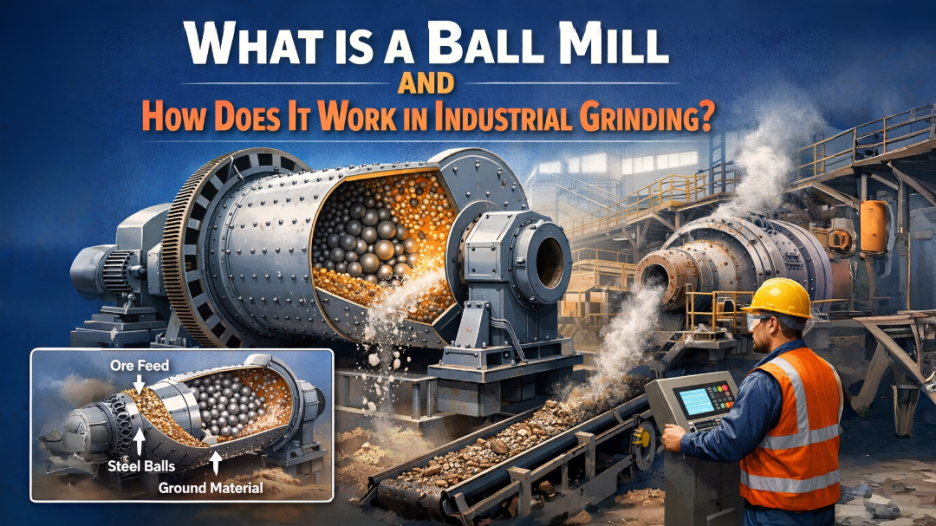
A ball mill is one of the most widely used industrial grinding machines across the world. From cement plants to chemical factories, from mining operations to pharmaceutical units the industrial ball mill plays a central role in reducing hard materials into fine, uniform powder. If you are planning to invest in a grinding solution or simply want to understand how this machine functions, this guide covers everything in detail.
Shalimar Engineering is a leading ball mill manufacturer and exporter based in Ahmedabad, India, supplying high-performance grinding solutions to industries across India and 30+ countries worldwide.
What is a Ball Mill
A ball mill is a cylindrical rotating drum filled with grinding media — typically steel balls or ceramic balls along with the raw material that needs to be ground. As the drum rotates, the grinding media lifts up and then falls, striking the material through impact and attrition. This continuous action breaks down the material into fine particles of a desired mesh size.
The ball mill working principle is based on two forces:
- Impact — The balls fall from a height and strike the material with force, breaking it into smaller pieces.
- Attrition — The rolling motion of the balls against each other and against the cylinder wall grinds the material further into fine powder.
This dual-action mechanism makes the ball mill highly effective for both coarse and ultra-fine grinding across industries.
Key Components of an Industrial Ball Mill
Understanding the structure of an industrial ball mill helps in selecting the right machine for your application. The main components are:
- Cylindrical Shell The main body of the mill, made from heavy-duty steel or alloy material. Its diameter and length determine the ball mill capacity and the type of grinding it can handle.
- Grinding Media Steel balls, ceramic balls, or flint pebbles are used depending on the material being processed. The size and material of the grinding media directly affect the fineness of the output.
- Inlet and Outlet Raw material enters from one end and the ground powder exits from the other. In a continuous ball mill, this process happens without interruption, while in a batch ball mill, the material is loaded and unloaded in cycles.
- Drive System A motor and gear arrangement rotates the cylindrical drum at a controlled speed (typically 20–40 RPM), ensuring optimal grinding action.
- Lining Material The inner surface of the drum is lined with manganese steel or rubber to protect the shell from wear and to control the grinding efficiency.
Types of Ball Mills Used in Industry
Shalimar Engineering manufactures multiple variants of ball mills tailored to different industrial requirements. Here is a breakdown of the main types:
Continuous Ball Mill
A continuous ball mill is designed for large-scale, uninterrupted production. Raw material is fed from one end and the finished product exits from the other continuously. This type is widely used in cement, mineral, and chemical industries where high output is required without stopping the process.
Batch Ball Mill
A batch ball mill works in cycles the material is loaded, ground to the required fineness, and then unloaded before the next batch begins. It is preferred for small-scale production, pilot testing, and industries that require frequent material changes.
Cement Grinding Ball Mill
A cement grinding ball mill is specifically built for grinding cement clinker and additives into fine cement powder. These mills operate under high load conditions and are engineered for continuous heavy-duty performance.
Iron Ore Crushing Ball Mill
The iron ore crushing ball mill is designed for hard mineral grinding including iron ore, bauxite, limestone, and other ores. It uses high-hardness grinding media to handle the abrasive nature of mineral processing.
Sand Grinding Ball Mill
The sand grinding ball mill is used for grinding silica sand, quartz, and similar materials used in glass, paint, and construction industries.
Ball Mill with Micronizing Plant
The ball mill with micronizing plant is an advanced system that combines coarse grinding with ultra-fine micronizing, producing particle sizes as fine as 200–400 mesh. It is used in pharmaceuticals, specialty chemicals, and pigment industries.
Dry Grinding Ball Mill vs Wet Grinding Ball Mill
One of the most common questions industries ask is whether to use a dry grinding ball mill or a wet grinding ball mill. Here is a clear comparison:
| Feature | Dry Grinding Ball Mill | Wet Grinding Ball Mill |
| Medium Used | Air or gas | Water or liquid |
| Output Form | Dry powder | Slurry |
| Application | Cement, minerals, chemicals | Mining, paint, ceramics |
| Energy Consumption | Slightly higher | Lower |
| Fineness Achieved | Medium to fine | Very fine |
| Maintenance | Easier | Requires more care |
The choice between dry and wet grinding depends on the end product requirement, the material being processed, and the downstream process in your plant.
Ball Mill Applications Across Industries
The ball mill for mining, ball mill for cement industry, and ball mill for chemical industry are the three most dominant use cases globally. However, the applications go far beyond:
Cement Industry Grinding clinker, gypsum, and fly ash into fine cement powder. The cement grinding ball mill is a critical machine in every cement manufacturing plant.
Mining and Mineral Processing Processing iron ore, copper ore, gold ore, and other minerals. The ball mill for mining grinds ore to a fine slurry for further separation and extraction.
Chemical Industry Producing fine powders for dyes, pigments, fertilizers, pesticides, and specialty chemicals. The ball mill for chemical industry handles both reactive and non-reactive materials with precision.
Pharmaceutical Industry Grinding APIs (Active Pharmaceutical Ingredients) and excipients to micron-level fineness.
Paint and Pigment Industry Achieving uniform particle distribution for high-quality coatings and color pigments.
Ceramics and Refractory Industry Grinding raw materials like feldspar, quartz, and kaolin for tile, porcelain, and refractory product manufacturing.
Ball Mill Capacity and Technical Specifications
Ball mill capacity varies depending on the cylinder size, motor power, grinding media, and material type. At Shalimar Engineering, we manufacture custom ball mills to match exact production requirements.
| Specification | Range |
| Capacity | 1 TPH to 25 TPH |
| Motor Power | 10 HP to 200 HP |
| Cylinder Diameter | 800 mm to 2000 mm |
| Rotation Speed | 20 to 40 RPM |
| Feed Size | Up to 25 mm |
| Output Fineness | 200 to 400 mesh (adjustable) |
| Lining Material | Manganese Steel or Rubber |
| Grinding Media | Steel Balls or Ceramic Balls |
All our machines are built with grinding media ball mill systems optimized for longevity and consistent output. As a trusted custom ball mill manufacturer, we also design mills beyond standard specifications based on client-specific requirements.
Why Choose Shalimar Engineering as Your Ball Mill Manufacturer and Exporter
Shalimar Engineering is a well-established ball mill manufacturer and exporter with decades of manufacturing experience and a strong global presence. Here is what sets us apart:
Proven Manufacturing Expertise Every ball mill is engineered with precision using high-grade raw materials sourced from certified suppliers. Our in-house design team ensures each machine meets the required performance and safety standards.
Custom Engineering We offer fully custom ball mill solutions — whether you need a compact batch unit or a high-capacity continuous grinding plant, we build it to your specifications.
Global Export Network As a trusted ball mill exporter worldwide, Shalimar Engineering has supplied machines to clients in the Middle East, Southeast Asia, Africa, and other regions. Our export-ready designs comply with international quality standards.
Comprehensive After-Sales Support From installation to operator training, spare parts supply, and maintenance guidance — we support our clients throughout the equipment lifecycle.
Competitive Pricing As a direct manufacturer, we offer competitive pricing without compromising on quality making us a preferred partner for industries looking for value-driven grinding solutions.
Frequently Asked Questions About Ball Mills
Q1. What is the working principle of a ball mill?
A ball mill works on the principle of impact and attrition. The rotating cylinder causes the grinding media (steel or ceramic balls) to lift and fall, breaking and grinding the material placed inside into fine powder.
Q2. What is the difference between a batch ball mill and a continuous ball mill?
A batch ball mill processes material in fixed cycles load, grind, unload. A continuous ball mill operates without interruption, with material entering from one end and exiting as finished product from the other. Continuous mills are better suited for large-scale industrial production.
Q3. Which industries use ball mills?
Ball mills are used across cement, mining, chemical, pharmaceutical, paint, pigment, ceramics, and refractory industries. They are essential wherever fine or ultra-fine powder production is required.
Q4. What is the ball mill capacity range offered by Shalimar Engineering?
Shalimar Engineering offers ball mills with capacities ranging from 1 TPH to 25 TPH. Custom capacities beyond this range can also be designed based on project requirements.
Q5. What is the difference between dry grinding and wet grinding in a ball mill?
Dry grinding produces a dry powder output and is used in cement and mineral industries. Wet grinding uses water or liquid and produces a slurry, commonly used in mining, paint, and ceramic industries.
Q6. Do you export ball mills outside India?
Yes. Shalimar Engineering is a leading ball mill exporter with an active supply network across 30+ countries including UAE, Saudi Arabia, Oman, Iran, Iraq, Bangladesh, Indonesia, Malaysia, and more.
Q7. Can ball mills be customized for specific materials?
Yes. We design custom ball mills based on material hardness, moisture content, desired fineness, and production capacity. Our engineering team evaluates each project individually.
Get a Quote from India’s Trusted Ball Mill Manufacturer and Exporter
Whether you need a continuous ball mill for large-scale cement production, a batch ball mill for specialty chemicals, or a ball mill with micronizing plant for ultra-fine powder — Shalimar Engineering has the right solution for your application.
We are India’s trusted ball mill manufacturer and exporter, delivering precision-engineered grinding machines to industries across the globe.
Send an Enquiry Now and our team will get back to you with a customized solution and competitive quote within 24 hours.