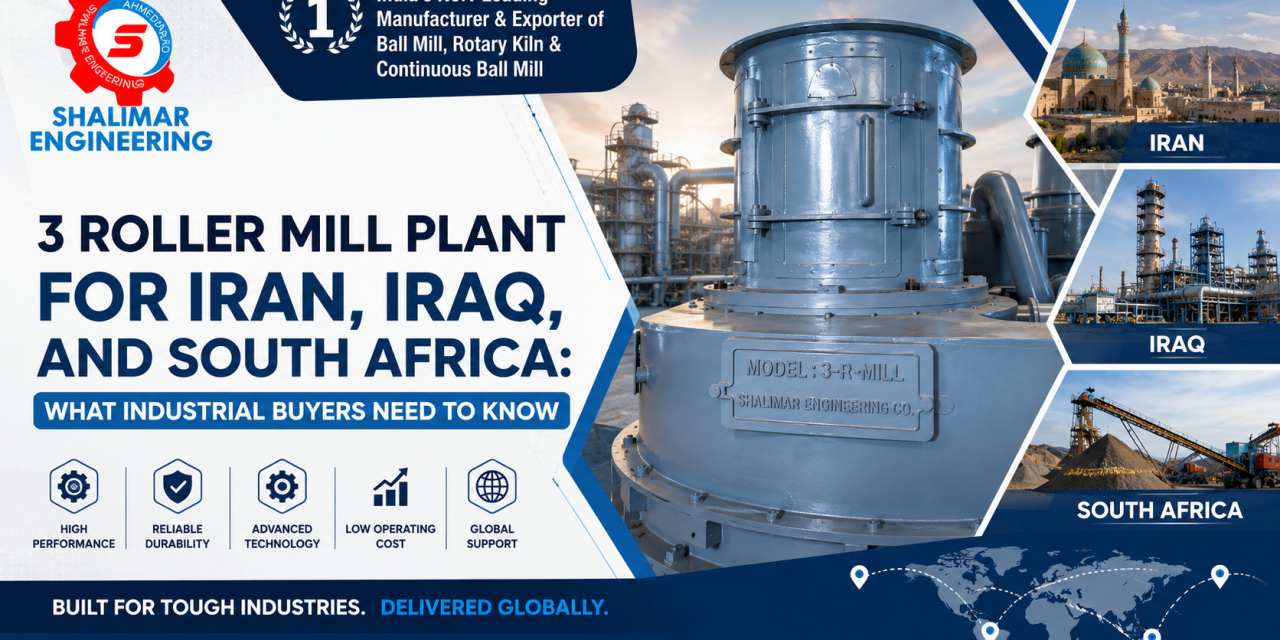
3 Roller Mill Plant for Iran, Iraq, and South Africa: What Industrial Buyers Need to Know
Selecting the right heavy-duty grinding machinery for cross-border operations requires a balance of mechanical precision, durable construction, and reliable export logistics. Whether you are running a high-throughput mineral processing facility in Iran, rebuilding industrial infrastructure in Iraq, or managing large-scale beneficiation plants in South Africa, a 3 Roller Mill Plant provides the tight particle size distribution and operational reliability your facility needs. This guide breaks down specific market requirements, essential technical evaluations, and key export considerations to help industrial procurement teams make informed, risk-free machinery investments.
Different Markets, Common Requirements
Iran, Iraq, and South Africa represent three distinctly different industrial landscapes. Iran has a deep-rooted minerals and petrochemical processing sector with significant domestic industrial capacity. Iraq is in an active phase of infrastructure rebuilding and industrial expansion. South Africa’s mining and mineral beneficiation industry is among the most developed on the continent.
Yet for all their differences, processing facilities in each of these countries share a common need: reliable, precise, and durable grinding equipment that can handle demanding industrial materials consistently.
The 3 Roller Mill Plant fits this requirement well. Its two-stage compression design produces tighter particle size distributions than single-roller configurations, and the equipment’s mechanical simplicity makes it well-suited for facilities where advanced maintenance infrastructure may not always be readily available.
What Iran’s Processing Industry Needs from a Roller Mill Supplier
Iran’s processing sector spans minerals, fertilizers, construction materials, and chemicals. Many facilities operate with materials that include calcium carbonate, gypsum, coal, bentonite, and various ore concentrates — all of which are suitable for 3-roller grinding configurations.
Key requirements for Iranian industrial buyers typically include:
- Machines rated for consistent, high-throughput operation in environments that may have variable power supply quality
- Roller materials capable of handling abrasive feed materials without premature wear
- Clear technical documentation available in both English and Persian (Farsi) where possible
- Suppliers familiar with the documentation requirements and shipping logistics for Iran-bound exports
Iran’s industrial procurement landscape often involves intermediaries or trading companies. Working with a supplier experienced in this structure avoids delays in order confirmation, documentation exchange, and equipment dispatch.
Understanding the broader context of size reduction technology is also useful for Iranian procurement teams evaluating multiple equipment types. For reference on related grinding systems, the iron ore pelletizing plant technology guide provides useful insight into how grinding equipment integrates with downstream processing.
Supplying Industrial Grinding Equipment to Iraq
Iraq’s rebuilding industrial base presents an interesting procurement environment. Cement plants, chemical processing units, fertilizer manufacturing, and mineral processing operations are all in active development or expansion phases. Equipment buyers in Iraq are often working under tight project timelines, which makes supplier reliability and on-time delivery especially critical.
For roller mill equipment supplied to Iraq, buyers should focus on:
Delivery Reliability Confirm your supplier’s track record with deliveries to Iraq specifically. Port clearance at Umm Qasr or Basra can be complex, and a supplier with prior Iraq export experience will know how to prepare documentation to minimize delays.
Rugged Construction Iraqi facilities may expose equipment to high ambient temperatures, dusty environments, and variable power conditions. Insist on machines built with thermal protection in motor systems, sealed bearing configurations, and dust-resistant electrical enclosures.
Simplified Maintenance Choose a machine whose routine maintenance tasks — roller gap adjustment, roller replacement, lubrication — can be performed by trained operators without specialized tooling. The simpler the maintenance protocol, the less operational risk you carry.
Spare Parts Lead Time Ask your supplier directly: if I need replacement rollers in six months, how long will it take? A supplier with a production line dedicated to standard components can often respond in four to six weeks. One that manufactures purely on demand may take significantly longer.
Have Questions About Industrial Machinery?
Get in touch with our engineering experts at Shalimar Engineering to discuss your project requirements, technical specs, or site support.
South Africa’s Mineral Processing Sector and Grinding Equipment Needs
South Africa is one of the world’s most mineral-rich countries, with active operations in gold, platinum group metals, chromite, manganese, vanadium, and coal. The country’s mineral beneficiation and chemical processing sectors create consistent demand for size reduction equipment across particle size ranges.
The 3 Roller Mill Plant serves South African processing operations particularly well in:
- Fine grinding of industrial minerals for export or local use
- Reducing coal fines to consistent particle sizes for downstream applications
- Processing base chemicals and agricultural inputs
- Grinding construction material components like gypsum and limestone
South African buyers are generally sophisticated industrial procurement teams. They expect detailed engineering documentation, third-party inspection options, and suppliers who understand CE marking or comparable standards.
One consideration specific to South Africa: local content requirements in some government-linked procurement projects may influence supplier selection. For private sector buyers, sourcing from an experienced Indian manufacturer with good export infrastructure is typically straightforward.
Evaluating Technical Specifications Across Markets
Whether you are based in Tehran, Baghdad, Johannesburg, or Durban, the core technical evaluation criteria for a 3 Roller Mill Plant remain consistent. Here is a structured checklist:
Feed Material Properties
- What is the Mohs hardness of your material?
- What moisture level does the feed material carry?
- What is the maximum feed size you will be processing?
Output Requirements
- What particle size (in microns or mesh) does your process require?
- How uniform does the output distribution need to be?
- What throughput (tonnes per hour) does your operation demand?
Utility and Infrastructure
- What is the available electrical supply voltage and phase at your facility?
- What space is available for the equipment footprint?
- Is compressed air available, or does the mill need to be self-contained?
Any supplier who responds to these questions with a specific, documented answer — rather than a generalized claim — is demonstrating the kind of technical seriousness that international buyers need.
When comparing your requirements against available configurations, the 3 Roller Mill Plant product page gives you a direct starting point for specification review.
Packaging and Shipping for International Destinations
For long-distance export shipments to Iran, Iraq, and South Africa, packaging quality directly affects whether your equipment arrives in full working condition.
Insist that your supplier uses:
- Heavy-duty export-grade wooden crating with internal bracing
- Anti-corrosion wrapping for all metal surfaces
- Shock-absorbing packing for precision components
- Clearly labeled crates with part numbers that match the packing list
Poorly packaged industrial equipment is not uncommon in lower-cost supply chains, and the consequences — bent shafts, damaged rollers, cracked castings — can be both costly and time-consuming to resolve after a long international transit.
Building a Long-Term Equipment Partnership
The most efficient industrial buyers do not treat every equipment procurement as a one-off transaction. They identify reliable suppliers and build partnerships that allow them to source spare parts quickly, get maintenance advice without friction, and access new equipment models as their operations grow.
For buyers in Iran, Iraq, and South Africa, finding an Indian supplier with the right combination of technical competence, export experience, and genuine after-sales commitment creates a valuable long-term advantage.
Frequently Asked Questions (FAQs)
Q1. What types of raw materials can a 3 Roller Mill Plant process?
A 3 Roller Mill Plant is ideal for grinding soft to medium-hard industrial minerals and materials, including calcium carbonate, gypsum, bentonite, limestone, coal fines, bauxite, and various agricultural inputs.
Q2. How does a 3 Roller Mill Plant compare to single-roller grinding systems?
A 3 roller setup uses a two-stage compression mechanism. This delivers a significantly tighter, more uniform output particle size distribution and higher throughput efficiency compared to single-roller configurations.
Q3. What spare parts should I stock for long-distance export operations?
We recommend keeping critical high-wear items on-site to minimize downtime. These include spare grinding rollers, ring dies, main shaft bearings, oil seals, and wear-resistant liners. Standard spare shipments typically take 4 to 6 weeks.
Q4. Do you provide localized technical documentation for export orders to Iran and Iraq?
Yes, along with standard English engineering documents, technical manuals, installation guides, and shipping manifests can be formatted to meet localized regulatory and port requirements for smooth customs clearance at ports like Bandar Abbas, Umm Qasr, or Basra.
Q5. How is the mill packaged to prevent damage during ocean transit?
All machinery components undergo anti-corrosion surface treatment and are vacuum-sealed before being secured in heavy-duty, heat-treated export wooden crates with internal shock-absorbing bracing.
Export-Ready Roller Mill Equipment for Your Country
Our export team is equipped to support buyers in Iran, Iraq, South Africa, and across the GCC. From initial specification through to delivery and commissioning, we handle the process with complete technical and documentation support.
Connect with our export desk to start the conversation today.
Need a Custom Machine Quote?
Share your operational needs with Shalimar Engineering and receive a tailored quote with precise specifications for your plant.