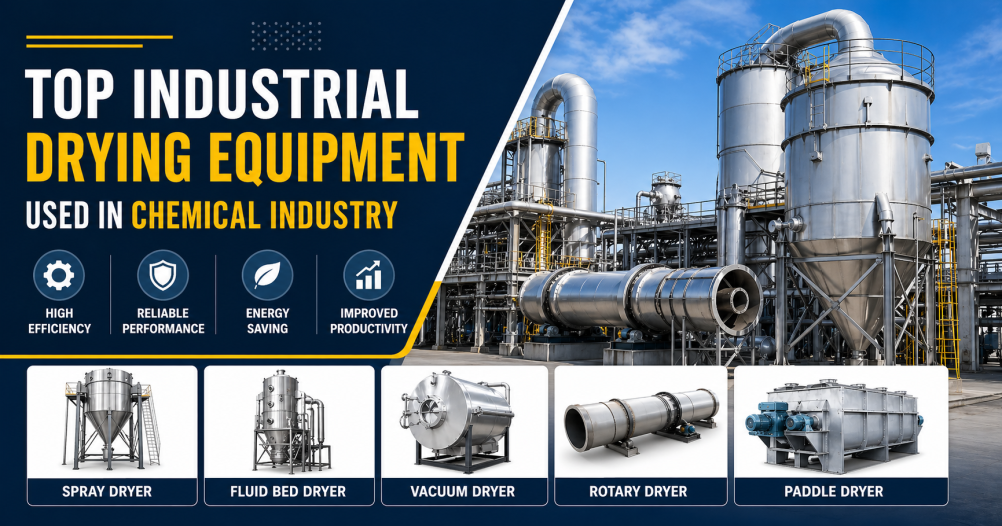
Drying is one of the most critical and energy-intensive operations in chemical processing. Whether it is removing moisture from a pigment slurry, drying a filter cake after reaction, reducing water content from a fertilizer granule, or converting a liquid chemical feed into dry powder every chemical plant requires a reliable industrial drying equipment solution tailored to its specific material and process requirements.
Shalimar Engineering is a leading industrial drying equipment manufacturer based in Ahmedabad, India, supplying high-performance industrial dryers to chemical, pharmaceutical, mineral, food, and agrochemical industries across India and worldwide.
This guide covers the most widely used drying equipment for chemical industry how each one works, what it is best suited for, and how to choose the right dryer for your process.
Why Drying is Critical in the Chemical Industry
In the chemical industry, drying serves multiple important functions beyond simply removing water. It affects product quality, shelf life, bulk density, flowability, reactivity, and downstream processability. Poorly dried chemical products can cause caking, clumping, degradation, microbial growth, or process failures in the next stage of production.
Key drying challenges specific to the chemical industry include:
- Many chemical materials are heat-sensitive and cannot tolerate high temperatures without degradation
- Drying of reactive, toxic, or flammable materials requires enclosed systems with inert atmosphere
- Particle size and morphology must be preserved during drying in certain applications
- Consistent residual moisture content is a quality parameter in most chemical products
- Energy efficiency directly impacts production cost at industrial scale
Selecting the right industrial drying system requires understanding the material properties, required output moisture, production capacity, thermal sensitivity, and regulatory requirements of each application.
1. Rotary Dryer — Best for High-Volume Bulk Chemical Drying
The rotary dryer is the most widely used industrial dryer in the chemical industry for drying bulk granular or lump materials at high throughput. It consists of a long, slightly inclined rotating cylinder through which the wet material travels while hot air flows counter-currently or co-currently to remove moisture.
How it works: Wet material is fed into the elevated end of the rotating drum. As the drum rotates, internal flights lift the material and shower it through the hot air stream, maximizing heat and mass transfer. Dried material exits from the lower end continuously.
Best suited for:
- Fertilizers and chemical granules
- Mineral salts and chemical precipitates
- Coal and mineral ores
- Large-volume continuous drying operations
Key advantages:
- Very high production capacity handles tonnes per hour continuously
- Handles wet, sticky, and lumpy feed materials
- Robust, low-maintenance mechanical design
- Can operate with direct or indirect heating
Not recommended for: Heat-sensitive materials or applications requiring very precise residual moisture control.
2. Spray Dryer — Best for Converting Liquid Chemicals to Powder
The spray dryer is the standard industrial drying equipment for converting liquid feeds solutions, suspensions, slurries, or emulsions directly into dry powder in a single operation. It is one of the most important machines in the chemical industry because it eliminates the need for separate filtration, crystallization, and milling steps.
How it works: The liquid feed is atomized into fine droplets inside a drying chamber using a rotary atomizer or nozzle atomizer. Hot air contacts the droplets instantly, evaporating the moisture and leaving dry powder particles that are collected at the base or through cyclones and bag filters.
Best suited for:
- Dyes and pigments producing free-flowing, uniform powder directly from slurry
- Detergents and surfactants spray drying of sodium sulphate, LABSA neutralized products
- Chemical intermediates and specialty chemicals from liquid feeds
- Pesticide and agrochemical formulations
- Silica, titanium dioxide, and inorganic chemical powders
Key advantages:
- Converts liquid directly to dry powder in one step
- Short residence time protects heat-sensitive compounds
- Produces consistent, uniform particle size powder
- Fully continuous operation with no intermediate handling
Temperature range: Inlet air 150°C to 350°C outlet temperature 60°C to 100°C. Despite the high inlet temperature, the evaporative cooling effect keeps the product at much lower temperatures, making it suitable for moderately heat-sensitive materials.
3. Spin Flash Dryer — Best for Wet Cakes and Filter Cakes
The spin flash dryer is a highly efficient drying equipment for chemical industry designed specifically for drying wet cakes, filter cakes, pastes, and thick slurries that cannot be atomized in a spray dryer and are too sticky or wet for a rotary dryer.
How it works: The wet feed typically with 30% to 60% moisture is fed into a cylindrical drying chamber at the base. A high-speed rotor at the bottom of the chamber mechanically disintegrates the wet feed while simultaneously hot air entering tangentially creates an upward spiral flow. Fine dry particles are carried upward and collected through a classifier and bag filter, while oversized wet particles are retained at the base for further drying.
Best suited for:
- Pigment filter cakes after precipitation and filtration
- Dye intermediates and organic chemical wet cakes
- Inorganic salt filter cakes (sulphates, carbonates, chlorides)
- Calcium carbonate, barium sulphate, and other precipitated chemical powders
- Titanium dioxide and alumina filter cakes
Key advantages:
- Handles very high moisture input (30% to 60%) directly no pre-drying needed
- Integrated disintegration and drying in one machine
- Very fast drying short residence time of 1 to 3 seconds
- Compact footprint compared to rotary dryers at equivalent capacity
- Produces fine, free-flowing powder without additional milling
The spin flash dryer fills a critical gap it handles materials that are too wet and sticky for spray drying but too fine and cohesive for rotary drying.
4. Tray Dryer — Best for Batch Drying of Multiple Chemical Products
The tray dryer is a batch dryer for chemical industry applications where small quantities of multiple different materials need to be dried at controlled temperature in a clean environment. It uses a heated air circulation system to dry material spread on trays inside an insulated cabinet.
How it works: Wet material is spread uniformly on perforated stainless steel trays and loaded into the drying cabinet. A fan circulates hot air horizontally or vertically across the trays, evaporating moisture from the material surface. Fresh hot air enters continuously while moist air exits through exhaust vents.
Best suited for:
- Pharmaceutical API drying and chemical intermediates requiring batch control
- Dye and pigment samples and small production batches
- Laboratory and pilot-scale drying trials for new chemical products
- Materials requiring gentle drying at low temperatures (40°C to 120°C)
- Multipurpose facilities where different products are dried in small quantities
Key advantages:
- Simple, low-cost batch drying solution
- Suitable for temperature-sensitive materials at low drying temperatures
- Easy loading and unloading of trays
- No material degradation from mechanical action
- Suitable for GMP environments with SS304/SS316 construction
Limitation: Not suitable for large-scale continuous production it is a batch process with manual tray loading and unloading.
5. Belt Dryer — Best for Continuous Drying of Granules and Formed Products
The belt dryer is a continuous dryer for chemical industry that transports material on a moving perforated belt through a drying tunnel while hot air is blown through the belt and the material bed from below or above.
How it works: Wet granules, extrudates, or formed chemical products are fed onto a continuously moving wire mesh or perforated belt. As the belt travels through the drying chamber, hot air passes through the material bed, removing moisture progressively. The dried product exits at the far end continuously.
Best suited for:
- Chemical granules produced by granulation, extrusion, or pelletizing
- Fertilizer granules requiring gentle through-drying without mechanical agitation
- Wettable powder (WP) and water dispersible granule (WDG) products after granulation
- Food chemical ingredients like starch, glucose, and maltodextrin granules
- Catalyst pellets and extrudates from the chemical industry
Key advantages:
- Gentle drying no mechanical agitation or impact on the product
- Very uniform drying controlled temperature zones along the belt length
- Long residence time available adjustable belt speed
- Can handle fragile, friable, or structured products that would break in a rotary dryer
- Multi-zone temperature control for precise drying profiles
6. Hot Air Generator — Essential Support Equipment for All Dryers
The hot air generator is not a dryer itself, but it is an essential piece of industrial drying equipment that provides the hot air supply required by rotary dryers, belt dryers, spray dryers, spin flash dryers, and tray dryers.
How it works: A hot air generator burns fuel natural gas, diesel, LPG, furnace oil, or biomass in a combustion chamber and uses a heat exchanger or direct firing to heat fresh air to the required temperature before it enters the dryer. Indirect-fired hot air generators prevent combustion gases from contacting the product, which is critical for food-grade and pharmaceutical-grade drying applications.
Types used in chemical industry:
- Direct-fired hot air generator — for non-food, non-pharma applications where combustion gases do not contaminate the product
- Indirect-fired hot air generator — where product purity requires combustion gas-free hot air
Proper sizing and specification of the hot air generator directly determines the drying capacity and energy efficiency of the entire drying system.
Choosing the Right Industrial Drying Equipment for Your Chemical Process
Selecting the right drying equipment for chemical industry applications requires evaluating several key factors:
| Selection Factor | Recommended Dryer |
|---|---|
| Liquid feed — need powder output | Spray Dryer |
| Wet cake or filter cake feed | Spin Flash Dryer |
| Bulk granules — high capacity continuous | Rotary Dryer |
| Fragile granules — gentle drying | Belt Dryer |
| Small batches — multiple products | Tray Dryer |
| Heat-sensitive material | Spray Dryer or Tray Dryer |
| Sticky or pasty feed | Spin Flash Dryer |
| Very high throughput | Rotary Dryer |
In many chemical plants, more than one type of dryer is used for example, a spray dryer for converting reaction slurry into powder, and a belt dryer for drying granulated product after a granulation step.
Comparison of Top Industrial Drying Equipment for Chemical Industry
| Dryer Type | Feed Form | Output Form | Operation | Capacity | Best Application |
|---|---|---|---|---|---|
| Rotary Dryer | Granules, lumps | Dry granules | Continuous | Very high | Fertilizers, minerals, bulk chemicals |
| Spray Dryer | Liquid, slurry | Fine powder | Continuous | High | Dyes, pigments, detergents, chemicals |
| Spin Flash Dryer | Wet cake, paste | Fine powder | Continuous | Medium-high | Pigments, dye intermediates, salts |
| Tray Dryer | Any solid | Dry solid | Batch | Low | Lab, pilot, pharma, multi-product |
| Belt Dryer | Granules, pellets | Dry granules | Continuous | Medium-high | Chemical granules, WDG, catalysts |
Why Choose Shalimar Engineering for Industrial Drying Equipment
Shalimar Engineering is a trusted industrial drying equipment manufacturer with decades of experience designing and supplying complete drying solutions to chemical, pharmaceutical, mineral, food, and agrochemical industries across India and internationally.
Complete Drying Equipment Range
We manufacture the complete range of industrial drying equipment rotary dryer, spray dryer, spin flash dryer, tray dryer, belt dryer, and hot air generator giving chemical industry clients access to the right solution for every drying requirement from a single manufacturer.
Custom Engineering for Each Application
Every dryer is engineered based on the client’s specific material properties, feed moisture, required output moisture, production capacity, and available energy source. No standard off-the-shelf dryers each unit is designed for its application.
High-Quality Construction
All contact parts are manufactured in SS304 or SS316 where required for chemical purity and corrosion resistance. Heavy-duty carbon steel construction with appropriate insulation and surface treatment is used for standard chemical applications.
Global Export Capability
As a trusted industrial drying equipment manufacturer and exporter, Shalimar Engineering has supplied drying systems to clients in UAE, Saudi Arabia, Oman, Bangladesh, Malaysia, Indonesia, Africa, and other regions.
Full After-Sales Support
Installation supervision, commissioning, operator training, spare parts supply, and maintenance support are provided for all equipment supplied.
Frequently Asked Questions About Industrial Drying Equipment
Q1. What is the most commonly used industrial drying equipment in the chemical industry?
The rotary dryer and spray dryer are the two most commonly used industrial drying equipment in the chemical industry. Rotary dryers handle high-volume bulk granule drying, while spray dryers convert liquid feeds directly into fine powder making them standard equipment in dye, pigment, detergent, and specialty chemical plants.
Q2. What dryer is used for drying filter cakes or wet cakes in chemical plants?
A spin flash dryer is the most effective solution for drying filter cakes and wet pastes in chemical plants. It accepts high-moisture feed (30% to 60% moisture) directly and produces fine dry powder through integrated mechanical disintegration and hot air drying in a single compact unit.
Q3. Which industrial dryer is best for heat-sensitive chemical materials?
A spray dryer is suitable for moderately heat-sensitive materials because the short residence time and evaporative cooling keep the product temperature much lower than the inlet air temperature. For highly heat-sensitive materials requiring very low drying temperatures, a tray dryer operating at 40°C to 60°C is the appropriate choice.
Q4. What is the difference between a continuous dryer and a batch dryer?
A continuous dryer such as a rotary dryer, spray dryer, spin flash dryer, or belt dryer processes material without interruption, with feed entering and dried product exiting simultaneously. A batch dryer such as a tray dryer processes a fixed quantity of material per cycle, with loading, drying, and unloading happening in sequence. Continuous dryers are used for high-volume production; batch dryers are used for small quantities and multi-product facilities.
Q5. What is the role of a hot air generator in industrial drying?
A hot air generator supplies the heated air required by industrial dryers to carry out the drying process. It burns fuel in a combustion chamber and heats fresh air to the required temperature before delivering it to the dryer. The hot air generator must be correctly sized to match the dryer’s thermal load and the required inlet air temperature.
Q6. Does Shalimar Engineering supply complete industrial drying systems?
Yes. Shalimar Engineering supplies complete industrial drying systems including the dryer, hot air generator, feed system, product collection system, dust control, and instrumentation all integrated and commissioned as a complete production-ready system.
Q7. What industries does Shalimar Engineering supply drying equipment to?
Shalimar Engineering supplies industrial drying equipment to chemical, pharmaceutical, food, mineral, fertilizer, pigment, dye, detergent, agrochemical, and ceramic industries across India and worldwide.
Q8. Can the drying equipment be customized for specific chemical materials?
Yes. Every dryer supplied by Shalimar Engineering is engineered based on the client’s specific material properties, feed condition, required output moisture, production capacity, and site conditions. Material-specific customizations such as corrosion-resistant construction, inert atmosphere operation, or explosion-proof electrical systems are available based on requirements.
Get a Quote from India’s Trusted Industrial Drying Equipment Manufacturer
Whether you need a rotary dryer for bulk chemical granule drying, a spray dryer for converting chemical slurry to powder, a spin flash dryer for filter cake drying, or a complete integrated industrial drying system for your chemical plant Shalimar Engineering has the engineering capability and manufacturing experience to deliver the right solution.
We are India’s trusted industrial drying equipment manufacturer and exporter, building reliable drying solutions for the chemical industry and beyond.
Send an Enquiry Now and our engineering team will respond with a detailed technical proposal and competitive quote within 24 hours.