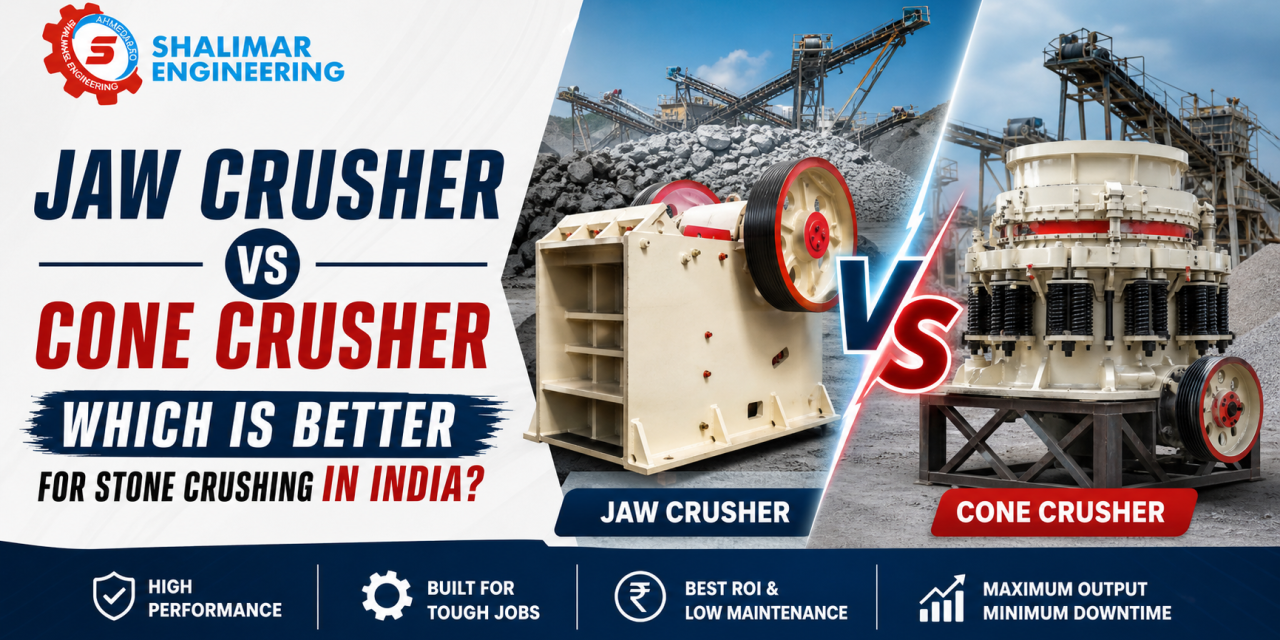
Jaw Crusher vs Cone Crusher: Which is Better for Stone Crushing in India?
Stone crushing is one of the most capital-intensive decisions a quarry owner, mining operator, or construction aggregate producer makes. Pick the wrong crusher and you pay for it every single day in energy bills, maintenance downtime, and output that does not meet specification.
The two most common crushers in Indian stone crushing operations are the jaw crusher and the cone crusher. Both break rock. But they are built for entirely different stages of the crushing process and perform very differently depending on the material, required output size, and production volume.
This guide gives you a complete, straight comparison – no filler, no vague answers – so you can make the right equipment decision for your operation.
What is a Jaw Crusher?
A jaw crusher is a primary crushing machine that breaks large rocks and stones by compressing them between a fixed jaw plate and a moving jaw plate. The moving jaw swings back and forth, driven by an eccentric shaft, creating a crushing action that reduces feed material progressively as it moves down through the jaw opening.
Jaw crushers accept large feed sizes, typically 500 mm to 1,200 mm, and reduce them to output sizes ranging from 50 mm to 300 mm depending on the closed side setting (CSS). This makes the jaw crusher the standard first stage in any crushing circuit.
Key characteristics of a jaw crusher:
- Feed size: Up to 1,200 mm
- Output size: 50–300 mm (adjustable via CSS)
- Crushing action: Compression
- Stage: Primary crushing
- Material: Hard, abrasive rock granite, basalt, quartzite, limestone, iron ore
Shalimar Engineering manufactures jaw crushers for mining, quarrying, construction aggregate, and mineral processing applications, with single-toggle and double-toggle configurations available based on feed size and production requirements.
What is a Cone Crusher?
A cone crusher is a secondary or tertiary crushing machine that breaks material between a rotating mantle (inner cone) and a fixed concave (outer bowl). As material enters from the top, the gyrating motion of the mantle continuously crushes and squeezes particles until they are small enough to fall through the gap at the bottom.
Cone crushers accept pre-crushed material, typically the output of a jaw crusher, and reduce it further to a 10–50 mm output size for aggregate, road base, or downstream processing.
Key characteristics of a cone crusher:
- Feed size: 50–300 mm (pre-crushed material only)
- Output size: 6–50 mm
- Crushing action: Compression + attrition
- Stage: Secondary or tertiary crushing
- Material: Medium-hard to hard rock — limestone, granite, river gravel
The Most Important Fact About These Two Crushers
Before comparing them further, this needs to be said clearly:
A jaw crusher and a cone crusher are not competitors. They are partners.
A cone crusher cannot accept raw quarry feed; it requires pre-crushed material from a primary crusher. A jaw crusher alone cannot produce the fine aggregate sizes required for construction and road building.
In a complete crushing plant, the jaw crusher is Stage 1 and the cone crusher is Stage 2 (or Stage 3). The question is not always “which one” it is often “which one do I need to add to what I already have?”
That said, many buyers in India do face a genuine choice, particularly small- to mid-size quarry operators deciding how to configure their first crushing setup or operators evaluating whether to add a secondary crusher. This comparison gives you the clarity to make that call.
Jaw Crusher vs Cone Crusher — Complete Comparison
| Parameter | Jaw Crusher | Cone Crusher |
|---|---|---|
| Crushing stage | Primary | Secondary / Tertiary |
| Maximum feed size | Up to 1,200 mm | 50–300 mm only |
| Output size range | 50–300 mm | 6–50 mm |
| Output shape | Flaky / elongated | Cubical — better shape |
| Reduction ratio | 4:1 to 6:1 | 5:1 to 8:1 |
| Crushing mechanism | Compression (jaw plates) | Compression + attrition (mantle + concave) |
| Material hardness | Soft to very hard | Medium-hard to hard |
| Abrasive material | Handles well | Wears faster on abrasive rock |
| Capital cost | Lower | Higher |
| Operating cost | Lower | Higher (liner replacement) |
| Maintenance | Simple — jaw plates replaceable | More complex — liner, mantle, concave |
| Throughput | High | Moderate to high |
| Output gradation | Wider distribution | Tighter, more uniform |
| Oversize protection | Toggle plate (mechanical fuse) | Hydraulic overload protection |
| Application | Quarry primary, mine ROM crushing | Aggregate finishing, road base, rail ballast |
When a Jaw Crusher is the Right Choice
Primary Crushing of Run-of-Mine Material
No other machine handles large, irregular quarry feed as efficiently as a jaw crusher. Granite boulders, blasted limestone, and iron ore ROM material that comes straight from the face or blast goes directly into the jaw crusher feed opening without any pre-processing.
This is the defining advantage of the jaw crusher: it accepts raw, unprocessed feed at sizes that no other crusher can handle. For any quarry or mine starting a new crushing circuit, a jaw crusher is always the first machine installed.
Hard and Highly Abrasive Rock
While both crushers handle hard rock, jaw crushers are more forgiving with highly abrasive materials. The jaw plates typically made from manganese steel are straightforward to inspect and replace. High abrasion increases jaw plate wear, but replacement is a planned maintenance activity that does not require extended downtime.
Cone crusher liners also wear on abrasive rock, but the replacement process is more involved requiring hydraulic tools and longer downtime. For highly abrasive material like quartzite, silica rock, or abrasive granite, the simpler maintenance of a jaw crusher is a practical advantage.
Smaller Operations and Budget-Conscious Buyers
For small- to mid-size quarry operations in India, aggregate producers supplying local construction, road contractors, and building material suppliers, a jaw crusher machine with a vibrating screen gives a complete, functional crushing and sizing plant at a significantly lower capital cost than a cone crusher setup.
Jaw crusher manufacturers in India supply complete primary crushing stations – crusher, hopper, vibrating feeder, and screen – as integrated packages for operators who need a fast, cost-effective setup.
Limestone and Softer Rock Crushing
For limestone, sandstone, coal, and other medium-hard materials where fine aggregate shape is less critical for road sub-base, concrete aggregate, or ballast, a jaw crusher alone often produces acceptable output without a secondary cone crusher. This keeps the plant simple, the capital investment low, and maintenance straightforward.
When a Cone Crusher is the Right Choice
Cubical Aggregate for High-Specification Projects
Highway construction, airport runways, railway ballast, and premium concrete mix designs specify cubical aggregate particles that are roughly equal in all dimensions, not flat or elongated. A cone crusher produces significantly more cubical output than a jaw crusher because of its compression-plus-attrition crushing action.
If your aggregate business supplies highway contractors or infrastructure projects with strict aggregate shape specifications, a cone crusher in the secondary position is not optional — it is a requirement.
Fine Aggregate Production
Construction aggregate in the 10–20 mm and 6–10 mm size ranges, the sizes used in concrete and asphalt mixes, requires a secondary or tertiary crusher. A jaw crusher operating at normal settings cannot consistently produce these sizes at the volumes required.
A cone crusher in a secondary position, fed by a jaw crusher, produces fine aggregate at high throughput with consistent gradation, the combination that high-volume aggregate producers depend on.
High-Volume Continuous Production
Large quarries supplying continuous aggregate to highway projects, dam construction, or large urban development projects need secondary crushing capacity that matches the primary jaw crusher throughput. Cone crushers are designed for continuous, high-volume operation with hydraulic adjustment and automated overload protection.
The Two-Stage Crushing Setup — Jaw Crusher Plus Cone Crusher
For mid- to large-quarry operations in India, the standard and most productive crushing plant configuration is the following:
Stage 1 → Jaw Crusher: Reduces ROM feed from 600–1,000 mm down to 75–150 mm at high throughput.
Stage 2 → Cone Crusher: Takes the jaw crusher output and reduces it to 10–40 mm cubical aggregate for construction and infrastructure use.
Screening at each stage separates material by size; oversized material recirculates back to the respective crusher, and the correctly sized product moves forward.
This two-stage setup gives quarry operators the following:
- Maximum reduction ratio across the full circuit
- Cubical, well-shaped aggregate that meets highway specifications
- High throughput with consistent product gradation
- Flexibility to adjust output size at both stages independently
Shalimar Engineering supplies complete crushing equipment, ranging from primary jaw crushers to secondary cone crushers and screening equipment, allowing operators to build a full crushing circuit from a single, experienced supplier.
Total Cost of Ownership — Jaw Crusher vs Cone Crusher in the Indian Context
For Indian quarry operators evaluating equipment economics, here is how the two machines compare over a 5-year operating period:
| Cost Factor | Jaw Crusher | Cone Crusher |
|---|---|---|
| Purchase price | ₹15–60 lakhs (capacity-dependent) | ₹40–150 lakh |
| Installation | Simple, low cost | More complex, higher cost |
| Wear parts (annual) | Jaw plates — low cost, local availability | Mantle + concave — higher cost |
| Maintenance labor | Semi-skilled sufficient | Skilled technician required |
| Downtime for wear part change | 4–8 hours | 8–16 hours |
| Energy consumption | Moderate | Moderate to high |
| Machine life | 15–20 years | 10–15 years with proper maintenance |
For most Indian small- to mid-size quarry operators, the jaw crusher offers the best return on investment as a standalone machine. The cone crusher earns its higher cost back through aggregate quality premiums and access to higher-specification supply contracts.
How to Decide — A Practical Guide for Indian Quarry Operators
Buy a jaw crusher first if:
- You are setting up a new quarrying operation
- Your primary product is road sub-base, fill material, or coarse aggregate
- Your budget is limited and you need a functional plant fast
- Your material is highly abrasive or feed size is very large
- You are a small to mid-size operator supplying local construction
Add a cone crusher if:
- You are already running a jaw crusher and need finer output
- Your customers specify cubical aggregate for highway or infrastructure projects
- Your operation supplies 10–20 mm concrete aggregate at high volume
- You are targeting premium aggregate supply contracts with shape specifications
Still unsure? Contact a qualified jaw crusher manufacturer or crushing equipment supplier and share your feed material, required output sizes, and monthly production target. An experienced supplier will design the right crushing circuit for your specific operation.
Frequently Asked Questions
Q1. Can a jaw crusher work without a cone crusher?
Yes. A jaw crusher operates as a standalone primary crusher for applications where the output size of 50–150 mm is acceptable for road sub-base, fill material, coarse aggregate, and limestone crushing for many industrial uses. A cone crusher is added when finer, cubical aggregate is required.
Q2. What is the feed size limit for a jaw crusher?
Most industrial jaw crushers accept feed sizes up to 600–1,200 mm depending on the jaw opening size. This is far larger than any cone crusher can accept, which is why the jaw crusher is always the primary crushing stage.
Q3. Which crusher is better for granite crushing in India?
Both are used for granite: a jaw crusher for primary reduction and a cone crusher for secondary finishing. For standalone granite crushing producing 40–75 mm road metal, a jaw crusher machine alone handles the job. For cubical granite aggregate for concrete, a two-stage setup is recommended.
Q4. How long do jaw crusher wear parts last?
Jaw plates, the primary wear parts of a jaw crusher, typically last 500–1,500 operating hours depending on material abrasiveness. Manganese steel jaw plates are the standard material, and replacements are readily available from jaw crusher manufacturers in India.
Q5. Where can I get a jaw crusher with after-sales support in India?
Shalimar Engineering is a trusted jaw crusher manufacturer and supplier in India, offering single-toggle and double-toggle jaw crushers with full after-sales support, including wear parts supply, installation, and operator training. View our complete crushing equipment range for the full product lineup.
Build Your Crushing Plant with Shalimar Engineering
Whether you need a primary jaw crusher to start your quarrying operation or a complete two-stage crushing circuit with secondary cone crushing, the right equipment setup depends on your material, production volume, and output specification.
Shalimar Engineering is a leading jaw crusher manufacturer and exporter based in Ahmedabad, India, with 20+ years of experience supplying crushing equipment to quarrying, mining, and construction aggregate operations across India and 30+ countries.
Our engineering team will assess your feed material, required output sizes, and production capacity and recommend the right crusher configuration with full technical and commercial details.
View our Jaw Crusher range | View all Crushing Equipment | Contact Shalimar Engineering for a free plant design consultation today.