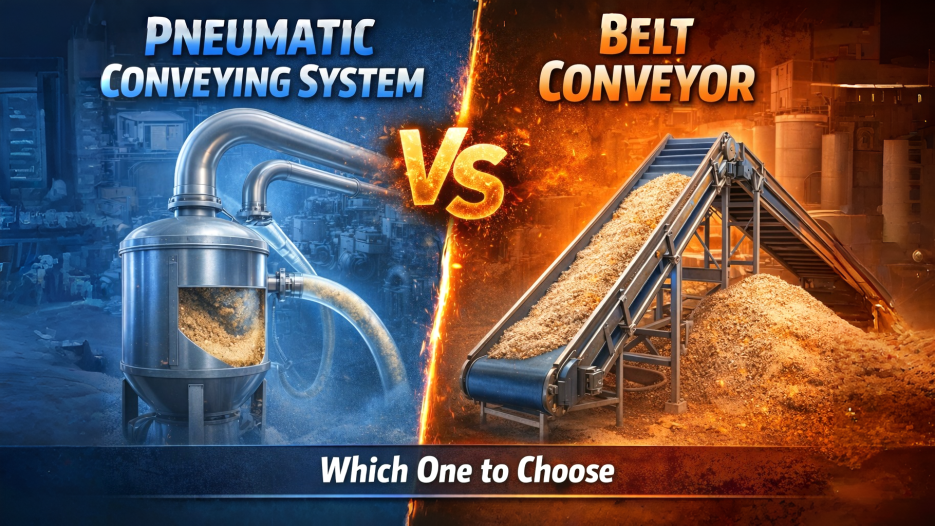
Material handling is one of the most critical aspects of any industrial plant. Choosing the wrong conveying system can result in material loss, dust contamination, higher maintenance costs, and production inefficiency. The two most widely used conveying technologies in industries today are the pneumatic conveying system and the belt conveyor and while both move bulk materials from one point to another, they do it in fundamentally different ways and are suited to very different applications.
Shalimar Engineering is a trusted pneumatic conveying system manufacturer and belt conveyor manufacturer based in Ahmedabad, India, supplying complete material handling solutions to industries across India and worldwide.
This guide gives you a clear, practical comparison to help you choose the right conveying system for your plant.
What is a Pneumatic Conveying System
A pneumatic conveying system uses a stream of air or gas moving through a pipeline to transport bulk powder or granular materials from one or more pickup points to one or more delivery points. The material is suspended or pushed through enclosed pipes by a blower, compressor, or vacuum pump making it a fully enclosed, dust-free conveying method.
The pneumatic conveying system working principle is based on two main modes of transport:
1. Dilute Phase Conveying System
In dilute phase conveying, the material is suspended and carried in a high-velocity air stream through the pipeline. It is suitable for light, non-abrasive, and free-flowing powders that can tolerate particle-to-particle and particle-to-pipe contact at high velocities. Both pressure and vacuum configurations are available.
2. Dense Phase Conveying System
In a dense phase conveying system, the material moves at low velocity in a slug or plug form through the pipeline. It is used for fragile, abrasive, or heavy materials that cannot withstand the high-velocity impact of dilute phase conveying. Dense phase systems are more energy-efficient for heavier materials over shorter distances.
3. Vacuum Transfer System (VTS)
A vacuum transfer system uses negative pressure (vacuum) to suck material from a pickup point into a receiving vessel. It is ideal for transferring material from open bags, hoppers, or process equipment into closed vessels or reactors without any dust emission.
4. Pressure Transfer System (PTS)
A pressure transfer system uses positive air pressure to push material from a feed point through pipelines to a receiving silo, hopper, or process equipment.
Key Characteristics of a Pneumatic Conveying System
- Transport medium: Air or inert gas through enclosed pipelines
- Material type: Powders, granules, fine particles, chips
- Transfer direction: Horizontal, vertical, multi-directional — pipelines can bend around existing equipment
- Dust control: Fully enclosed — zero dust emission during transfer
- Multiple pickup/delivery points: Yes — a single system can serve multiple sources and destinations
- Floor space: Minimal — pipelines occupy very little floor space
- Suitable industries: Chemical, pharmaceutical, food, cement, mineral, pigment, agrochemical
What is a Belt Conveyor
A belt conveyor is a mechanical conveying system that uses a continuous moving belt made of rubber, canvas, or specified materials running over rollers or a slider bed to transport bulk materials or packaged goods from one point to another. The belt is driven by a motor and gearbox at one end and supported by idler rollers along its length.
Types of Belt Conveyors
Troughed Belt Conveyor
The most common type for bulk material handling. The belt is shaped into a trough by angled idler rollers, increasing the carrying cross-section and preventing material spillage. Widely used for coal, minerals, aggregates, and ores.
Flat Belt Conveyor
Used for transporting packaged goods, cartons, and manufactured products in assembly, packing, testing, and inspection lines.
Inclined Belt Conveyor
Used for elevating material from a lower level to a higher elevation in quarries, mining operations, and processing plants.
Wire Mesh Belt Conveyor
A wire mesh belt conveyor uses a metal wire mesh belt for applications requiring airflow, heat transfer, or drainage through the belt such as drying, cooling, and washing operations.
Key Characteristics of a Belt Conveyor
- Transport medium: Continuous rubber or fabric belt on mechanical drive
- Material type: Lump material, aggregates, ores, packaged goods, bulk solids
- Transfer direction: Horizontal or inclined — straight line only
- Dust control: Open system — dust suppression or covers needed for dusty materials
- Multiple pickup/delivery points: Limited — fixed pickup and discharge points
- Floor space: Requires dedicated floor or structural space along the full conveyor length
- Suitable industries: Mining, quarrying, cement, construction, logistics, food processing
Pneumatic Conveying System vs Belt Conveyor — Full Comparison
| Parameter | Pneumatic Conveying System | Belt Conveyor |
| Transport Method | Air stream through enclosed pipeline | Continuous belt on rollers |
| Material Type | Powders, granules, fine particles | Lumps, aggregates, packaged goods, bulk solids |
| Transfer Direction | Horizontal, vertical, multi-directional | Horizontal or inclined — straight path |
| Dust Control | Fully enclosed — zero dust emission | Open system — dust suppression needed |
| Multiple Pickup/Delivery Points | Yes — easily configured | Limited — fixed points |
| Floor Space Required | Minimal — pipelines routed overhead or underground | High — full conveyor length needs floor/structure |
| Distance Capability | Short to medium (up to 500 m for dilute phase) | Long distances (up to several km) |
| Material Degradation | Higher — velocity impact can degrade fragile material | Lower — gentle surface transport |
| Abrasive Material Handling | Limited — causes pipe wear | Excellent — belt handles abrasive material well |
| High Capacity Transport | Limited for very high tonnage | Excellent — very high throughput capacity |
| Energy Consumption | Higher per tonne (blower/compressor energy) | Lower per tonne for long distances |
| Maintenance | Lower — fewer moving parts | Moderate — belts, rollers, and drives need servicing |
| Installation Complexity | Moderate — pipeline routing | High — structural supports, rollers, drive systems |
| Hygiene and Contamination Control | Excellent — fully closed, no external contact | Lower — open belt exposed to environment |
| Initial Cost | Moderate to high | Moderate |
| Best For | Powder, pharma, food, chemical, pigment industries | Mining, quarrying, cement, aggregate, logistics |
When to Choose a Pneumatic Conveying System
The pneumatic conveying system is the right choice when:
1. Material is a fine powder or granule
Pneumatic conveying is the standard solution for transferring powders like lime, calcium carbonate, fly ash, cement, pharmaceutical powders, sugar, starch, dyes, pigments, and similar fine materials. A belt conveyor cannot handle fine powders without significant dust spillage.
2. Dust-free enclosed transfer is required
In pharmaceutical, food, and chemical industries, material contamination and dust emission are major compliance concerns. The fully enclosed pipeline of a pneumatic conveyor for powder ensures zero cross-contamination and zero dust emission during transfer something an open belt conveyor cannot guarantee.
3. Plant layout is complex with multiple routing requirements
Pneumatic conveying pipelines can be bent, routed upward, downward, or around existing equipment. This makes them ideal for complex plant layouts where a straight-line belt conveyor is not feasible. A bulk material handling system using pneumatic conveying can serve multiple silos, reactors, or packing stations from a single source.
4. Multiple pickup and delivery points are needed
A single pneumatic conveying system can be designed with multiple pickup points (different silos or hoppers) and multiple delivery points (different reactors, packaging lines, or storage bins) switching between them using diverter valves. A belt conveyor handles only one fixed path.
5. Minimal floor space is available
Pneumatic conveying pipelines occupy very little floor space they can be routed overhead or underground. In space-constrained plants, a powder conveying system via pneumatic conveying is far more practical than installing a belt conveyor structure across the plant.
When to Choose a Belt Conveyor
The belt conveyor is the right choice when:
1. Material is coarse, lumpy, or heavy
Belt conveyors handle material types that pneumatic systems cannot large lump coal, crushed stone, iron ore, aggregates, and packaged goods. The belt conveyor for bulk material transport in mining, quarrying, and construction is unmatched for handling coarse and heavy material at high throughput.
2. You need to move very large volumes over long distances
Belt conveyors can transport hundreds of tonnes per hour over several kilometers at low energy cost per tonne. For long-distance, high-capacity transport such as ore from a mine to a processing plant a belt conveyor for mining is the most practical and cost-effective solution.
3. Material is highly abrasive
Abrasive materials like crushed rock, sand, iron ore, and coal cause significant pipe wear in pneumatic conveying systems, increasing maintenance costs. Belt conveyors handle abrasive materials on a rubber surface with much lower wear rates.
4. Energy cost per tonne needs to be minimized
Belt conveyors are significantly more energy-efficient than pneumatic conveying systems on a per-tonne-per-kilometer basis. For long-distance bulk material transport, the lower operating energy cost of a belt conveyor makes it the economically superior choice.
5. Material is fragile and cannot tolerate air velocity impact
In pneumatic dilute phase systems, material travels at high velocity and experiences repeated impacts against pipe walls and bends. Fragile materials like large granules, certain food products, or friable minerals may degrade unacceptably in a pneumatic system. A belt conveyor transports material gently on a flat or troughed surface without impact damage.
Shalimar Engineering Complete Material Handling Range
Beyond pneumatic conveying systems and belt conveyors, Shalimar Engineering supplies a complete range of material handling equipment to cover every conveying requirement in your plant:
- Pneumatic Conveying Systems — dilute and dense phase
- Dense Phase Conveying Systems — for fragile and abrasive materials
- Vacuum Transfer System (VTS) — for dust-free vacuum transfer
- Pressure Transfer System (PTS) — positive pressure bulk transfer
- Belt Conveyor — for bulk and packaged material
- Screw Conveyor — for enclosed horizontal powder transfer
- Bucket Elevator — for vertical elevation of bulk material
- Drag Chain Conveyor — for heavy bulk material in enclosed horizontal transfer
- Wire Mesh Belt Conveyor — for drying, cooling, and washing applications
- Rotary Air Lock Valve — for controlled material feeding into pneumatic systems
- Silo / Hopper / Bin — for bulk material storage integrated with conveying systems
This complete range means clients can source their entire material handling system from one trusted manufacturer simplifying procurement, ensuring system compatibility, and providing single-source accountability for the full installation.
Why Choose Shalimar Engineering for Material Handling Equipment
Shalimar Engineering is a well-established pneumatic conveying system manufacturer and belt conveyor manufacturer with a strong track record of delivering complete material handling solutions to industries across India and internationally.
Custom-Engineered Systems Every pneumatic conveying system is custom-designed based on material characteristics, particle size, throughput capacity, number of pickup and delivery points, and pipeline distance. Every belt conveyor is sized and configured for the specific material, capacity, and plant layout.
Complete In-House Manufacturing From engineering design and fabrication to testing and commissioning all work is done at our Ahmedabad manufacturing facility. This ensures consistent quality and faster delivery timelines.
Global Export Capability As a trusted material handling equipment manufacturer and exporter, Shalimar Engineering has supplied conveying systems to clients in UAE, Saudi Arabia, Oman, Bangladesh, Malaysia, Indonesia, and other countries across Asia, the Middle East, and Africa.
Single Source for Complete Plants Shalimar Engineering provides complete material handling plants from storage silos and feed hoppers through conveying systems to receiving vessels, dust collectors, and controls all from one manufacturer.
Full After-Sales Support Installation supervision, operator training, spare parts supply, and maintenance support are provided for all systems supplied, ensuring maximum uptime and long operational life.
Frequently Asked Questions
Q1. What is the main difference between a pneumatic conveying system and a belt conveyor?
A pneumatic conveying system uses air pressure or vacuum to transport fine powders and granules through enclosed pipelines. A belt conveyor uses a moving rubber belt to transport coarse, lumpy, or heavy bulk materials over fixed horizontal or inclined paths. Pneumatic systems are enclosed and dust-free; belt conveyors are open and handle larger, heavier material.
Q2. Which conveying system is better for fine powder transfer?
A pneumatic conveying system is the correct choice for fine powder transfer. It keeps the material completely enclosed during transfer, preventing dust emission and contamination. Belt conveyors cannot handle fine powders without significant dust spillage.
Q3. What is the difference between dilute phase and dense phase conveying?
In dilute phase conveying, material is suspended in high-velocity air and transported at high speed suitable for light, non-abrasive powders. In dense phase conveying, material moves at low velocity in slugs or plugs suitable for fragile, heavy, or abrasive materials that cannot tolerate high-velocity impact.
Q4. Can a pneumatic conveying system handle multiple delivery points?
Yes. A pneumatic conveying system can be designed with multiple pickup and delivery points using diverter valves, allowing one system to serve multiple silos, reactors, or packing stations. This flexibility is one of the key advantages over belt conveyors, which have fixed pickup and discharge points.
Q5. Which system has lower energy consumption?
Belt conveyors are more energy-efficient per tonne-kilometer, especially for long-distance, high-capacity transport of bulk materials. Pneumatic conveying systems consume more energy per tonne because of the continuous air blower or compressor operation, but their enclosed design and flexible routing often justify the higher energy cost in powder handling applications.
Q6. What materials are best suited for belt conveyors?
Belt conveyors are best suited for coal, crushed stone, iron ore, sand, aggregates, mineral ores, packaged goods, and other coarse or heavy bulk materials. They are the standard choice in mining, quarrying, cement, and aggregate industries.
Q7. Does Shalimar Engineering supply complete pneumatic conveying systems?
Yes. Shalimar Engineering supplies complete pneumatic conveying systems including blowers/compressors, rotary air lock valves, pipelines, diverter valves, receiving vessels, and dust collectors fully integrated and commissioned as a complete material transfer solution.
Q8. Can Shalimar Engineering supply both pneumatic conveying and belt conveyor for the same plant?
Yes. Shalimar Engineering supplies both systems and can design an integrated material handling plant where pneumatic conveying handles fine powder transfer between process equipment while belt conveyors handle coarse bulk material transport between storage and processing areas.
Get a Quote from India’s Trusted Material Handling Equipment Manufacturer
Whether you need a pneumatic conveying system for dust-free powder transfer, a belt conveyor for bulk material transport, or a complete integrated material handling system for your plant Shalimar Engineering has the engineering capability and manufacturing experience to deliver the right solution.
We are India’s trusted pneumatic conveying system manufacturer and belt conveyor manufacturer, building reliable material handling systems for industries across the globe.
Send an Enquiry Now and our engineering team will respond with a detailed technical proposal and competitive quote within 24 hours.