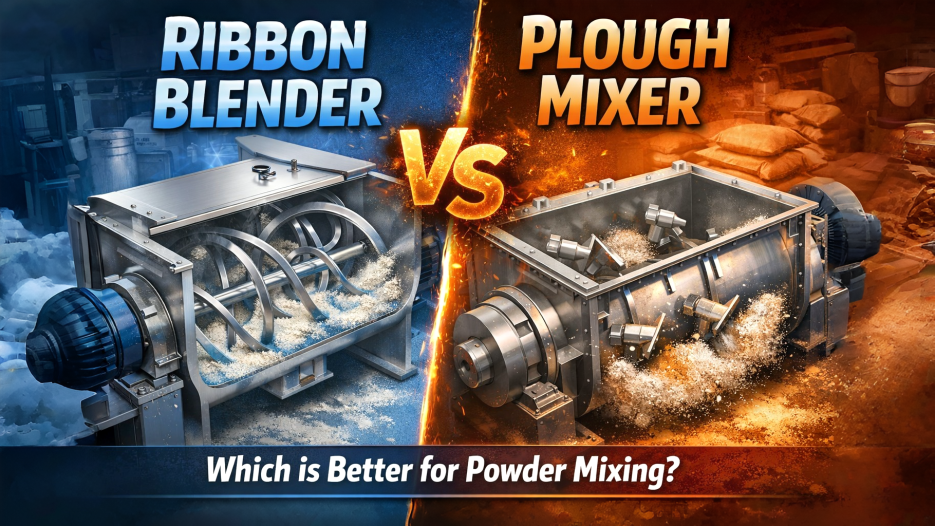
When it comes to industrial powder mixing, two machines are most widely used across chemical, pharmaceutical, food, fertilizer, and mineral industries — the ribbon blender and the plough mixer. Both are horizontal batch mixers, both handle powders and granules effectively, but they work on different principles and are suited for different applications.
If you are setting up a new mixing line or replacing an existing machine, this comparison will help you understand which mixer is the right fit for your material and process.
Shalimar Engineering is a trusted ribbon blender manufacturer and exporter and plough mixer manufacturer based in Ahmedabad, India, supplying precision-engineered mixing solutions to industries across India and worldwide.
What is a Ribbon Blender
A ribbon blender is a horizontal cylindrical trough mixer that uses a dual helical ribbon agitator to mix dry powders, granules, and semi-moist materials. The inner ribbon moves material from the center toward the ends of the trough, while the outer ribbon moves material from the ends toward the center. This counter-flow action creates a uniform, thorough blend throughout the batch.
The ribbon blender working principle is based on controlled convective mixing — material is constantly moved in opposite axial directions while also being displaced radially, ensuring every particle in the batch is uniformly blended within the mixing time.
Key Characteristics of a Ribbon Blender
- Mixing mechanism: Dual counter-flow helical ribbons — convective mixing
- Material type: Free-flowing dry powders, granules, and light semi-moist blends
- Mixing intensity: Gentle — low shear
- Mixing uniformity: Very high — ideal for fine, uniform powder blends
- Batch capacity: 50 litres to 20,000 litres per batch
- Typical mixing time: 10 to 20 minutes per batch
- Construction material: Carbon steel or SS304/SS316 for food and pharma
- Optional features: Jacket for heating/cooling, vacuum blanketing, spray nozzles, PLC automation
What is a Plough Mixer
A plough mixer also known as a ploughshare mixer is a horizontal cylindrical mixer that uses plough-shaped mixing tools mounted on a central shaft to lift, fluidize, and fold the material in a three-dimensional mixing pattern. The ploughs mechanically throw material from the base of the trough into a fluidized zone, creating intensive mixing action.
The plough mixer working principle is based on mechanical fluidization the plough-shaped tools create a fluidized bed of particles inside the trough even without using air, which results in faster and more intensive mixing compared to ribbon blenders. Optional high-speed choppers mounted on the trough wall can break up lumps and agglomerates during the mixing cycle.
Key Characteristics of a Plough Mixer
- Mixing mechanism: Ploughshare tools — mechanical fluidization mixing
- Material type: Powders, granules, pastes, semi-moist, and slightly sticky materials
- Mixing intensity: High — medium to high shear
- Mixing uniformity: Excellent — very fast homogenization
- Batch capacity: 50 litres to 30,000 litres per batch
- Typical mixing time: 2 to 5 minutes per batch (much faster than ribbon blender)
- Construction material: Carbon steel or SS304/SS316
- Optional features: High-speed choppers for lump breaking, jacket for heating/cooling, liquid spray nozzles, roster type design
Ribbon Blender vs Plough Mixer — Full Comparison
| Parameter | Ribbon Blender | Plough Mixer |
| Mixing Principle | Dual helical ribbon counter-flow | Ploughshare mechanical fluidization |
| Mixing Intensity | Low to medium shear | Medium to high shear |
| Mixing Speed | 10–20 minutes per batch | 2–5 minutes per batch |
| Material Suitability | Free-flowing dry powders and granules | Powders, granules, pastes, semi-moist |
| Lump Breaking | Not possible without separate equipment | Possible with optional choppers |
| Fragile Material Handling | Excellent — gentle mixing | Moderate — higher shear may damage fragile particles |
| Sticky Material Handling | Limited | Better — ploughs handle slightly sticky material |
| Energy Consumption | Lower | Higher (due to intensive mixing action) |
| Residual Material | Slightly higher (ribbon design) | Lower — ploughs sweep the trough base cleanly |
| Cleaning Ease | Moderate | Easier — bolted ploughs and end plates allow quick disassembly |
| Maintenance | Low | Moderate |
| Initial Cost | Lower | Slightly higher |
| Best Industries | Chemical, food, pharma, minerals, fertilizer | Chemical, agrochemical, food, pharma, pigments, pesticides |
Ribbon Blender Working Principle in Detail
The industrial ribbon blender uses two helical ribbons — an inner ribbon and an outer ribbon mounted on the same central shaft but wound in opposite directions. As the shaft rotates at 30 to 100 RPM, the outer ribbon moves material from the ends of the trough toward the center, while the inner ribbon moves material from the center toward the ends.
This creates a constant counter-flow of material in both axial and radial directions simultaneously. The result is a thoroughly homogeneous blend within 10 to 20 minutes, even for fine powders with very different particle sizes, densities, or flow characteristics.
Ribbon blenders are particularly effective for:
- Blending fine chemical powders with uniform particle size requirements
- Mixing food ingredients where gentle handling is critical to prevent degradation
- Pharmaceutical powder blending where API uniformity is mandatory
- Fertilizer and mineral blending where large batch volumes are needed
The dual ribbon blender design ensures that the entire batch is in constant motion throughout the mixing cycle, with no dead zones in the trough. A full-sweep butterfly discharge valve at the bottom allows complete emptying of the trough, reducing cross-contamination between batches.
Plough Mixer Working Principle in Detail
The industrial plough mixer uses ploughshare-shaped mixing tools bolted onto a central shaft running through a horizontal cylindrical trough. As the shaft rotates at higher speeds, the plough tools continuously lift the material from the trough base and throw it into the free space above, creating a three-dimensional fluidized mixing zone.
This mechanical fluidization is the key difference from a ribbon blender. The material is not simply moved axially it is actively thrown, lifted, and folded in all directions simultaneously. This creates a far more intensive mixing action that achieves homogeneous blending in 2 to 5 minutes significantly faster than a ribbon blender.
Optional high-speed choppers mounted on the trough wall operate at 1500 to 3000 RPM and can break down lumps and agglomerates that form during mixing something a ribbon blender cannot do without separate equipment.
Plough mixers are particularly effective for:
- Agrochemical and pesticide powder blending where fast batch turnaround is needed
- Food and spice mixing where moisture addition through spray nozzles is required
- Chemical pigment and dye mixing where lump-free output is critical
- Semi-moist and slightly sticky material blending that would clog a ribbon blender
- Products that require liquid addition (binders, oils, solvents) during mixing
When to Choose a Ribbon Blender
The ribbon blender is the right choice when:
Your material is a free-flowing dry powder or granule
Ribbon blenders perform best with free-flowing materials that do not clump or stick. If your material flows freely and does not require lump breaking, a ribbon blender will give you excellent uniformity at lower cost.
You need gentle mixing for fragile particles
The low-shear, gentle mixing action of the ribbon blender makes it ideal for fragile particles that would break down under the more intensive action of a plough mixer — such as porous granules, encapsulated particles, or crystalline products.
You are blending for pharma, food, or nutraceutical industries
The ribbon blender for pharmaceutical industry and ribbon blender for chemical industry are standard choices because the gentle mixing action preserves particle integrity and ensures API uniformity without thermal stress.
You need a large batch capacity at lower cost
Ribbon blenders are available in capacities from 50 litres to 20,000 litres and are generally less expensive than plough mixers of equivalent capacity. For large-volume, simple blending applications, the ribbon blender offers the best value.
When to Choose a Plough Mixer
The plough mixer is the right choice when:
Your material is slightly sticky, semi-moist, or prone to lumping
The mechanical fluidization action of the plough mixer handles slightly sticky and semi-moist materials that would jam or clog a ribbon blender. The optional choppers break down any lumps that form during mixing.
You need very fast batch mixing
The plough mixer achieves homogeneous blending in 2 to 5 minutes per batch, compared to 10 to 20 minutes for a ribbon blender. If production speed is critical and you need high batch throughput per shift, a plough mixer delivers significantly faster cycle times.
You need to add liquids during mixing
Plough mixers are designed for liquid spray addition during the mixing cycle. The intense fluidization action distributes the liquid uniformly throughout the batch without causing agglomeration. This is standard in plough mixer for food industry and plough mixer for agrochemical applications.
You need lump-free output with chopper action
The optional high-speed choppers on a plough mixer break down agglomerates during mixing. This is critical in pigment, dye, pesticide, and chemical applications where lump-free powder is a quality requirement.
You need easier cleaning between products
Plough mixers have a bolted design — the ploughs, end plates, and stuffing boxes can be removed quickly for thorough cleaning and reassembly. This makes product changeover faster and reduces cross-contamination risk in multi-product facilities.
Ribbon Blender and Plough Mixer Specifications from Shalimar Engineering
Ribbon Blender Capacity Range
| Model | Motor (HP) | Useful Volume (Litres) |
| SRB-500 | 5–7.5 | 500 |
| SRB-1000 | 7.5–10 | 1,000 |
| SRB-2000 | 10–15 | 2,000 |
| SRB-5000 | 20–25 | 5,000 |
| SRB-10000 | 30–40 | 10,000 |
| SRB-20000 | 60–75 | 20,000 |
Plough Mixer Capacity Range
Available from 50 litres to 30,000 litres per batch. Custom sizes and configurations including jacketed shells, chopper units, liquid spray systems, and roster type plough mixer designs are available based on client requirements.
All machines are manufactured in carbon steel or SS304/SS316 with options for FDA-compliant finishes for food and pharmaceutical applications.
Why Choose Shalimar Engineering for Industrial Mixing Equipment
Shalimar Engineering is a leading ribbon blender manufacturer and exporter and plough mixer manufacturer in India with decades of experience supplying mixing solutions to industries across chemical, pharmaceutical, food, mineral, fertilizer, and agrochemical sectors.
Custom Engineering
Every mixer is designed based on the client’s material properties, batch size, mixing time requirement, and process conditions. No standard off-the-shelf machines — each unit is engineered for its specific application.
Full Range of Mixing Equipment
Beyond ribbon blenders and plough mixers, Shalimar Engineering also supplies drum mixers for rotary batch blending giving clients access to the complete range of horizontal mixing solutions from one manufacturer.
Global Export Capability
As a trusted ribbon blender manufacturer and exporter, Shalimar Engineering supplies mixing equipment to clients in UAE, Saudi Arabia, Oman, Bangladesh, Malaysia, Indonesia, and other countries. Export-ready packaging and documentation are standard.
Complete After-Sales Support
From installation and commissioning to spare parts, operator training, and maintenance support Shalimar Engineering provides full lifecycle support for every machine supplied.
Competitive Pricing
Direct manufacturer pricing with no intermediary costs, ensuring clients get the best value for their investment in industrial mixing equipment.
Frequently Asked Questions About Ribbon Blender and Plough Mixer
Q1. What is the main difference between a ribbon blender and a plough mixer?
A ribbon blender uses dual helical ribbons to create a gentle counter-flow mixing action, ideal for free-flowing dry powders. A plough mixer uses ploughshare tools to mechanically fluidize the material, creating a faster and more intensive mixing action suitable for powders, semi-moist materials, and applications requiring liquid addition.
Q2. Which mixer is faster — ribbon blender or plough mixer?
A plough mixer is significantly faster. A plough mixer achieves homogeneous blending in 2 to 5 minutes per batch, while a ribbon blender typically requires 10 to 20 minutes. For high-throughput production where batch cycle time is critical, a plough mixer is the better choice.
Q3. Can a ribbon blender handle wet or semi-moist materials?
A ribbon blender handles light moisture addition through spray nozzles but is not ideal for semi-moist or sticky materials. A plough mixer is better suited for materials with higher moisture content or those requiring significant liquid addition during mixing.
Q4. What is the ribbon blender capacity range offered by Shalimar Engineering?
Shalimar Engineering offers ribbon blenders from 500 litres to 20,000 litres per batch under the SRB model range. Custom capacities are available based on project requirements.
Q5. Can choppers be added to a plough mixer?
Yes. High-speed choppers operating at 1500 to 3000 RPM can be mounted on the trough wall of a plough mixer to break down lumps and agglomerates during the mixing cycle. This is a standard optional feature for chemical, pigment, and agrochemical applications.
Q6. Which industries use ribbon blenders?
Ribbon blenders are widely used in chemical, pharmaceutical, nutraceutical, food and spice, mineral, pigment, fertilizer, and detergent industries for uniform dry powder and granule blending.
Q7. Which industries use plough mixers?
Plough mixers are used in agrochemical, pesticide, pigment, food, pharmaceutical, chemical, fertilizer, and mineral industries especially where fast mixing, liquid addition, or lump-free output is required.
Q8. Does Shalimar Engineering offer jacketed ribbon blenders and plough mixers?
Yes. Both ribbon blenders and plough mixers are available with optional outer jackets for heating or cooling the product during the mixing cycle, suitable for temperature-sensitive processes.
Get a Quote from India’s Trusted Ribbon Blender and Plough Mixer Manufacturer
Whether you need an industrial ribbon blender for gentle pharmaceutical powder blending, a plough mixer for fast agrochemical mixing with liquid addition, or a complete powder mixing solution for your production line Shalimar Engineering has the right machine for your application.
We are India’s trusted ribbon blender manufacturer and exporter and plough mixer manufacturer, building precision-engineered mixing solutions for industries across the globe.
Send an Enquiry Now and our engineering team will respond with a detailed technical proposal and competitive quote within 24 hours.