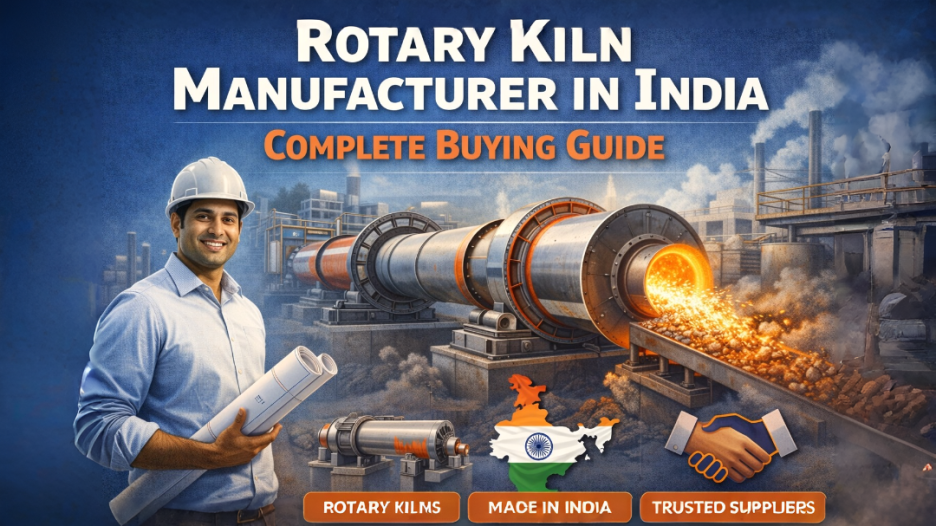
If you are looking for a rotary kiln manufacturer in India, this guide will give you everything you need before making a purchase decision. From understanding how a rotary kiln works to selecting the right type for your industry, capacity planning, refractory selection, and choosing a reliable supplier — this buying guide covers all the critical factors in one place.
Shalimar Engineering is a trusted rotary kiln manufacturer and exporter based in Ahmedabad, India, supplying industrial-grade rotary kilns to cement, mineral, chemical, and waste processing industries across India and 30+ countries worldwide.
What is a Rotary Kiln
A rotary kiln is a long, cylindrical, slightly inclined rotating drum used for high-temperature processing of materials. It is one of the most versatile and widely used thermal processing equipment in the industrial world. The drum rotates slowly on its axis, and as material travels from the feed end to the discharge end, it is subjected to controlled heat, achieving chemical reactions, drying, calcination, sintering, or combustion — depending on the application.
The industrial rotary kiln operates at temperatures ranging from 500°C to over 1400°C and is used across industries such as cement manufacturing, mineral processing, chemical production, lime calcination, and waste management.
Rotary Kiln Working Principle
The rotary kiln working principle is straightforward but highly effective. Here is how it works step by step:
Step 1 — Material Feed Raw material is fed into the upper end of the inclined rotating cylinder through a feed hopper or screw feeder.
Step 2 — Rotation and Material Movement The drum rotates at a controlled speed (typically 0.5 to 5 RPM). The slight inclination (1° to 5°) causes the material to travel slowly from the feed end toward the discharge end through gravity and rotation.
Step 3 — Heat Application A burner located at the discharge end fires fuel into the kiln, generating heat that travels counter-currently against the material flow. This counter-current arrangement maximizes heat transfer efficiency. Rotary kiln temperature inside the processing zone can range from 800°C to 1400°C depending on the material and process.
Step 4 — Chemical Reaction or Physical Change As the material moves through the hot zone, it undergoes the desired process — calcination, sintering, drying, or thermal decomposition. The rotary kiln refractory lining protects the outer shell from the extreme heat inside.
Step 5 — Product Discharge Processed material exits from the lower discharge end into a cooler or collection system for further handling.
Types of Rotary Kilns
As a leading rotary kiln manufacturer and exporter, Shalimar Engineering produces several types of rotary kilns to match different industrial requirements.
Direct Fired Rotary Kiln
In a direct fired rotary kiln, the burner flame and hot gases come into direct contact with the material inside the drum. This type is used when direct heat exposure does not contaminate or damage the product. It is the most common configuration used in cement, lime, and mineral processing industries.
Indirect Fired Rotary Kiln
An indirect fired rotary kiln has the heating source outside the drum. The drum is heated externally, and the material inside is processed without direct contact with combustion gases. This type is used for heat-sensitive materials, processes requiring inert atmosphere, or when combustion gases would contaminate the product. Common in chemical, pharmaceutical, and activated carbon industries.
Rotary Kiln for Cement Industry
The rotary kiln for cement industry is the most critical equipment in cement manufacturing. It processes limestone and other raw materials at temperatures up to 1450°C, converting them into clinker the main ingredient in cement production. These kilns operate continuously under heavy load and require robust refractory lining and a reliable drive system.
Rotary Kiln for Calcination
The rotary kiln for calcination is used to thermally decompose materials such as limestone (to produce lime), bauxite, dolomite, magnesite, and other minerals. Calcination kilns operate at temperatures between 800°C and 1200°C and are widely used in the lime, alumina, and refractory industries.
Rotary Kiln for Mineral Processing
The rotary kiln for mineral processing handles iron ore, bauxite, copper concentrate, titanium ore, and other minerals that require heat treatment before further processing. These kilns are engineered for continuous heavy-duty operation with abrasive feed materials.
Batch Type Rotary Kiln
The batch type rotary kiln is a smaller, intermittent-operation kiln designed for processing materials in cycles. It is suitable for small-scale production, pilot testing, and industries that need to process multiple different materials with frequent changeovers. It offers greater flexibility compared to continuous kilns.
Rotary Kiln for Chemical Industry
The rotary kiln for chemical industry processes materials such as activated carbon, zinc oxide, titanium dioxide, iron oxide pigments, and specialty chemicals. These kilns often require precise temperature control, inert atmosphere, or indirect heating to protect sensitive chemical products.
Rotary Kiln for Waste Processing
The rotary kiln for waste processing is used in hazardous waste incineration, sewage sludge treatment, and industrial waste thermal treatment. The rotating drum handles heterogeneous waste materials and ensures complete combustion at high temperatures, reducing waste volume and neutralizing harmful compounds.
Lime Kiln
The lime kiln is specifically designed for calcining limestone at temperatures between 900°C and 1100°C to produce quicklime (calcium oxide). Lime is widely used in steel making, water treatment, paper production, and construction.
Bauxite Kiln
The bauxite kiln is used to calcine bauxite ore for producing calcined bauxite used in refractory materials, abrasives, and aluminium production.
Key Components of an Industrial Rotary Kiln
Understanding the major components helps buyers evaluate the quality and durability of the rotary kiln they are purchasing.
Rotary Shell The main cylindrical drum made from heavy-duty carbon steel or alloy steel plates, rolled and welded to form a continuous tube. Shell thickness and material grade determine the kiln’s durability under thermal and mechanical stress.
Rotary Kiln Refractory Lining The rotary kiln refractory lining on the inner surface of the shell protects it from extreme heat and thermal shock. Different refractory materials — firebricks, castables, ceramic fiber are selected based on the operating temperature and material being processed. The right refractory choice directly affects kiln life and heat efficiency.
Riding Rings (Tyres) and Rollers The kiln drum rests on riding rings (tyres) that roll on support rollers. These components carry the full weight of the rotating drum and must be precision-machined for smooth and stable rotation.
Rotary Kiln Drive System The rotary kiln drive system consists of a main drive motor, gearbox, pinion, and girth gear that rotate the drum at the required speed. The drive system must handle the high torque demands of a fully loaded kiln. A reliable drive system is critical to avoiding unplanned shutdowns and production losses.
Burner and Combustion System The burner system fires fuel natural gas, diesel, coal, or biomass to generate the required process heat. Modern burners offer precise flame control and can operate on multiple fuel types for operational flexibility.
Seals End seals at both feed and discharge ends prevent heat loss and stop false air from entering the kiln, which would reduce thermal efficiency. Proper sealing is important for both energy savings and product quality.
Cooling System A rotary cooler or planetary cooler at the discharge end cools the hot processed material before it is conveyed to storage or further processing.
Rotary Kiln Design Considerations
Selecting the right rotary kiln design requires evaluating several technical and operational factors:
Material Properties The feed material’s physical and chemical properties — particle size, moisture content, bulk density, chemical composition, and temperature sensitivity — determine the kiln diameter, length, inclination, and rotation speed.
Required Processing Temperature Rotary kiln temperature requirements vary by application. Calcination typically requires 800°C to 1200°C, cement clinker formation requires up to 1450°C, while some chemical processes operate below 700°C.
Rotary Kiln Capacity Rotary kiln capacity is determined by the diameter and length of the drum, rotation speed, and material residence time. Shalimar Engineering manufactures kilns with capacities from small pilot-scale units to large continuous kilns handling hundreds of tonnes per day. We also design custom rotary kilns beyond standard ranges based on client requirements.
Firing Method Direct or indirect firing is chosen based on whether the product can tolerate direct contact with combustion gases.
Fuel Type The burner system is designed based on available fuel — natural gas, LPG, diesel, furnace oil, coal, or biomass. Multi-fuel burners are available for operational flexibility.
Refractory Selection The correct rotary kiln refractory material is selected based on the peak operating temperature, thermal cycling conditions, and the chemical nature of the material being processed.
Rotary Kiln Technical Specifications
| Specification | Range |
| Shell Diameter | 0.9 m to 4.5 m |
| Shell Length | 10 m to 100 m |
| Inclination | 1° to 5° |
| Rotation Speed | 0.5 to 5 RPM |
| Operating Temperature | 500°C to 1450°C |
| Capacity | 10 TPD to 1500 TPD |
| Fuel Type | Gas, Diesel, Coal, Biomass |
| Drive System | Gear Drive / Friction Drive |
| Refractory | Firebrick / Castable / Ceramic Fiber |
| Shell Material | Carbon Steel / Alloy Steel |
All specifications can be customized. As a custom rotary kiln manufacturer, Shalimar Engineering designs and builds kilns based on each client’s specific process, material, and capacity requirements.
Why Choose Shalimar Engineering as Your Rotary Kiln Manufacturer and Exporter
Shalimar Engineering has built a strong reputation as a dependable rotary kiln manufacturer and exporter with a long track record of successful installations across India and internationally.
Complete In-House Engineering From process design and mechanical engineering to fabrication, refractory selection, and commissioning — all work is done in-house at our Ahmedabad manufacturing facility. This ensures consistent quality and faster delivery timelines.
Industry-Specific Expertise We have designed and supplied rotary kilns for cement, lime, bauxite, mineral processing, chemical, and waste treatment industries. Each kiln is engineered specifically for its application — not a one-size-fits-all product.
Custom Rotary Kiln Designs Every project starts with a detailed process study. We design custom rotary kilns to match feed material properties, required processing temperature, production capacity, and site conditions.
Reliable Drive and Mechanical Systems Our kilns are built with heavy-duty rotary kiln drive systems using precision girth gears, pinions, and support rollers that are manufactured to tight tolerances for long service life and minimal maintenance.
Global Export Track Record As a trusted rotary kiln exporter worldwide, Shalimar Engineering has supplied kilns to clients in the Middle East, Southeast Asia, Africa, and South Asia. Our export-ready designs comply with international engineering standards.
Full Lifecycle Support We provide installation supervision, operator training, spare parts supply, and maintenance support for all kilns supplied — ensuring maximum uptime and long operational life.
Frequently Asked Questions About Rotary Kilns
Q1. What is a rotary kiln used for?
A rotary kiln is used for high-temperature processing of materials including calcination of limestone and bauxite, cement clinker production, mineral processing, chemical thermal treatment, activated carbon production, and industrial waste incineration.
Q2. What is the difference between a direct fired and indirect fired rotary kiln?
In a direct fired rotary kiln, the burner flame and combustion gases contact the material directly. In an indirect fired rotary kiln, the drum is heated externally and the material is processed without contact with combustion gases. Indirect firing is used for heat-sensitive or contamination-sensitive materials.
Q3. What temperatures can a rotary kiln reach?
Rotary kiln temperature can range from 500°C for some chemical processes to over 1450°C for cement clinker formation. The operating temperature depends entirely on the material being processed and the required chemical reaction.
Q4. What is the difference between a continuous rotary kiln and a batch type rotary kiln?
A continuous rotary kiln operates without interruption, with material fed and discharged simultaneously. A batch type rotary kiln processes material in fixed cycles — load, process, discharge making it suitable for small-scale or flexible production requirements.
Q5. What refractory is used in a rotary kiln?
Rotary kiln refractory selection depends on the operating temperature and material being processed. Common materials include high-alumina firebricks, magnesia-chrome bricks, castable refractories, and ceramic fiber for lower temperature zones. The right refractory selection is critical to kiln life and energy efficiency.
Q6. What is the rotary kiln capacity range offered by Shalimar Engineering?
Shalimar Engineering manufactures rotary kilns with capacities from 10 TPD for small pilot or batch operations to over 1500 TPD for large industrial plants. Custom capacities are designed based on specific project requirements.
Q7. Do you export rotary kilns outside India?
Yes. Shalimar Engineering is an active rotary kiln exporter worldwide, with a strong supply record in UAE, Saudi Arabia, Oman, Iraq, Iran, Bangladesh, Malaysia, Indonesia, Kenya, and other countries.
Q8. Can Shalimar Engineering supply a complete calcination plant?
Yes. Shalimar Engineering supplies complete turnkey calcination plants including rotary kiln, preheater, cooler, dust collection, material handling, and process controls — all integrated and commissioned as a complete production system.
Get a Quote from India’s Trusted Rotary Kiln Manufacturer and Exporter
Whether you need a direct fired rotary kiln for lime calcination, an indirect fired rotary kiln for chemical processing, a batch type rotary kiln for pilot production, or a large-capacity rotary kiln for cement industry Shalimar Engineering has the engineering capability and manufacturing experience to deliver the right solution.
We are India’s trusted rotary kiln manufacturer and exporter, building heavy-duty thermal processing equipment for industries across the globe.
Send an Enquiry Now and our engineering team will respond with a detailed technical proposal and competitive quote within 24 hours.